Miyajima — officially known as Itsukushima — is one of Japan’s most sacred and breathtaking destinations, a small island in Hiroshima Bay where a magnificent vermilion shrine appears to float on the sea. But what you see today is the result of more than 1,400 years of history, layered across every era of Japanese civilization. From the earliest age of myth to the modern World Heritage designation, the story of Miyajima is nothing less than the story of Japan itself.
Miyajima’s history is a living museum of Japanese politics, religion, and culture. Ancient nature worship, the grand reconstruction by the Heian-era warlord Taira no Kiyomori, the dramatic Battle of Itsukushima, the upheavals of the Meiji Restoration, and the island’s 1996 UNESCO listing — at every turning point in Japanese history, Miyajima has played a role. This article traces that journey from the island’s mythological origins to the present day, exploring the religious, political, cultural, and natural dimensions that make Miyajima unlike anywhere else on earth.
Miyajima History Through the Ages
Ancient Origins: Mythology to the Asuka Period
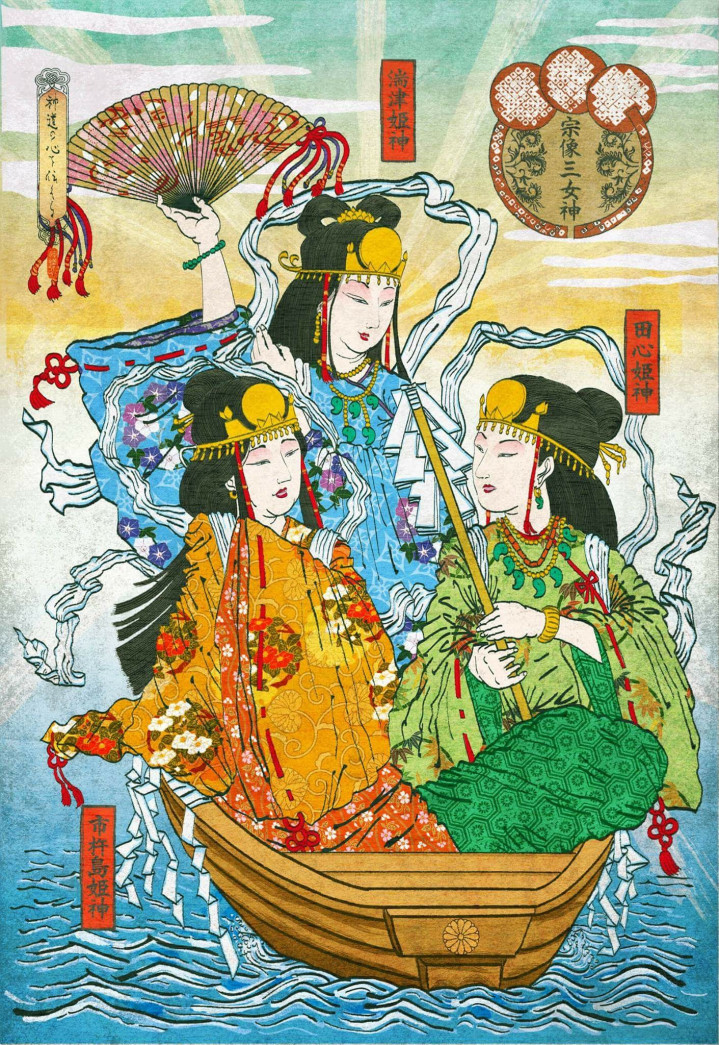
The history of Miyajima begins before written records, deep in the age of Japanese myth. According to the Kojiki and Nihon Shoki — Japan’s oldest chronicles — the three goddesses enshrined here were born from a sacred oath between the sun goddess Amaterasu and the storm god Susanoo. These three deities, known as Ichikishimahime, Tagirihime, and Tagitsuhime, have been venerated since antiquity as guardians of maritime safety and safe passage across the sea.
The island itself was revered as a sacred body. Mount Misen, rising 535 meters at the island’s heart, was cloaked in primeval forest and punctuated by enormous boulders — a landscape that ancient people experienced as inherently divine. The very name “Itsukushima” means “island of the gods,” and the entire landmass was treated as a sacred object, not merely a place where a shrine happened to stand.
According to shrine tradition, formal worship was established in 593 CE, when a powerful local chieftain named Saeki Kuramoto received a divine oracle and built the first shrine on the present site. Saeki’s clan controlled maritime traffic through this part of the Seto Inland Sea, and the shrine was constructed over the water specifically to avoid breaking ground on the island’s sacred soil — a principle that still shapes the shrine’s architecture today.
For the full story of the shrine’s founding mythology, see our related guide below.
Itsukushima Shrine on Miyajima Island is famous for its breathtaking h...
The Nara and Heian Periods: Connections to the Imperial Court
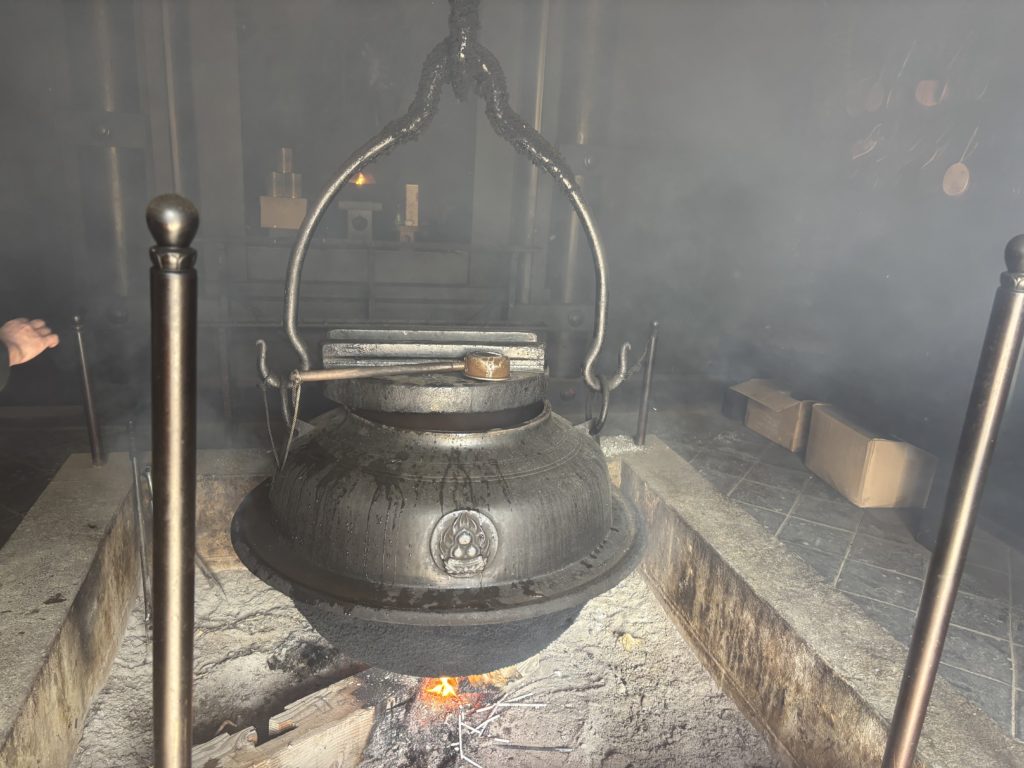
In 806 CE, the monk Kukai — known posthumously as Kobo Daishi and the founder of Shingon Buddhism in Japan — visited Miyajima and sensed a powerful spiritual energy radiating from Mount Misen. He performed 100 days of intensive Buddhist meditation on the mountain, and the sacred fire he lit during that ritual has been burning continuously ever since in the Reika-do (Eternal Flame Hall). That same flame later provided the spark for the Peace Flame in Hiroshima’s Peace Memorial Park — a chain of fire stretching more than 1,200 years.
Kukai’s opening of Mount Misen transformed Miyajima into a place where Shinto and Buddhism coexisted and intertwined, a spiritual blending known in Japanese as shinbutsu-shugo. The principal goddess Ichikishimahime came to be identified with the Buddhist deity Benzaiten, goddess of music, arts, and learning, and the shrine’s Buddhist aspect was represented by an eleven-faced Kannon. This fusion of traditions deepened Miyajima’s religious significance and drew the attention of the aristocracy in Kyoto.
By the mid-Heian period, noble families including the powerful Fujiwara clan were making pilgrimages to Itsukushima Shrine. The celebrated aristocrat Fujiwara no Michinaga recorded offerings made here, and the flow of court culture to Miyajima began in earnest. Elegant musical traditions including gagaku (court music) and bugaku (ceremonial dance) arrived during this era, laying the foundations for Miyajima’s uniquely rich performing arts heritage.
Late Heian Period: Taira no Kiyomori and the Golden Age
No single figure did more to shape the Miyajima you see today than Taira no Kiyomori, the most powerful warlord of the late 12th century. Appointed governor of Aki Province in 1146, Kiyomori poured enormous resources into rebuilding Itsukushima Shrine on a scale that had never been seen — and by 1168 he had completed the spectacular complex of vermilion halls, walkways, and pavilions that still define the island.
Kiyomori’s motivations were threefold. Politically, the shrine served as a symbol of his control over the Seto Inland Sea — the most important maritime highway in medieval Japan. Militarily, the Taira clan’s naval forces were under the protection of the shrine’s goddesses. And personally, Kiyomori had an unusually deep and lifelong devotion to Itsukushima that predated his political ambitions. His reconstruction of the shrine was not simply a religious project — it was a fusion of faith, power, and cultural patronage on a grand scale.
In 1164, Kiyomori and 32 members of the Taira clan offered one of Japan’s most extraordinary cultural treasures: the Heike Nokyo, a set of 33 elaborately decorated sutras, one copied by each member of the clan. Lavished with gold and silver ornamentation, exquisite painted frontispieces, and intricate decorative metalwork, the Heike Nokyo is considered the pinnacle of Heian decorative manuscript art and remains a National Treasure today.
The prestige Kiyomori brought to Miyajima was extraordinary. Retired Emperor Go-Shirakawa made a pilgrimage in 1174, and Retired Emperor Takakura followed in 1176. Imperial visits raised the shrine’s status to something approaching a western counterpart to the great shrines of the capital, and the full splendor of Heian court culture — architecture, music, poetry, and ceremonial practice — took root on the island. Miyajima in this era was, in effect, a reflection of the Heian court set adrift on the sea.
For a deeper look at why Kiyomori chose Miyajima and what his legacy means today, see our related guide below.
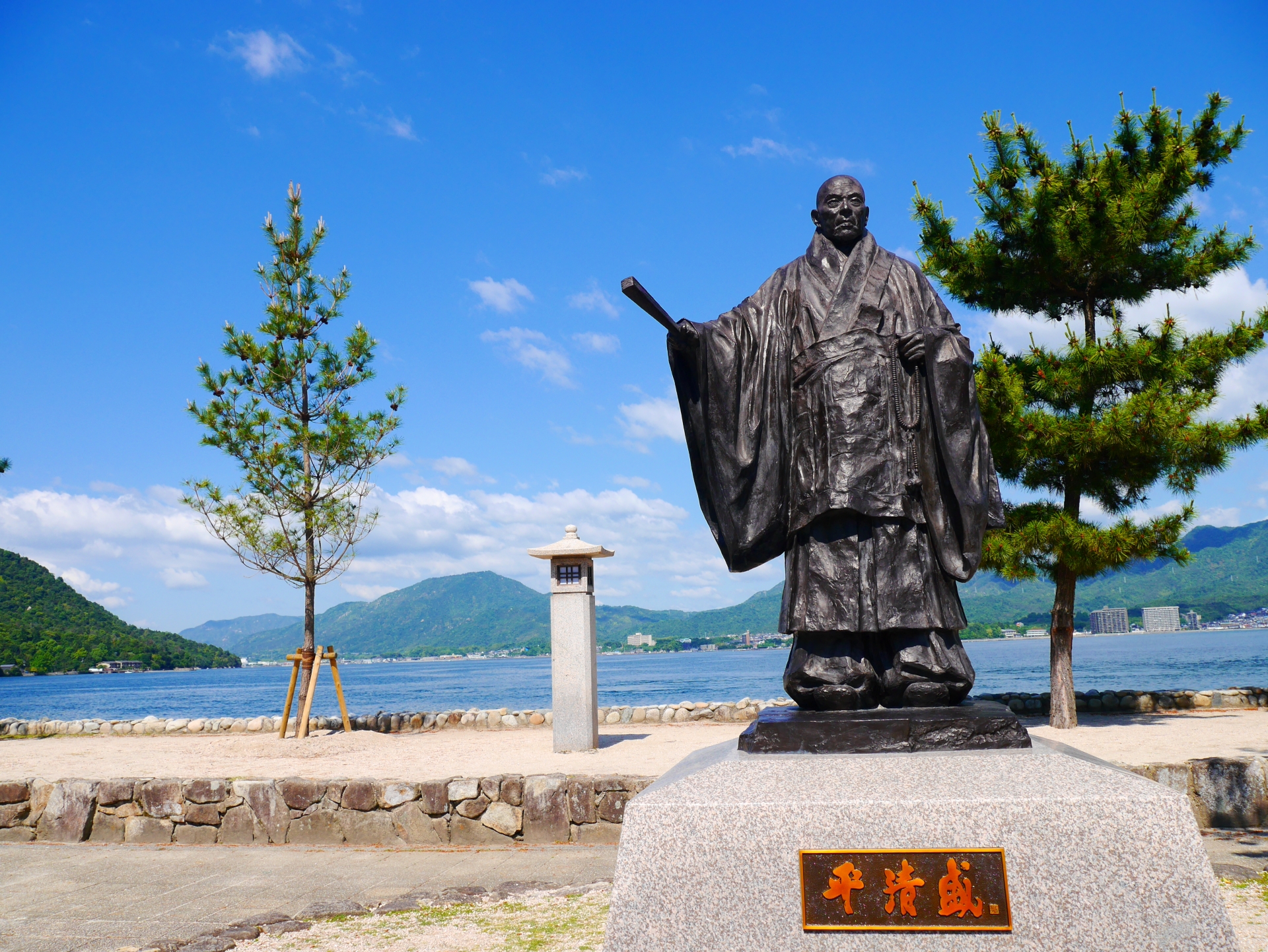
When you stand before the iconic floating torii gate at Itsukushima Sh...
Kamakura and Muromachi Periods: Samurai Rule and Cultural Flourishing
The fall of the Taira clan at the hands of the Minamoto in the 1180s might have spelled disaster for a shrine so closely identified with the losing side. Instead, the new Kamakura shogunate recognized the shrine’s immense cultural and religious importance and continued its protection. Minamoto no Yoritomo himself dispatched envoys with offerings in 1192, ensuring that Itsukushima Shrine’s status survived the transition from aristocratic to warrior rule.
One of the most far-reaching decisions of this era came in 1251, when the Kamakura shogunate formally designated the entire island as shrine land and strictly prohibited logging, hunting, and farming. This decree, rooted in reverence for the island’s sacred character, had the unintended but magnificent consequence of preserving Miyajima’s primeval forest in virtually untouched condition to the present day.
The Muromachi period brought noh theater to Miyajima. Performers from the great Kanze and Konparu schools came to the island to stage sacred noh performances, and the current noh stage — built in 1568 — is considered the oldest surviving seaside noh stage in Japan. With classical court music, ceremonial dance, and noh now all performed on the same island, Miyajima became an unparalleled repository of Japanese performing arts.
In 1407, the Five-Story Pagoda that still stands near the shrine was built by a sub-temple of Daishoin. At 27.6 meters tall, with elegantly curved rooflines that blend Zen and traditional Japanese architectural styles, it added a striking vertical accent to the Miyajima skyline that remains one of the island’s most photographed sights.
The Warring States Period: The Battle of Itsukushima and the Mori Clan
The most dramatic episode in Miyajima’s long history unfolded in the autumn of 1555, when the island became the stage for one of Japan’s most celebrated and strategically brilliant battles. The Battle of Itsukushima pitted the warlord Mori Motonari — badly outnumbered — against the forces of Sue Harukata, who had seized control of the western Japan by overthrowing the powerful Ouchi clan.
Motonari’s plan was audacious. He constructed a fort on Miyajima to lure Sue’s forces onto the island, then waited for a violent autumn storm on the night of October 1st before launching a surprise landing from the north coast of the island. His troops swept down from the heights in darkness and chaos, routing Sue’s forces and driving them into the sea. Sue Harukata died in the battle, and Motonari emerged as the dominant force in western Japan — the foundation for the Mori clan’s eventual control of eight provinces.
Motonari attributed his victory to divine favor from the shrine’s goddesses and deepened his clan’s support for Itsukushima Shrine, funding repairs and enriching its festivals. Even in the violence of the Warring States period, Miyajima’s cultural traditions were maintained under Mori protection.
In 1587, the warlord Toyotomi Hideyoshi visited Miyajima and ordered the construction of the massive unfinished hall known today as Senjokaku — literally “hall of a thousand tatami mats.” Hideyoshi conceived it as a memorial hall for Taira no Kiyomori, planned on an almost incomprehensible scale of 857 tatami mats. When Hideyoshi died suddenly in 1595, construction stopped mid-build — and the hall has remained magnificently unfinished ever since, a frozen monument to Momoyama-era ambition.
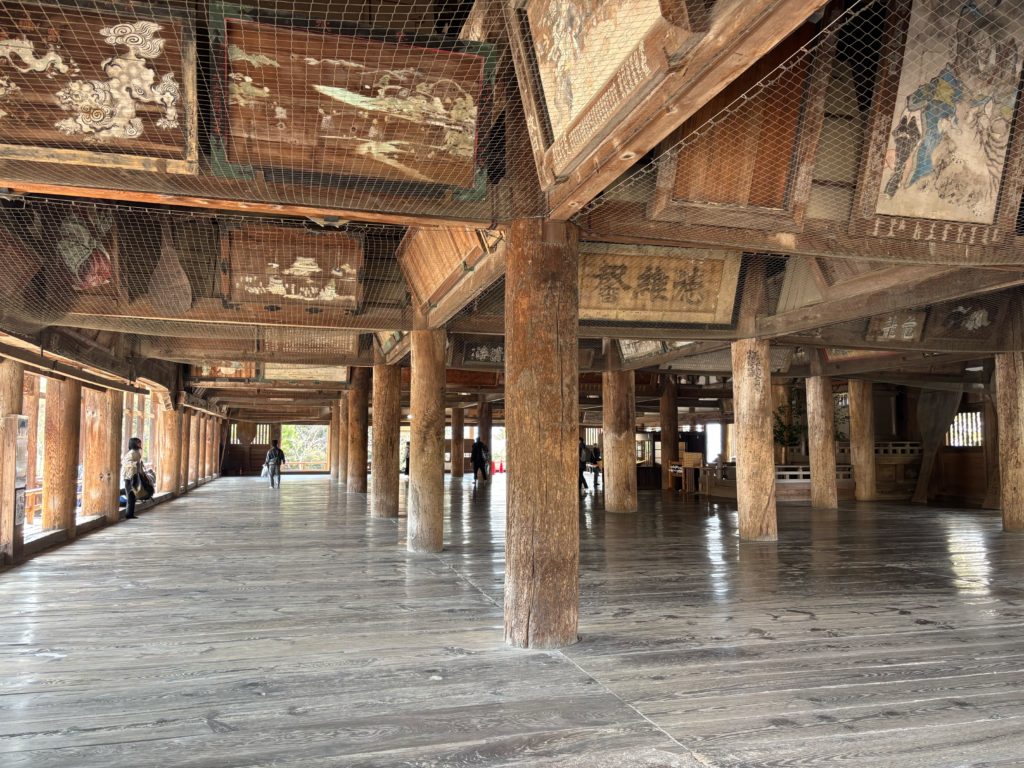
The Edo Period: Asano Clan Protection and the Rise of Popular Tourism
After the Battle of Sekigahara in 1600, the Fukushima clan took control of Hiroshima domain, followed in 1619 by the Asano clan, who would govern the region until the Meiji Restoration. The Asano lords made Itsukushima Shrine the spiritual centerpiece of their domain, conducting regular repairs of the shrine buildings, guaranteeing shrine lands, and sustaining the major festivals. Most of the shrine structures visible today reflect the care taken during this long period of Asano stewardship.
One of the most beloved figures in Edo-period Miyajima is a Buddhist monk named Seishin, who was active during the 1660s and 1670s. Originally a rice merchant in Hiroshima, Seishin renounced his former life and took Buddhist vows at Miyajima’s Komyoin temple, dedicating himself to improving life for the island’s residents. He is credited with inventing the shamoji — the iconic Japanese rice paddle — inspired by the shape of a biwa lute associated with Benzaiten. He also dug wells to solve the island’s chronic water shortage and constructed the stone landing steps (gangi) that made the harbor more functional. Islanders still honor his memory today.
By the mid-Edo period, improvements in transportation and rising prosperity among ordinary Japanese made Miyajima a nationally famous destination. The woodblock print artist Utagawa Hiroshige immortalized Itsukushima Shrine in his celebrated landscape series, spreading images of the shrine’s beauty across the country and triggering a surge of visitors. The comic travel novel Tokaido Hizakurige — Japan’s equivalent of a road-trip novel — even sent its bumbling protagonists to Miyajima, a sign of the island’s place in popular culture.
The town along the shoreline grew dramatically to serve the pilgrimage trade, with inns, souvenir shops, and restaurants lining the approach to the shrine. Miyajima lacquerware and woodcarving crafts developed during this era, as did organized oyster farming — the beginnings of the culinary traditions that make Miyajima famous among food lovers today.
In a footnote of political history, the monk Ryokan’s quarters at Daiganjii temple on Miyajima served as the venue for armistice negotiations during the Second Choshu Expedition in 1866, when the legendary statesman Katsu Kaishu met with Choshu negotiators in the final turbulent years of the Edo period.
The Meiji Period: Upheaval, Reform, and the Modern Torii Gate
The Meiji Restoration of 1868 brought the most disruptive change Miyajima had experienced in over a millennium. The new government issued the Shinbutsu Bunri — the Separation of Shinto and Buddhism Decree — which mandated the disentangling of a religious fusion that had been building on Miyajima since Kobo Daishi’s time in the 9th century. Government officials arrived and initially ordered the demolition of shrine buildings deemed too Buddhist in character — a potential catastrophe for one of Japan’s great architectural treasures.
Local shrine officials and community leaders mounted an urgent appeal to the Meiji government in Tokyo, arguing passionately for the shrine’s historical and cultural irreplaceability. Their efforts saved the buildings from destruction, but the price was significant: all colored decorative elements judged to be Buddhist in origin were stripped away and the structures were repainted in plain natural wood tones. New architectural elements — forked roof finials (chigi) and cylindrical roof logs (katsuogi) — were added to give the buildings a more purely Shinto appearance. The great unfinished hall (Senjokaku) was reconsecrated as Toyokuni Shrine, and the Five-Story Pagoda was placed under the same jurisdiction. The island’s Buddhist temples, including Daishoin and Daiganjii, were formally separated from the shrine and reconstituted as independent institutions.
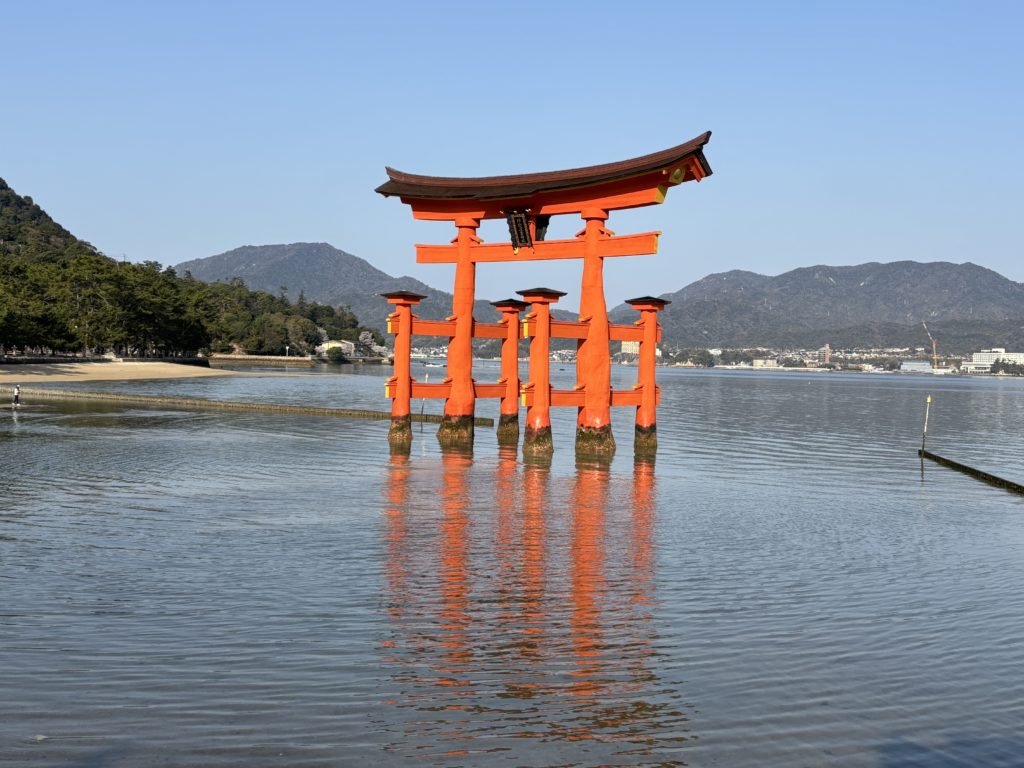
But the Meiji period also brought renewal. In 1875, the current Great Torii Gate was rebuilt — the eighth iteration of the gate in the shrine’s history, standing 16.6 meters tall with its two main pillars hewn from enormous natural camphor trees. It was designated an Important Cultural Property as early as 1899, and it has stood as the defining symbol of Miyajima ever since. The gate recently underwent its first major structural restoration in approximately 70 years, completing in 2023 with its vivid vermilion color fully restored.
The Meiji era also brought the birth of formal cultural property protection in Japan. When the Ancient Shrines and Temples Preservation Law was enacted in 1897, the Heike Nokyo sutras and other Miyajima treasures were among the first objects designated as national treasures under the modern system.

The Taisho and Showa Periods: Cultural Preservation, War, and Recovery
The Taisho period saw a landmark achievement in cultural preservation. Beginning in 1920, a group of cultural patrons led by the connoisseurs Masuda Donno and Takahashi Soan — with financial support from industrialists including Okura Kihachiro — commissioned a meticulous facsimile reproduction of the Heike Nokyo sutras. The Japanese painter Tanaka Shinbi spent five and a half years producing replicas so faithful to the originals that scholars still use them for study and exhibition. This project was a pioneering example of the reproductive preservation of cultural properties, influencing Japanese conservation practice for generations.
In 1929, the opening of the Miyajima Line (now the Hiroshima Electric Railway Miyajima Line) made day trips from Hiroshima City easy and affordable for ordinary families. Visitor numbers surged, and Miyajima established itself as a modern mass-tourism destination even as it maintained its character as a sacred site.
During the Pacific War, Miyajima’s location near the Kure naval port gave it strategic significance, and the island saw an influx of military personnel and workers. But local residents and shrine officials worked to protect the cultural treasures, evacuating vulnerable items from potential harm. The shrine’s major artifacts survived the war intact — a significant achievement given the devastation visited upon so much of the surrounding region.
In the postwar recovery, Miyajima took on new symbolic meaning as an emblem of peace. The Eternal Flame of Mount Misen — burning continuously since Kobo Daishi’s time in the 9th century — provided the kindling spark for the Peace Flame in Hiroshima’s Peace Memorial Park, where it burns to this day. The 1950 enactment of Japan’s Law for the Protection of Cultural Properties placed Miyajima’s most significant structures and landscapes under comprehensive legal protection, with the main shrine buildings designated National Treasures, the island’s historic zones designated Special Historic Sites and Special Places of Scenic Beauty, and the primeval forest of Mount Misen designated a Natural Monument.
Modern Times: UNESCO World Heritage Status and the Global Stage
The defining event of modern Miyajima came in December 1996, when Itsukushima Shrine was inscribed on the UNESCO World Heritage List at the 20th World Heritage Committee session in Merida, Mexico. The inscription recognized Miyajima across all four of the cultural heritage criteria applied, an unusual achievement that underscores the site’s exceptional breadth of significance. The road to inscription had begun in 1992 with placement on Japan’s tentative list, and years of coordinated effort by the Agency for Cultural Affairs, Hiroshima Prefecture, Hatsukaichi City, and local stakeholders brought it to fruition.
World Heritage status transformed Miyajima into a global destination. Annual visitor numbers climbed past four million, and international travelers — particularly from Europe and the Americas — began ranking Itsukushima Shrine among Japan’s most beautiful places. The island is now one of the most photographed locations in all of Asia.
That success has also brought new challenges. The costs of maintaining historic structures at this scale are enormous, managing crowds on a small island is genuinely difficult, and protecting the natural environment from the impact of millions of visitors requires constant vigilance. Sustainable tourism policy has become one of the most pressing issues facing Miyajima’s administrators and community.
The major restoration of the Great Torii Gate, completed in 2023 after roughly 70 years, stands as a symbol of this ongoing commitment. Combining traditional craftsmanship with modern engineering techniques, the project returned the gate’s brilliant vermilion to full glory — and offered a compelling demonstration that Miyajima’s history is still very much alive and being actively written.

Key Themes in Miyajima’s History
A History of Faith: How Religion Shaped the Island
Miyajima’s religious history is a compressed version of Japan’s own spiritual evolution. The three goddesses enshrined here — protectors of maritime safety — were the focus of a practical, seafaring faith from the earliest times. Kobo Daishi’s arrival in the 9th century layered Shingon Buddhist practice over that foundation, creating the syncretic space in which the two traditions would coexist for over a thousand years. The principal goddess became identified with Benzaiten, the Buddhist deity of music and arts, and the mountain became a place of rigorous ascetic training for monks and mountain practitioners (shugendo).
The Meiji-era separation of Buddhism and Shinto dismantled that fusion, but the island has retained a layered religious character. Itsukushima Shrine performs Shinto ceremonies, Daishoin temple conducts Buddhist rituals on the mountain, and Mount Misen continues to draw practitioners of mountain asceticism. The three traditions exist separately today but continue to shape the island’s atmosphere collectively.
Miyajima as a Cultural Stage
Miyajima is arguably Japan’s most concentrated outdoor museum of performing arts. Court music (gagaku) arrived in the Heian period; ceremonial dance (bugaku) followed; noh theater was added in the Muromachi period; and folk performing traditions developed through the Edo era. Each of these traditions was layered onto what came before rather than replacing it — so today, all of them can still be witnessed on the same island.
The Kangen Festival, held each year on the 17th day of the sixth lunar month, is perhaps the most vivid surviving expression of this heritage. Three ornately decorated boats process across the water to the sound of court music, recreating a tradition that Taira no Kiyomori transplanted from the imperial palace in Kyoto over 850 years ago. It is considered one of Japan’s three great boat festivals and represents a form of musical performance — gagaku performed at sea — that is essentially unique in the world.
In the applied arts, Miyajima woodcarving — using timber sourced from the island — developed from the Edo period into a recognized craft tradition. The island’s distinctive rice paddles (shamoji) evolved from folk utensils into recognized craft objects, and the two crafts together remain important local industries today.
Power and the Sacred: Miyajima’s Political History
Every major center of power in Japanese history has felt the need to claim a relationship with Miyajima. Taira no Kiyomori used the shrine to legitimize his dominance over the Seto Inland Sea. Mori Motonari credited his improbable victory at the Battle of Itsukushima to divine favor and responded with generous patronage. The Asano lords of Hiroshima domain made it their spiritual anchor. The Meiji government, despite the disruption it caused, ultimately preserved the shrine because its cultural and political value was too great to sacrifice.
This pattern reflects a consistent truth about Miyajima: the island’s sacred character has never been purely religious. It has always been entangled with questions of legitimacy, identity, and authority — which is one reason why successive rulers, far from neglecting the shrine, competed to be its protectors.
Nature and Humanity in Balance
One of the least expected aspects of Miyajima’s history is how thoroughly its religious character has served as a form of environmental protection. Because the island was treated as a divine body, cutting trees, hunting, and farming were forbidden for centuries — and the primeval forest of Mount Misen survived essentially intact as a result. The stands of fir, hemlock, and oak on Misen now represent one of the most ecologically significant remnant forests in the Seto Inland Sea region.
Miyajima’s roughly 600 deer — regarded as divine messengers in the Shinto tradition — have coexisted with human residents for centuries, though their growing numbers and their habit of eating anything left unattended have become a source of debate in the tourism era. The intertidal zone around the shrine buildings has also developed a distinctive marine ecosystem shaped by the interaction between ancient wooden structures and the tidal rhythms of the sea, a subject of ongoing scientific interest.
What Miyajima’s History Teaches Us
The 1,400-plus years of Miyajima history are not characterized by destruction and rebuilding from scratch — they are characterized by the creative accumulation of value across time. Each era’s leaders chose, in the main, to honor what came before while adding something new. Taira no Kiyomori preserved the ancient Shinto traditions while transplanting the finest Heian court culture onto the island. The Muromachi period added noh to the existing repertoire of gagaku and bugaku without displacing either. The Asano lords of the Edo period maintained the earlier Taira and Mori legacies while nurturing the island’s growth as a popular destination. Even the Meiji Restoration, for all its disruption, ultimately saved the structures that define Miyajima today.
The most difficult test came from the Meiji government’s separation of Buddhism and Shinto, which threatened to undo 1,200 years of spiritual synthesis in a matter of months. Local advocates saved the shrine buildings through direct appeals to Tokyo — and in doing so, demonstrated the principle that has kept Miyajima’s heritage alive: that its value is not owned by any one era, ideology, or institution. It belongs to the ongoing story of the place itself.
Today, Miyajima faces a new version of this challenge. The balance between preserving a fragile World Heritage site and welcoming millions of visitors each year requires exactly the kind of creative stewardship that has characterized the island’s best eras. The completed restoration of the Great Torii Gate, blending centuries-old carpentry techniques with 21st-century engineering, is perhaps the most encouraging sign that the tradition of thoughtful custodianship is continuing.
For travelers, understanding this history transforms the experience of visiting Miyajima. The shrine corridor is not just a beautiful walkway — it is the direct result of Kiyomori’s 12th-century vision. The unfinished ceiling of Senjokaku is not a construction accident — it is a frozen moment from the death of Toyotomi Hideyoshi. The Eternal Flame on Mount Misen is not just a tourist curiosity — it is the same fire that Kobo Daishi lit in 806, whose descendants now burn in a peace park less than an hour away. Miyajima rewards those who look closely.
References and Sources
- Agency for Cultural Affairs — World Heritage: Itsukushima Shrine
- National Cultural Properties Database: Itsukushima Shrine
- Itsukushima Shrine Official Website: History and Origins
- Miyajima Tourism Association: World Cultural Heritage Designation
- Miyajima Tourism Association: Mount Misen
- UNESCO World Heritage Centre: Itsukushima Shinto Shrine
- Hatsukaichi City Board of Education: Cultural Properties Division
- Miyajima Ropeway: History of Miyajima and Mount Misen
- Miyajima Town History Editorial Committee, Miyajima Town History: General History Volume, Miyajima Town, 1992
- Fukuyama Toshio, The Architecture of Itsukushima Shrine, Chuo Koron Bijutsu Shuppan, 1988
- Nishi Kazuo, Architectural History Research on Itsukushima Shrine, Chuo Koron Bijutsu Shuppan, 2005
- Komatsu Shigemi, Research on the Heike Nokyo, Kodansha, 1996
- Gomi Fumihiko, Miyajima: Itsukushima Shrine, Yoshikawa Kobunkan, 2010
FAQ
When was Itsukushima Shrine first built?
According to shrine tradition, the first structures were built in 593 CE by a local chieftain named Saeki Kuramoto following a divine oracle. The shrine was constructed over the water to avoid disturbing the island’s sacred soil. The grand complex that visitors see today largely reflects the reconstruction overseen by Taira no Kiyomori in the mid-to-late 12th century, with further modifications and repairs by the Asano lords of Hiroshima domain in the early Edo period.
Why was the shrine built over the water?
The entire island of Miyajima was — and still is — considered a sacred body. Building on the island’s soil was seen as an act of desecration, so the shrine was constructed on platforms that extend over the tidal flats. This placement creates the famous visual effect at high tide, when the shrine’s halls and corridors appear to float freely on the sea, with no land visible beneath them.
Why did Taira no Kiyomori rebuild Itsukushima Shrine so elaborately?
Kiyomori’s investment in Miyajima reflected a combination of deep personal faith, political strategy, and cultural ambition. The shrine’s location at the heart of the Seto Inland Sea made it a powerful symbol of his control over Japan’s most important maritime highway. His devotion to the shrine’s three goddesses was genuine and lifelong. And rebuilding the shrine to the standards of the Heian imperial court was a way of asserting that the Taira clan — warriors by background — had arrived at the very center of Japanese civilization. His offering of the Heike Nokyo, 33 exquisitely decorated sutras, remains one of the supreme achievements of Heian art.
What was the Battle of Itsukushima and why does it matter?
The Battle of Itsukushima took place in October 1555 and was one of the most consequential military engagements of Japan’s Warring States period. The warlord Mori Motonari — badly outnumbered — used Miyajima’s terrain and a violent storm to mount a devastating surprise attack against the forces of Sue Harukata. His victory eliminated the most powerful rival in western Japan and gave the Mori clan the platform to eventually dominate eight provinces. In military history, the battle is celebrated as a textbook example of using terrain, timing, and deception to overcome numerical inferiority.
When did Miyajima become a UNESCO World Heritage Site?
Itsukushima Shrine was inscribed on the UNESCO World Heritage List in December 1996 at the 20th session of the World Heritage Committee, held in Merida, Mexico. The site was recognized under four separate evaluation criteria — an unusual distinction that reflects the exceptional range of Miyajima’s cultural significance, encompassing architectural genius, the blending of religious traditions, historical importance, and outstanding universal value as an expression of Japanese spiritual culture.
What is the Eternal Flame on Mount Misen?
The Eternal Flame (消えずの火, Kiezu no Hi) is a sacred fire that has reportedly burned without interruption for over 1,200 years in the Reika-do Hall on Mount Misen. It was first lit by the Buddhist monk Kobo Daishi during his 100-day retreat on the mountain in 806 CE. In 1964, a flame kindled from this source was used to ignite the Peace Flame in Hiroshima’s Peace Memorial Park, creating a direct symbolic connection between ancient religious practice and Japan’s modern commitment to peace. Visitors who hike or take the ropeway to the summit of Mount Misen can see — and if they wish, use to boil tea — water heated by this ancient fire.
What is the Heike Nokyo and where can I see it?
The Heike Nokyo is a set of 33 Buddhist sutras offered to Itsukushima Shrine in 1164 by Taira no Kiyomori and 32 members of his clan — one sutra written and decorated by each person. They are regarded as the supreme examples of Heian decorative manuscript art, featuring gold and silver ornamentation, painted frontispieces of great beauty, and exquisitely crafted metalwork fittings. Each scroll is approximately 30 meters long. The sutras are designated National Treasures and are preserved at the shrine’s Treasure Hall (Homotsu-kan). Due to their fragility, only facsimile reproductions are typically on display, but these replicas are themselves historically significant works produced in the Taisho period by the master painter Tanaka Shinbi.