
Momijidani Park is one of Miyajima Island’s most celebrated natural attractions — a quiet, stream-fed valley at the foot of Mount Misen, filled with around 700 maple trees that blaze with color every autumn. The park sits just a short walk from Itsukushima Shrine, and for many visitors it serves as a peaceful transition between the island’s famous waterfront and the forested trails that climb toward the summit. But beyond its seasonal beauty, Momijidani Park carries a remarkable and layered history: from Edo-period pioneers who first cultivated its landscape, to a devastating 1945 typhoon that nearly destroyed everything, to a pioneering reconstruction technique that was recently recognized as a nationally important cultural asset.
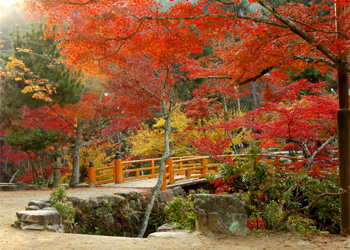
Momijidani Park is a rare place where nature and human craft have been quietly intertwined for centuries. The Momijidani River runs through the valley, its clear water threading between mossy stones and under vermilion bridges while maple branches arch overhead. Whether you visit in the vivid green of early summer or during the peak of November color season, the park rewards slow, attentive exploration — and understanding its history only deepens the experience.
The History of Momijidani Park: From Edo-Period Retreat to Famous Landmark
Origins in the Edo Period
The story of Momijidani Park begins in the Edo period, when this wooded valley at the base of Mount Misen was already attracting visitors drawn by its natural beauty. Historical documents from that era describe it evocatively: “A clear stream flows here; the trees are ancient and the atmosphere secluded — it is named for its abundance of maple trees.” Even then, Momijidani was known for its maples.
Toward the end of the Edo period, local enthusiasts began improving the area in earnest. The founder of the Iwaso Ryokan — still one of Miyajima’s most storied inns — took a leading role in planting maple saplings, constructing wooden bridges, and opening a tea house where visitors could rest and enjoy the scenery. The iconic Momiji Bridge dates from this era and remains one of the park’s most photographed features today.
One of the Eight Views of Itsukushima
Momijidani was traditionally listed among the Eight Views of Itsukushima — a classical set of scenic highlights on the island — under the name Tanigahara Biroku, which evokes the image of deer playing among the maples in the eastern part of the valley. This poetic designation attracted artists, scholars, and literary figures throughout the Edo period, cementing Momijidani’s reputation as a place of refined natural beauty.
As Miyajima developed as a pilgrimage and sightseeing destination, visiting Momijidani after prayers at Itsukushima Shrine became a natural part of the itinerary. By the late Edo period, the park had become a standard feature of any Miyajima visit.
The Meiji Era and the Birth of Momiji Manju
During the Meiji era, Momijidani’s reputation grew further as the island’s inns, including Iwaso, attracted a distinguished clientele — members of the imperial family, politicians, and cultural figures who came to stroll the valley and listen to the sound of the stream while taking in the colors of the maples. Old photographs from the period show well-dressed visitors wandering the paths in a way that feels surprisingly modern.
This era also gave rise to one of Japan’s most famous regional sweets. Momiji manju — the maple-leaf-shaped cakes filled with red bean paste that are now synonymous with Hiroshima — are said to have been inspired by Momijidani Park itself, created during the Meiji period in homage to the park’s signature trees. If you’ve ever bought a box of these treats at Hiroshima Station, you now know where the idea came from.
The Maples of Momijidani Park: What Makes the Autumn Color So Special
Around 700 Maple Trees — and Why Variety Matters
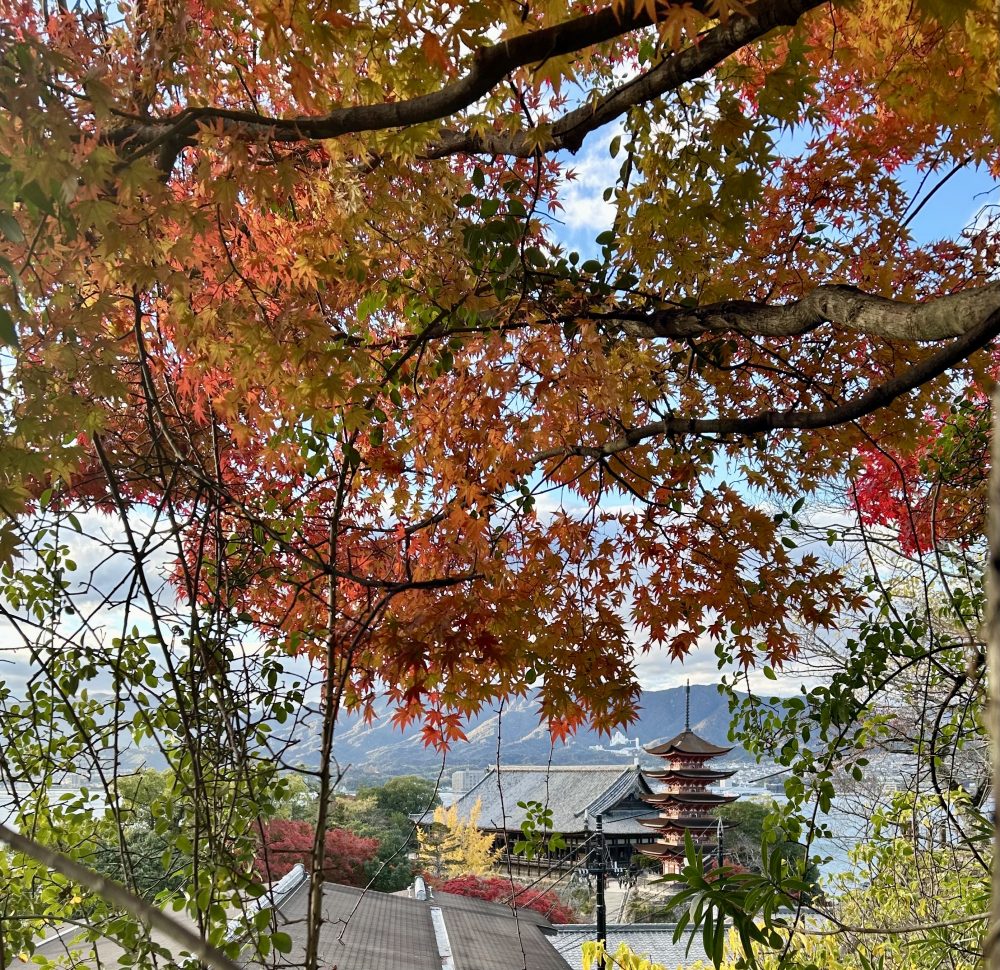
The park currently contains approximately 700 maple trees. The most common variety is the Iroha Maple (Acer palmatum), with around 560 trees, followed by roughly 100 Oo-Momiji maples, and about 40 trees of rarer varieties including Urihada Maple and Yama Momiji. The significance of this diversity is practical as well as aesthetic: different varieties reach peak color at slightly different times, which extends the overall viewing window and ensures the park rarely looks the same on two consecutive visits.
The vivid reds are produced by a compound called anthocyanin, which develops in maple leaves as temperatures drop in autumn. Through spring and summer, the leaves accumulate starch; once nighttime temperatures fall below about 8°C (46°F), the conversion process begins and the leaves start to turn. The color intensifies as temperatures approach 5–6°C (41–43°F). The quality of any given year’s autumn display depends heavily on the size of the daily temperature gap between day and night, hours of sunlight, and the absence of strong early winds.
Peak Season and Recent Timing Shifts
The typical peak for Momijidani Park’s autumn leaves falls in mid-to-late November. However, in recent years, climate patterns have pushed the peak later, and color season sometimes extends into early December. If you’re planning a visit specifically for the autumn foliage, it’s worth checking current conditions before you go rather than assuming a fixed date. The park is also noticeably less crowded on weekday mornings, even during peak season, so an early start from Hiroshima is well rewarded.
Four Seasons Worth Visiting
Autumn is Momijidani’s most famous season, but the park is genuinely beautiful year-round. Spring and early summer bring fresh ao-momiji — the brilliant lime-green of new maple leaves — which creates a completely different but equally striking atmosphere along the stream. The contrast between the red-lacquered Momiji Bridge and the lush surrounding greenery is one of those quiet Miyajima moments that tends to stay with you long after the trip. The sound of the river, the dappled light through the canopy, and the relative calm compared to the waterfront area make any season feel worthwhile.

The 1945 Makurazaki Typhoon: How Disaster Shaped Modern Momijidani
A Devastating Blow, Just Weeks After the War
On September 17, 1945 — barely one month after Japan’s surrender — Miyajima was struck by the Makurazaki Typhoon, one of the most powerful storms in modern Japanese history, with a central pressure of 916.1 hPa. The destruction it brought to Momijidani was catastrophic.
A landslide in the upper reaches of the Momijidani River unleashed a torrent of approximately 3,000 cubic meters of debris, which gathered force as it swept down the valley, tearing out trees and boulders along the way. The flood destroyed the Momiji Bridge, severely damaged the surrounding inns, and did not stop at the park boundary — approximately 18,000 cubic meters of sediment ultimately washed into the precincts of Itsukushima Shrine itself, burying sacred spaces that had stood for centuries.
The timing, coming in the immediate aftermath of a lost war, made the situation almost unbearably difficult. The country was in ruins, resources were scarce, and it would be more than a year before serious cleanup could even begin.
International Cooperation in the Reconstruction
In 1948, the Japanese national government formally approved a cultural heritage disaster restoration project covering the Momijidani River and its surroundings. What made this effort particularly remarkable was its scope of collaboration: the project was carried out with coordination between Japan’s national and prefectural governments and the Allied Occupation authorities (GHQ). That an international body would support the restoration of a Japanese cultural landscape, in such politically fraught circumstances and so soon after the war, speaks to the recognized global significance of Itsukushima as a place of cultural heritage.
The Birth of “Garden Erosion Control”
A special restoration committee was assembled, and before work began, the team produced a visionary design document that established a set of guiding principles unlike anything that had been applied to flood control engineering before. The concept they developed was called teien sabo — which translates roughly as “garden erosion control” — and it set out to reconcile the demands of flood safety with the aesthetics of a traditional Japanese garden.
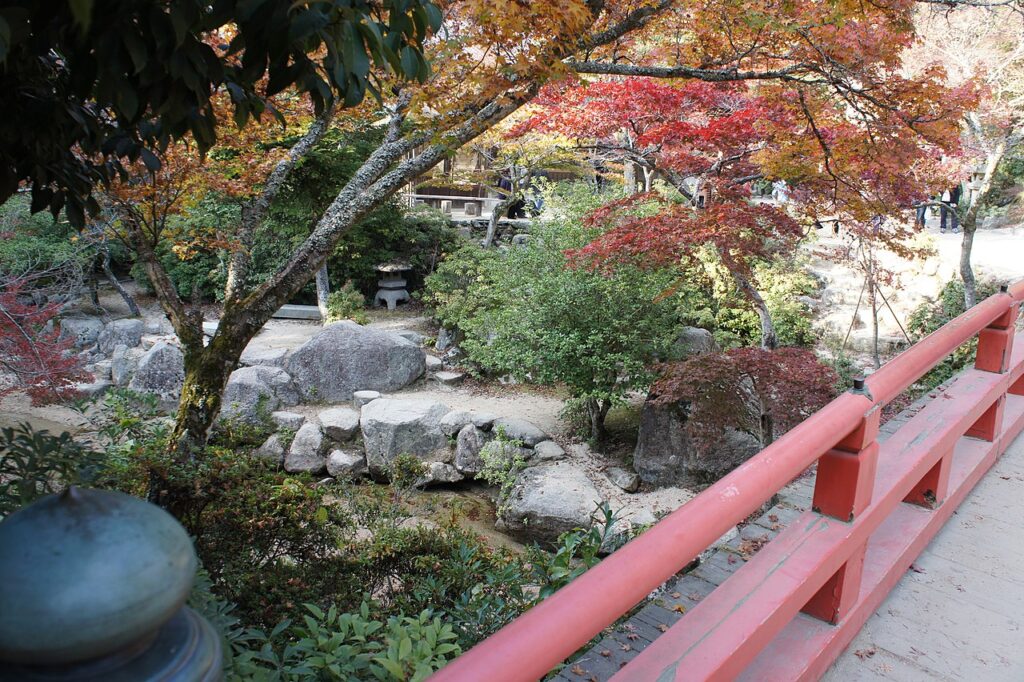
The principles were specific and demanding: boulders and stones were to be left completely intact and used exactly as they were found in nature. Not a single tree was to be felled. Any structural elements — retaining walls, channels, drainage infrastructure — were to be designed so they would be invisible to visitors. In other words, the engineering had to work invisibly inside a landscape that would continue to look completely natural.
The Hiroshima Prefectural Civil Engineering Department handled the design, while the construction was carried out by local Hiroshima landscape gardeners — craftspeople who understood both the technical and aesthetic requirements. Work ran from 1948 to 1950 at a cost equivalent to roughly 130 million yen in today’s money. Since the project’s completion, not a single sediment disaster has occurred in Momijidani.
National Recognition: An Important Cultural Property
In December 2020, the Momijidani River Garden Erosion Control Facilities were designated as an Important Cultural Property by the Japanese government — the first post-war civil engineering structure in Japan to receive this honor. The designation recognized not only the technical achievement itself, but the circumstances under which it was accomplished: a period of severe material shortage, physical exhaustion, and national demoralization, during which a group of engineers and craftspeople chose to restore a damaged landscape with extraordinary care and skill rather than simply patch it back together.
Momijidani Park Today: A Living Legacy
Momijidani Park today welcomes visitors throughout the year, with the autumn season drawing travelers from across Japan and from abroad. But the park’s value has always been more than scenic. Each generation has had to actively work to sustain what the previous one created — planting, maintaining, and protecting the landscape against both weather and heavy foot traffic.
In recent years, a local civic group called the NPO Sakura Momiji no Kai has taken on a hands-on conservation role, carrying out soil improvement, pruning of diseased branches, and pest management. As visitor numbers have grown, the roots of the maple trees have come under increasing pressure from foot traffic, and protecting them requires ongoing collaboration between local residents, botanists, and heritage specialists. The maples you walk among today are the result of more than two centuries of continuous care.
The garden erosion control concept pioneered here in the late 1940s has also attracted international attention as a model for balancing disaster prevention with cultural landscape preservation — a challenge that many heritage sites around the world now face. In that sense, Momijidani has become something of a reference point, not just a destination.
When you visit, take a moment to look at the riverbed stones — the large, weather-worn boulders sitting naturally in the stream — and consider that each one was carefully placed not to be noticed. That invisible craftsmanship is exactly what makes Momijidani Park so quietly extraordinary.
FAQ
When is the best time to see autumn leaves at Momijidani Park?
The typical peak falls in mid-to-late November, usually around the third or fourth week of the month. That said, recent years have seen peak color extend into early December due to shifting seasonal patterns. Autumn color begins when nighttime temperatures drop below about 8°C and intensifies as they approach 5–6°C. It’s worth checking current conditions closer to your visit, as timing varies each year.
What types of maple trees are in Momijidani Park?
The park contains around 700 maple trees across several varieties. The most common is the Iroha Maple, with approximately 560 trees, followed by roughly 100 Oo-Momiji maples, and about 40 trees of other native varieties including Urihada Maple and Yama Momiji. The mix of varieties means that different trees peak at slightly different times, extending the overall viewing window.
How do I get to Momijidani Park from Itsukushima Shrine?
From Itsukushima Shrine, Momijidani Park is roughly a 5-minute walk. From the Miyajima ferry pier, allow about 20 minutes on foot. The park also lies along the path toward the Miyajima Ropeway station, making it a natural part of any route up toward Mount Misen. The walk through the park itself adds another 10 or so relaxed minutes to the ropeway approach.
Is Momijidani Park worth visiting outside of autumn?
Yes — the park is genuinely lovely in every season. Spring and early summer bring fresh green maple foliage, known in Japanese as ao-momiji, which creates a cool, soft atmosphere along the stream. The contrast between the red-lacquered Momiji Bridge and the surrounding greenery is especially striking in May and June. The sound of the river and the relative quiet compared to the shrine waterfront make it a pleasant stop year-round.
What was the Makurazaki Typhoon and how did it affect the park?
The Makurazaki Typhoon struck on September 17, 1945, just weeks after the end of World War II, and caused catastrophic damage throughout Miyajima. In Momijidani, a landslide triggered by the storm sent approximately 3,000 cubic meters of debris crashing down the valley. The floodwaters destroyed the Momiji Bridge, damaged surrounding inns, and ultimately deposited around 18,000 cubic meters of sediment inside the grounds of Itsukushima Shrine. Full recovery took several years and involved cooperation between Japanese authorities and the Allied Occupation administration.
What is “garden erosion control” and why is it significant?
“Garden erosion control” (teien sabo) is a concept developed specifically for the post-typhoon reconstruction of Momijidani in 1948–1950. It refers to the approach of building fully functional flood-control infrastructure while making every engineered element invisible within a natural garden landscape — no damaged stones, no felled trees, no visible artificial structures. The result is a riverbed and valley that look entirely natural but are actually engineered for safety. In 2020, the facilities were designated as an Important Cultural Property — the first post-war civil engineering works in Japan to receive that honor.
Is there an admission fee for Momijidani Park?
The park itself is free to enter and open year-round. If you plan to continue to the Mount Misen Ropeway, a separate ticket is required for that. As always with Miyajima, the main logistical cost to plan for is the ferry from Miyajimaguchi on the mainland — the island itself has no entrance fee, but getting there does.
Sources
- Miyajima Tourism Association: Momijidani Park
- Wikipedia: Momijidani River Garden Erosion Control Facilities
- Hakataya Original Momiji Manju: Top Autumn Leaf Spots on Miyajima
- Miyajima Town History Editorial Committee, Miyajima Town History: General History Volume, Miyajima Town, 1992
Facility details, seasonal timing, and access information are subject to change. We recommend confirming the latest information directly with the Miyajima Tourism Association or relevant operators before your visit.