Itsukushima Shrine on Miyajima Island has one of the most remarkable histories of any Shinto shrine in Japan. Long before the famous floating torii gate became an icon of Japanese tourism, the nobles of the Heian court — Japan’s most powerful aristocratic class — regarded this island as a sacred place of extraordinary importance. Their devotion shaped the shrine into the cultural and religious treasure it is today.
This article explores why Japan’s Heian aristocrats venerated Miyajima so deeply, how they expressed that devotion from hundreds of miles away in Kyoto, and what their faith left behind — including national treasures that visitors can still see at Itsukushima Shrine today.
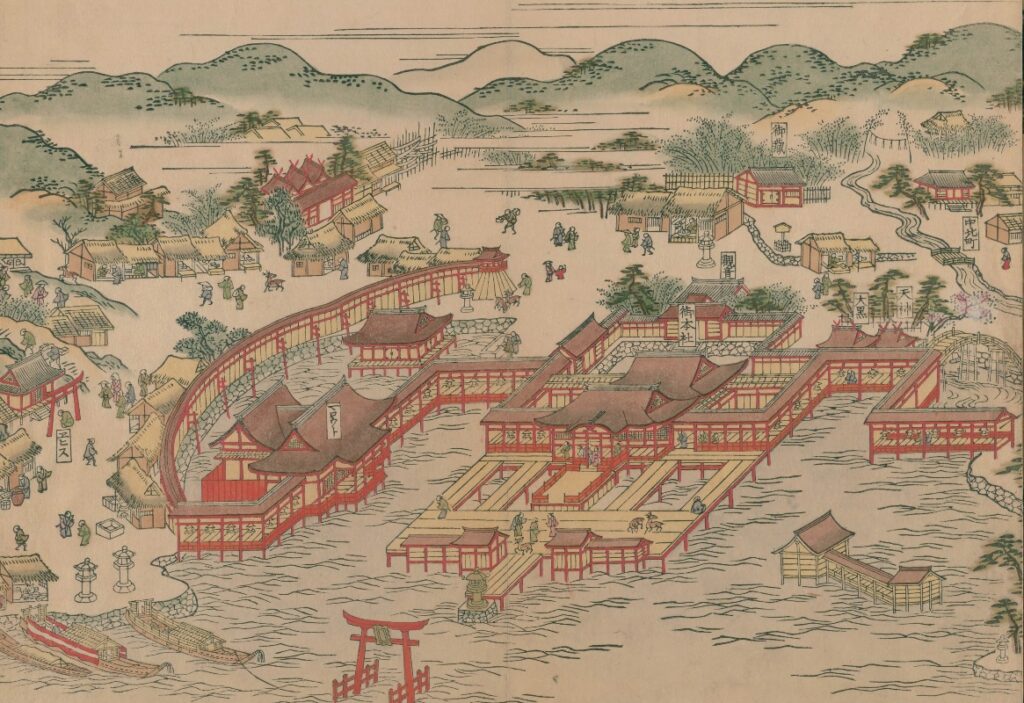
Itsukushima Shrine History: How Heian Aristocrats Shaped a Sacred Island
Early Heian Period: The Rise of Miyajima’s Prestige
In the early Heian period, Itsukushima Shrine began attracting serious attention from Japan’s central aristocracy. The driving force was a powerful current of religious thought known as shinbutsu-shūgō — the blending of Shinto and Buddhist belief that shaped much of Japanese spiritual life during this era.
The principal deity of Itsukushima Shrine, Ichikishimahime-no-Mikoto, came to be identified with Benzaiten, a Buddhist goddess associated with music, eloquence, and wealth. Benzaiten was enormously popular among Heian nobles, who believed her blessing could secure political power and personal fortune. For powerful families like the Fujiwara clan — who dominated the imperial court as regents and counselors — her protection was actively sought.
Miyajima’s growing status was formalized in 905 CE, when the imperial anthology known as the Engishiki classified Itsukushima Shrine as a myōjin taisha — a shrine of the highest rank recognized by the imperial court. This official designation confirmed what the aristocracy already believed: Miyajima was no ordinary provincial shrine.
The Fujiwara Era: Japan’s Most Powerful Family and Their Island Faith
From the tenth through the eleventh centuries, the Fujiwara clan ruled Japan from behind the throne, serving as regents for child emperors and consolidating extraordinary political influence. Their engagement with Itsukushima Shrine deepened steadily during this period.
Fujiwara no Michinaga, the clan’s most powerful figure, placed the province of Aki — modern-day Hiroshima Prefecture — under Fujiwara administration, directing economic resources toward the shrine. His diary, the Midō Kanpakuki, reflects close management of Aki Province, though direct references to Miyajima are limited.
In practice, high-ranking Fujiwara nobles rarely made the journey to Miyajima themselves. The distance from Kyoto was simply too great. Instead, they dispatched trusted representatives — called daisan-sha, or proxy pilgrims — to present offerings on their behalf. These offerings were far from modest: they included Buddhist sutras, religious implements, weapons, lacquerware, and fine silk textiles. Many such objects survive today in the shrine’s collection as nationally designated cultural treasures.
The Era of Retired Emperors: Go-Shirakawa and Miyajima’s Sacred Power
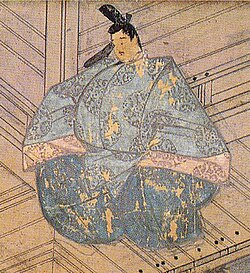
The twelfth century brought a significant shift in Japanese politics. Power moved from regents to insei — retired emperors who continued to govern from behind the scenes. Under this system, Itsukushima Shrine’s status rose even further.
Retired Emperor Go-Shirakawa was among Miyajima’s most devoted imperial patrons. His reverence for the shrine was partly shaped by Taira no Kiyomori, the great warrior-statesman who had served as governor of Aki Province and devoted enormous energy to developing Itsukushima Shrine into the grand structure it became. Kiyomori introduced Go-Shirakawa to the shrine’s spiritual significance, and the retired emperor channeled offerings through Kiyomori’s networks, reinforcing the connection between imperial prestige and the Taira clan’s power.
Go-Shirakawa was also famously devoted to the Kumano pilgrimage sites in the Kii Peninsula, and he understood Miyajima in similar terms — as a sacred site by the sea, offering protection to those traveling the western shipping lanes of the Seto Inland Sea. The shrine’s location made it a natural place to pray for safe passage, and for a court that depended on sea trade and western communication routes, that was not a minor consideration.
The Pilgrimage Journey: Kyoto to Miyajima in the Heian Age
A Journey of Ten Days or More
For any Heian-era traveler, the journey from Kyoto to Miyajima was a serious undertaking. The most common route combined overland and sea travel: heading west from the capital along the San’yōdō highway to Tomonoura, a port town in the eastern part of present-day Hiroshima Prefecture known as one of the great tidal harbors of the Seto Inland Sea.
From Tomonoura, pilgrims boarded ships and waited for favorable tides. The Seto Inland Sea, though calm by ocean standards, required patience — tidal timing was critical for safe and efficient passage. Ships would rest at ports like Murozumi in present-day Yamaguchi Prefecture before completing the final approach to Itsukushima Bay, opposite the island.
Under the best conditions, the journey from Kyoto to Miyajima took between ten days and two weeks one way. Poor weather or unfavorable winds could extend that considerably. It is easy to understand, then, why aristocrats of the highest rank almost never traveled in person — and why proxy pilgrims played such a central role in Heian devotional practice.
Rituals and Ceremonies Upon Arrival
Arriving at Miyajima was not simply a matter of stepping off a boat and walking into the shrine. Formal ritual preparations began well before departure in Kyoto, with court diviners selecting auspicious travel dates and pilgrims observing periods of ritual purification and abstinence.
Upon reaching the island, the first act was misogi — a purification ritual performed at the water’s edge to cleanse the body and spirit before approaching the gods. Only after this purification did pilgrims proceed into the shrine precincts to present offerings (heihaku) and recite formal prayers.
Proxy pilgrims read their patron’s prayer aloud before the deity, presenting offerings that might include hand-copied sutras, lacquered mirrors, swords, horse fittings, and finely woven textiles. These were not simply gifts — they were demonstrations of the patron’s wealth, piety, and political standing. The objects left behind became part of the shrine’s sacred collection, and many have survived to the present day.
Priceless Cultural Treasures Left Behind
The offerings of Heian and Taira-period patrons represent some of the most extraordinary surviving artifacts of classical Japanese culture.
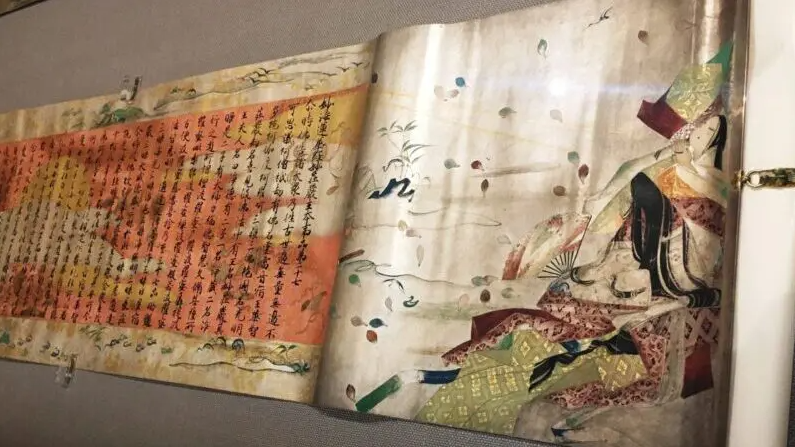
The most celebrated is the Heike Nōkyō, or Taira Sutras — a set of elaborately decorated sutra scrolls presented by the Taira clan in 1167 CE. Commissioned by Taira no Kiyomori himself, these scrolls record the Lotus Sutra and other sacred texts with breathtaking artistic embellishment: gold and silver pigments, painted landscapes, and decorative borders that rank among the finest surviving examples of Heian decorative art. The Heike Nōkyō is designated a National Treasure of Japan.
Another exceptional collection is the Kyūnōji-kyō, a complete set of Buddhist scriptures copied in the late Heian period by aristocratic patrons. These scrolls feature vivid polychrome decoration and are also preserved as National Treasures at Itsukushima Shrine.
Among the weaponry and equestrian objects, items such as elaborately ornamented saddles and sword mountings survive as testament to the aesthetic sensibilities of Heian aristocrats, for whom beauty and status were inseparable.
Why Heian Aristocrats Valued Miyajima: Politics, Economy, and Culture
The devotion of Japan’s Heian aristocracy to Itsukushima Shrine was never purely spiritual. Political, economic, and cultural motivations were intertwined in ways that were entirely typical of Heian elite behavior.
Politically, supporting a powerful shrine in Aki Province strengthened central authority over a strategically important region. Aki lay along the western shipping lanes of the Seto Inland Sea — the main artery of communication and trade connecting Kyoto with Kyushu and western Japan. Whoever cultivated influence at Miyajima cultivated influence over those routes. The Fujiwara and the Taira both understood this.
Economically, aristocratic patronage brought enormous resources to the shrine and its surrounding community. The flow of offerings, the spending of visiting retinues, and the expansion of the shrine’s landholdings all contributed to Miyajima’s growth as a place of wealth and local significance. Itsukushima Shrine eventually held substantial estates throughout Aki Province.
Culturally, the patronage of Miyajima carried sophisticated Kyoto culture westward. The sutras, artworks, and ceremonial objects transported to the island by Heian aristocrats raised the cultural level of the entire western region — and transformed Miyajima into a bridge between the imperial capital and the western provinces.
Perhaps most significantly for religious history, the Heian era’s embrace of Miyajima stands as one of the great examples of shinbutsu-shūgō in action. The merging of Shinto deity Ichikishimahime-no-Mikoto with Buddhist goddess Benzaiten created a uniquely Japanese form of worship — neither purely Shinto nor purely Buddhist, but something distinctly its own. This fusion defined Miyajima’s spiritual identity for centuries.
Heian History You Can Still See on Miyajima Today
Visiting Itsukushima Shrine today means stepping into a living connection with the Heian world. Many of the National Treasures and Important Cultural Properties in the shrine’s collection were placed there by the aristocrats described in this article. The Heike Nōkyō sutras and the Kyūnōji-kyō scrolls are accessible through the shrine’s Treasure House, where a rotating selection of artifacts is displayed.
For visitors with an interest in art history, Japanese religion, or classical history, the shrine’s collection is genuinely rare — objects of this age, quality, and cultural significance are extraordinarily difficult to see anywhere in the world. Many scholars and cultural heritage specialists visit Miyajima each year specifically to encounter these pieces.
The journey from Kyoto to Miyajima that took Heian proxy pilgrims two weeks now takes roughly two hours by bullet train. But standing before the torii gate at high tide, or walking the corridors of a shrine that Japan’s most powerful families treated as one of the holiest places on earth, it is not difficult to understand why this island inspired such devotion.
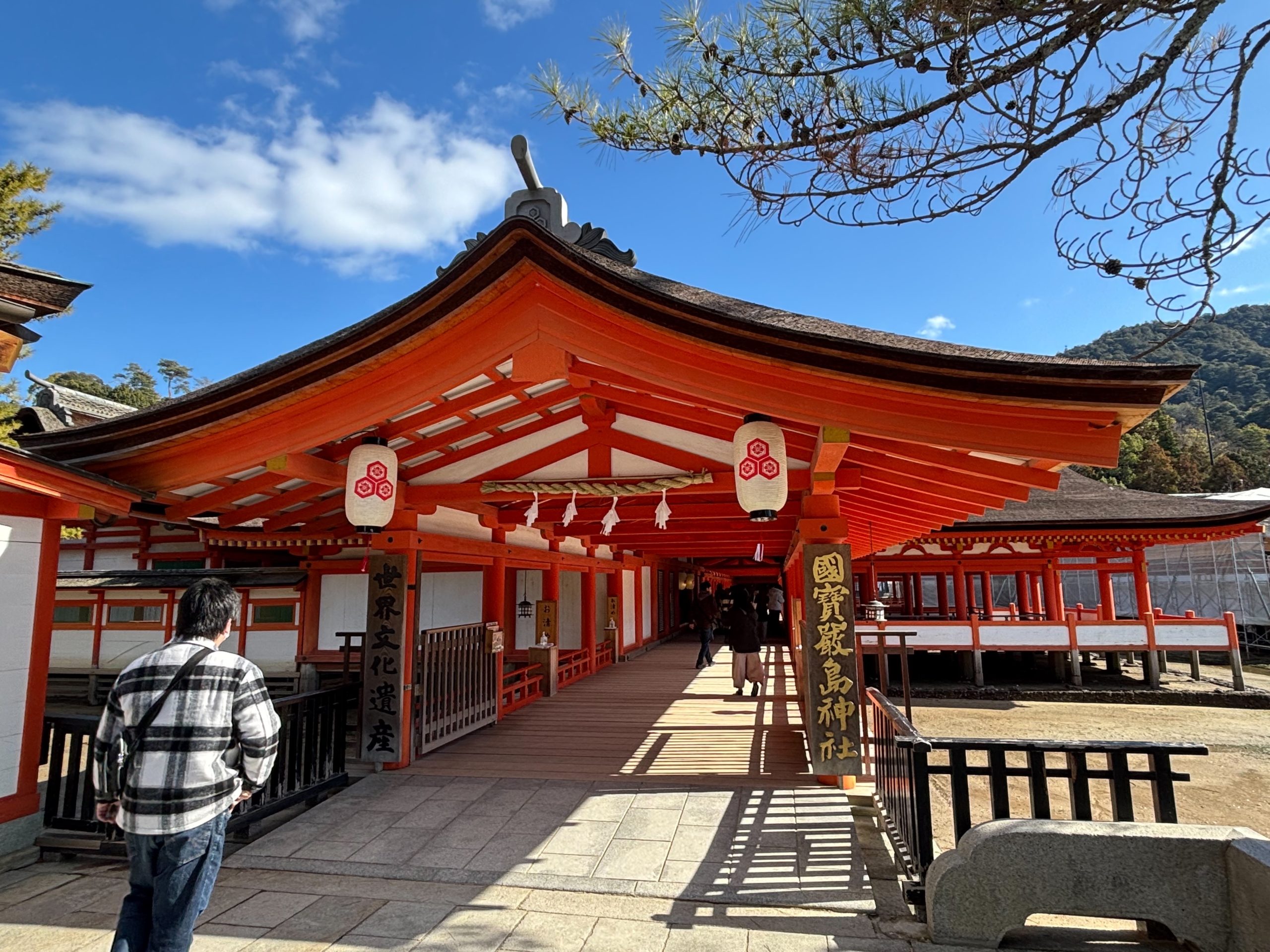
Itsukushima Shrine (Itsukushima-jinja, 厳島神社) is a Shinto shrine built ...
FAQ
Why did Heian aristocrats revere Itsukushima Shrine so strongly?
The shrine’s principal deity, Ichikishimahime-no-Mikoto, was identified with the Buddhist goddess Benzaiten, patroness of music, eloquence, and wealth — qualities the Heian aristocracy actively sought. Political factors also played a role: Miyajima’s location along the Seto Inland Sea made it strategically important, and supporting the shrine strengthened aristocratic influence over western Japan’s key maritime routes.
Did powerful nobles like Fujiwara no Michinaga actually visit Miyajima in person?
Rarely, if ever. The journey from Kyoto to Miyajima took between ten days and two weeks each way under favorable conditions — far too demanding for the highest-ranking nobles to undertake frequently. Instead, trusted household representatives called proxy pilgrims (daisan-sha) made the journey on their behalf, presenting offerings and prayers in the patron’s name.
What is the Heike Nōkyō, and can visitors see it today?
The Heike Nōkyō is a set of lavishly decorated sutra scrolls donated to Itsukushima Shrine by Taira no Kiyomori in 1167 CE. The scrolls are designated National Treasures of Japan and are considered among the finest examples of Heian decorative art in existence. Selected pieces are displayed in the shrine’s Treasure House and are open to visitors.
What does shinbutsu-shūgō mean, and how did it affect Miyajima?
Shinbutsu-shūgō refers to the blending of Shinto and Buddhist religious practices that was widespread in Japan from the Nara period onward. At Miyajima, this meant that the Shinto deity Ichikishimahime-no-Mikoto and the Buddhist goddess Benzaiten were worshipped as essentially the same divine being. This fusion made Itsukushima Shrine simultaneously meaningful to both Shinto devotees and Buddhist practitioners — a major reason for its broad aristocratic appeal.
What was the pilgrimage route from Kyoto to Miyajima like?
Pilgrims typically traveled west from Kyoto along the San’yōdō highway to Tomonoura, a tidal port in eastern Hiroshima Prefecture, then boarded ships to navigate the Seto Inland Sea westward. They waited at Tomonoura for favorable tides — the port was famous as a tidal staging point — and made rest stops at places like Murozumi in present-day Yamaguchi before arriving at Itsukushima Bay opposite Miyajima. The full journey took ten days to two weeks one way in good conditions.
How did Retired Emperor Go-Shirakawa relate to Itsukushima Shrine?
Go-Shirakawa was one of the most dedicated imperial patrons of the shrine. His connection deepened through Taira no Kiyomori, who had transformed Itsukushima Shrine into a grand complex and introduced the retired emperor to its significance. Go-Shirakawa compared Miyajima to the Kumano pilgrimage sites — a “Kumano of the Sea” — and valued it as a sacred place for praying over the western sea routes. His support also reinforced the political alliance between the imperial court and the Taira clan.
What is the best way to learn more about Itsukushima Shrine’s history when visiting Miyajima?
The shrine’s Treasure House (Homotsu-kan) is the best starting point — it displays a rotating selection of National Treasures and Important Cultural Properties including objects from the Heian and Taira periods. The Miyajima History and Folklore Museum on the island also covers the broader cultural context in depth. Most signage is in Japanese, but audio guides and English explanatory materials are available at the shrine itself.
Please note that opening hours, exhibition schedules, and access details for the Treasure House and other facilities may change. We recommend confirming current information through the official Itsukushima Shrine website or the Miyajima Tourist Association before your visit.
References and Sources
- Agency for Cultural Affairs – Cultural Heritage Online: Itsukushima Shrine (World Heritage Site)
- Agency for Cultural Affairs – National Designated Cultural Properties Database: Itsukushima Shrine
- Hiroshima Prefecture Board of Education – Cultural Properties Division
- Itsukushima Shrine Official Website: History and Origins
- Miyajima Tourist Association: World Cultural Heritage Designation
- Nara National Museum: Itsukushima Shrine National Treasures Exhibition
- Prefectural University of Hiroshima – Miyajima Studies Center
- Miyajima Town History Editorial Committee. Miyajima Town History: General History Volume. Miyajima Town, 1992.
- Gomi Fumihiko. Studies on the Society of the Insei Period. Yamakawa Publishing, 1984.
- Motoki Yasuo. Taira no Kiyomori and Retired Emperor Go-Shirakawa. Kadokawa, 2012.
- UNESCO World Heritage Centre: Itsukushima Shinto Shrine