
Itsukushima Shrine is famous for its stunning appearance, seemingly floating on the sea. At high tide, the buildings hover above the water; at low tide, the seabed emerges beneath them. This unique scenery has captivated visitors from around the world for centuries.
But how did this remarkable layout come to be? And how has it changed over the centuries? This article traces the development and evolution of the shrine’s layout from its founding to the present day, exploring the architectural planning that created one of Japan’s most iconic sacred sites.
The Original Shrine: A Small Seaside Sanctuary
According to shrine tradition, Itsukushima Shrine was founded in 593 CE during the reign of Empress Suiko. Local clan leader Saeki no Kuramono reportedly received a divine message and, with imperial permission, built a shrine on Mikasa Beach to enshrine Ichikishimahime-no-Mikoto, one of three Munakata goddesses.
However, this early shrine was nothing like the grand complex we see today. Historical records indicate that the shrine remained relatively small until Taira no Kiyomori undertook major renovations centuries later. While details about the original layout are scarce, the decision to build over the tidal flats reflected ancient beliefs about the island itself.
Miyajima’s name derives from “Itsuku-shima,” meaning “island dedicated to the gods.” Since ancient times, the entire island was considered sacred. To avoid disturbing the holy ground by cutting trees or digging into the earth, the shrine was built over the tidal zone—a brilliant solution that allowed worship while preserving the island’s sanctity.
For a comprehensive overview of Itsukushima Shrine’s architectural history from ancient times to the present, the following article provides essential context that will deepen your understanding of this topic.
Anyone who has visited Miyajima has been captivated by the beautiful sight of Itsukushima Shrine appearing to float on the sea. The vermilion corridors reflected on the water, the cypress bark roofs…
Taira no Kiyomori’s Grand Renovation: Introducing Shinden-Zukuri Design
The shrine layout we see today was essentially established around 1168 when Taira no Kiyomori, Japan’s most powerful military leader at the time, sponsored a major reconstruction led by head priest Saeki no Kagehiro. Kiyomori was 50 years old and at the peak of his power, having just become the first warrior to hold the title of Grand Minister of State.
Applying Palace Architecture to Shrine Design
Kiyomori introduced shinden-zukuri, the residential style used for aristocratic mansions during the Heian period. In this style, a central sleeping hall is flanked by subsidiary buildings on the east and west, all connected by covered corridors.
Kiyomori ingeniously adapted this palace style for shrine architecture, reimagining the Seto Inland Sea as the ornamental pond of a noble estate and the shrine buildings as the palace halls. Just as Heian aristocrats enjoyed musical performances on boats in their garden ponds, Itsukushima Shrine became a venue for sacred music performed on the sea. This tradition continues today in the annual Kangensai Festival.
The Basic Layout Configuration
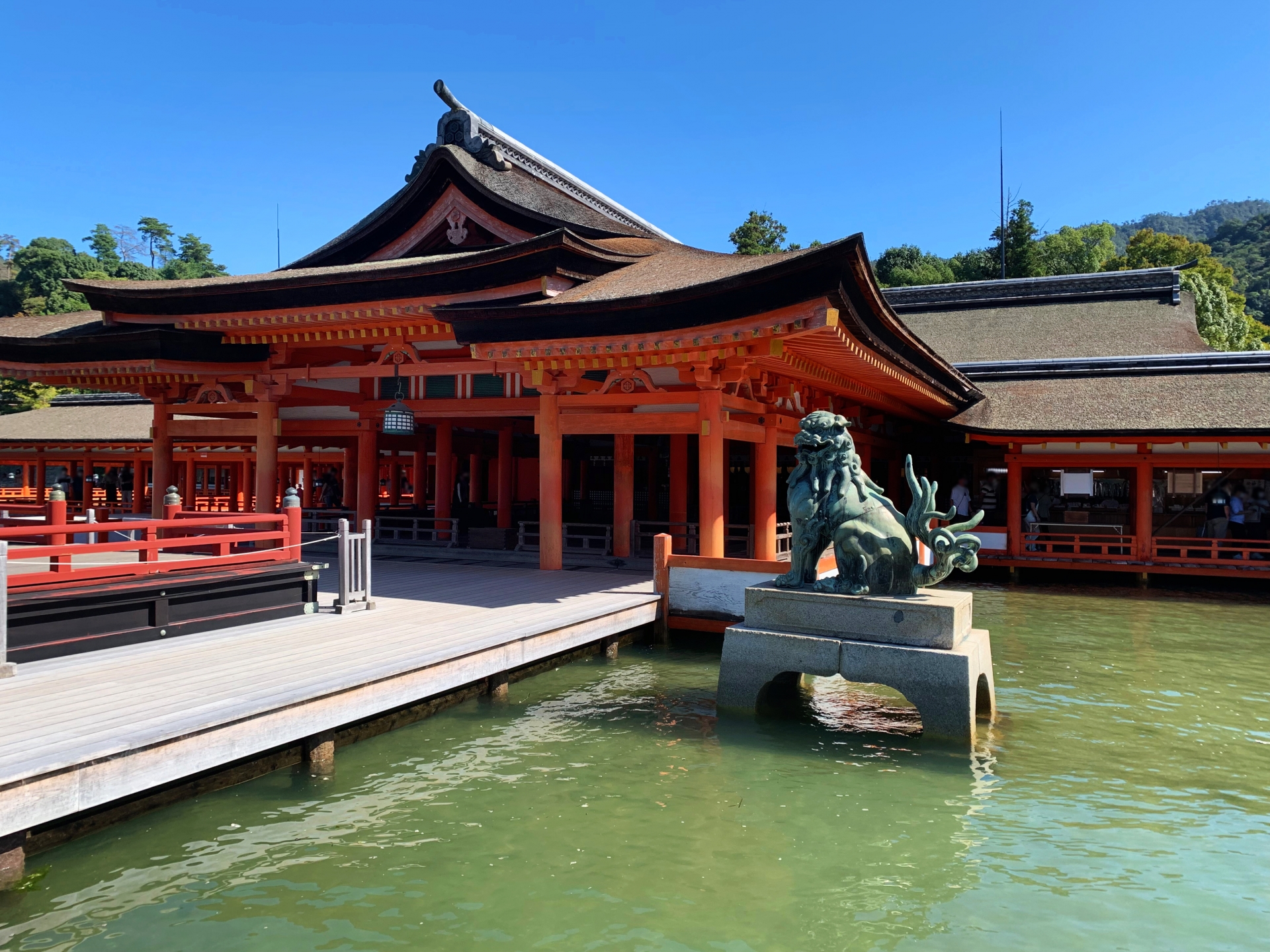
The layout established by Kiyomori follows a carefully planned arrangement. The main shrine (honsya) faces northwest at the innermost part of the bay. The main hall (honden), offering hall (heiden), worship hall (haiden), and purification hall (haraiden) align in a straight line.
In front of the purification hall, the raised stage (takabutai) is surrounded by the flat stage (hirabutai). Small structures including the gate guardian shrines (kadomaroudo-jinja) and music pavilions (gakubō) stand adjacent to the flat stage. The seaward edge of the flat stage extends into a pier-like section called the hitasaki, which aligns directly with the great torii gate standing in the sea.
Corridors extend from the sides of the purification hall, bending left and right (the east and west corridors). Along the east corridor stands the auxiliary Marodo Shrine, facing west. This entire configuration creates the distinctive landscape of Itsukushima Shrine spread across the water.
The Deliberate Asymmetry
Unlike most Japanese shrines, which emphasize symmetrical design, Itsukushima Shrine features intentional asymmetry—a characteristic inherited from shinden-zukuri architecture. The offering hall and purification hall are positioned slightly west of the main hall’s central axis. The pillar arrangements of the main hall and worship hall are also asymmetrical.
This design choice accommodates a wider bay (the space between pillars) for the section enshrining the principal deity, Ichikishimahime-no-Mikoto, shifting the building’s central axis westward. Such asymmetry reflects the shinden-zukuri philosophy of natural beauty and is extremely rare in shrine architecture.
The shrine Kiyomori created, with its main hall, worship hall, and corridors arranged over the sea, was praised as representing “Pure Land paradise on earth.” The layout and architectural style established during this period remain the foundation of Itsukushima Shrine today.
Kamakura Period Fires and Reconstruction: Faithful Preservation
The magnificent shrine buildings Kiyomori created were completely destroyed by fire twice—in 1207 and 1223. However, devotion to Itsukushima Shrine continued even after the fall of the Taira clan, with successive rulers including the Minamoto clan providing protection.
The main structures standing today were rebuilt during the Ninji era (1240–1243), following these fires. The reconstruction faithfully reproduced both the layout and architectural style from Kiyomori’s time. The offering hall, worship hall, and purification hall of the main shrine, as well as the corresponding buildings of the Marodo Shrine, date to 1241 and represent precious examples of Kamakura-period architecture.
The Kamakura shogunate was devoted to the shrine, even replacing the head priest family from the local Saeki clan with the Fujiwara clan, loyal retainers from eastern Japan. The reconstruction received substantial shogunate support, ensuring that the late Heian period layout was accurately recreated.
A Mystery in Historical Paintings
Interestingly, the “Ippen Shōnin Eden” (Illustrated Biography of the Monk Ippen), depicting a 1287 festival at the shrine, shows a layout different from today’s buildings. In the scroll painting, there is no purification hall in front of the worship hall. Instead, corridors extend from both sides of the worship hall to form a rectangular enclosure, with the raised stage floating within this enclosed area.
Scholars debate whether this painting depicts an imaginary scene or whether such a rectangular corridor arrangement actually existed before the Ninji reconstruction. What is certain is that the current layout has remained essentially unchanged since the Ninji reconstruction, preserving Kiyomori’s original design.
Muromachi and Sengoku Periods: Main Hall Rebuilding While Maintaining Layout
Throughout the Muromachi and Sengoku (Warring States) periods, successive rulers continued to protect and repair the shrine. The main hall was reconstructed in 1571 by Mōri Terumoto, grandson of the famous warlord Mōri Motonari. This rebuilding was not due to fire but to an incident in 1569 when the Wachi brothers, enemies of Mōri Motonari, barricaded themselves in the main hall and were killed there. The building was considered polluted by blood and was replaced.
The Marodo Shrine underwent major repairs between 1430 and 1433. Throughout the Muromachi period, continuous maintenance preserved the Kiyomori-era layout.
Mōri Motonari, who regretted using the sacred island as a battlefield during the Battle of Miyajima in 1555, actively undertook projects including rebuilding the great torii and restoring shrine buildings. Even during the turbulent Warring States period, Itsukushima Shrine’s layout and architectural style were carefully maintained.
Additional Structures: Expanding the Sacred Complex
Over the centuries, several buildings were added to the basic layout Kiyomori established. These additions enhanced the shrine’s religious functions while enriching the overall setting.
The Noh Stage
The current Noh stage, reconstructed in 1680 during the Edo period, is the only Noh stage in Japan built over the sea. Extended over the water, it features floor construction that resonates like a single plank when performers stamp their feet, earning recognition as one of Japan’s three great Noh stages. Though the Noh stage did not exist in Kiyomori’s time, it has become an essential element of the shrine’s landscape.
Gate Guardian Shrines and Music Pavilions
The paired gate guardian shrines and music pavilions standing adjacent to the flat stage are also later additions that did not exist in Kiyomori’s era. These simpler structures are typically the ones damaged during typhoons, while the original main buildings remain protected. The main hall, worship hall, and other principal structures were positioned where they would not be submerged even by a once-in-200-years storm surge. Remarkably, the inner sanctuary of the main hall has never been flooded in over 850 years.
Five-Story Pagoda and Tahoto Pagoda
On land, additional structures were built over time. On the eastern shore of the bay, on a hill called Tō-no-oka, stand the Toyokuni Shrine (Senjōkaku, or “Hall of a Thousand Tatami Mats”) and a five-story pagoda built in 1407. A tahoto (two-story pagoda) stands on the western shore. These Buddhist structures remain from the era when Shinto and Buddhism were practiced together at the same sites.
These additions have enriched Itsukushima Shrine’s layout over time, creating an increasingly complex and beautiful landscape. Yet the fundamental configuration established by Taira no Kiyomori remains intact to this day.
Architectural Philosophy: Living with the Sea
The shrine’s layout incorporates ingenious methods for coexisting with the tidal environment. Despite being built over the sea, the structures have not suffered from uneven settling of their pillars. Researchers believe this is because the buildings stand on solid bedrock—the site may have originally been land that was excavated to create the tidal basin.
The foundations follow the same method used for land-based buildings: foundation stones are placed on the shallow seabed, wooden posts (stakes) are erected on them, and plank flooring is laid above. Since these wooden posts are submerged at high tide, they are subject to rot and require regular inspection. When decay is found, the lower portions are replaced through a technique called netsugu (root grafting).
The corridor floorboards also have gaps between them, allowing seawater to pass through during high tides. This distributes water pressure and minimizes damage to the structures. These architectural solutions for coexisting with the sea have been passed down for more than 850 years.
FAQ
What was the shrine layout like before Taira no Kiyomori’s renovation?
Before Kiyomori’s major reconstruction, Itsukushima Shrine was a small-scale complex. While it was built over tidal flats since its founding in 593 CE, the grand layout we see today was only established around 1168 through Kiyomori’s patronage. Limited historical records make it impossible to know the exact original configuration.
Did the layout change after the Kamakura period fires?
Although the fires of 1207 and 1223 completely destroyed the buildings, the reconstruction during the Ninji era (1240–1243) faithfully reproduced Kiyomori’s original layout and architectural style. The fundamental arrangement is believed to have remained unchanged.
Why is Itsukushima Shrine asymmetrical?
The asymmetry comes from the shinden-zukuri architectural style that Kiyomori applied to the shrine. Shinden-zukuri design embraces natural, asymmetrical beauty, unlike the strict symmetry found in most shrine architecture. The wider pillar spacing for the main deity’s section shifts the building’s axis westward.
When was the Noh stage added to the shrine?
The current Noh stage was reconstructed in 1680 during the Edo period. It did not exist in Kiyomori’s time but has become an iconic part of the shrine’s scenery. It is the only Noh stage in Japan built over the sea and is counted among Japan’s three great Noh stages.
Are the shrine buildings damaged by typhoons and storm surges?
Typhoon damage is typically limited to the auxiliary structures—the Noh stage, gate guardian shrines, and music pavilions—which were added after Kiyomori’s time. The main hall, worship hall, and other principal buildings were strategically positioned to avoid flooding even in extreme storm surges. The inner sanctuary of the main hall has reportedly never been flooded in over 850 years.
How do the wooden posts survive being submerged in seawater?
The wooden foundation posts are regularly inspected for decay caused by seawater exposure. When rot is discovered, craftsmen use a traditional technique called netsugu (root grafting) to replace the damaged lower portions while preserving the original structure above. This ongoing maintenance has kept the shrine standing for centuries.
Can I see the shrine layout at both high and low tide?
Yes, and experiencing both tides is highly recommended. At high tide, the shrine appears to float majestically on the water—the effect Kiyomori intended. At low tide, you can walk out to the great torii gate and see the foundation structures and seabed that are normally hidden. Each tide offers a different perspective on the architectural genius of this World Heritage Site.
Summary
The layout of Itsukushima Shrine represents an architectural vision that has endured for over 850 years. From a small seaside sanctuary at its founding to the revolutionary shinden-zukuri design introduced by Taira no Kiyomori, through faithful reconstruction after devastating fires, to the gradual addition of auxiliary structures, the fundamental layout has been preserved across the centuries.
The ingenious engineering that allows the shrine to coexist with the tides, the distinctive asymmetrical beauty inherited from Heian palace architecture, and the layout that evokes the refined culture of ancient aristocracy—all of these elements contribute to Itsukushima Shrine’s status as a UNESCO World Heritage Site. When you visit, take time to appreciate the architectural planning that has survived the ages, and consider the remarkable continuity that connects today’s shrine to the vision of a 12th-century statesman.