
When you visit Itsukushima Shrine on Miyajima Island, the sight of its iconic “floating” torii gate and elegant vermillion shrine halls will take your breath away. But there’s something equally powerful waiting to deepen your experience: learning about the Itsukushima Shrine goddesses—the three ancient sea deities who’ve watched over this sacred island in Hiroshima for more than fourteen centuries.
The three goddesses enshrined at Itsukushima are Ichikishimahime-no-Mikoto, Tagorihime-no-Mikoto, and Tagitsuhime-no-Mikoto—collectively known as the Munakata Three Goddesses. These ancient sea deities have been venerated since 593 AD for safe voyages, prosperity, and the flourishing of arts and crafts. Understanding who they are and why they’re worshipped here transforms a visit to this UNESCO World Heritage site from a beautiful photo opportunity into a meaningful cultural pilgrimage.
The Ancient Mythology Behind the Three Sea Goddesses
Born from a Divine Oath Between the Sun Goddess and Storm God
The origin story of the Munakata Three Goddesses takes us deep into Japanese mythology, to a dramatic moment when the sun goddess Amaterasu Omikami tested her brother Susanoo-no-Mikoto’s true intentions. According to ancient texts, Susanoo had ascended to the heavenly realm, and his sister—suspicious of his motives—demanded proof of his sincerity.
In response, they performed a sacred oath ritual. Amaterasu took her brother’s sword, the Totsuka-no-Tsurugi, bit it into pieces, and from the divine mist of her exhaled breath, the three goddesses came into being. This mythological birth through such a powerful divine act established them from the very beginning as sacred protectors.
From earliest times, these three sister goddesses were revered as guardians of maritime routes, watching over the dangerous sea passages between Japan, the Asian continent, and the Korean Peninsula. This ancient role as protectors of seafarers and ocean travelers forms the foundation of their identity as sea deities—a role that made them perfect patrons for an island shrine like Itsukushima, surrounded by the waters of the Seto Inland Sea.
The Unique Roles and Divine Powers of Each Goddess
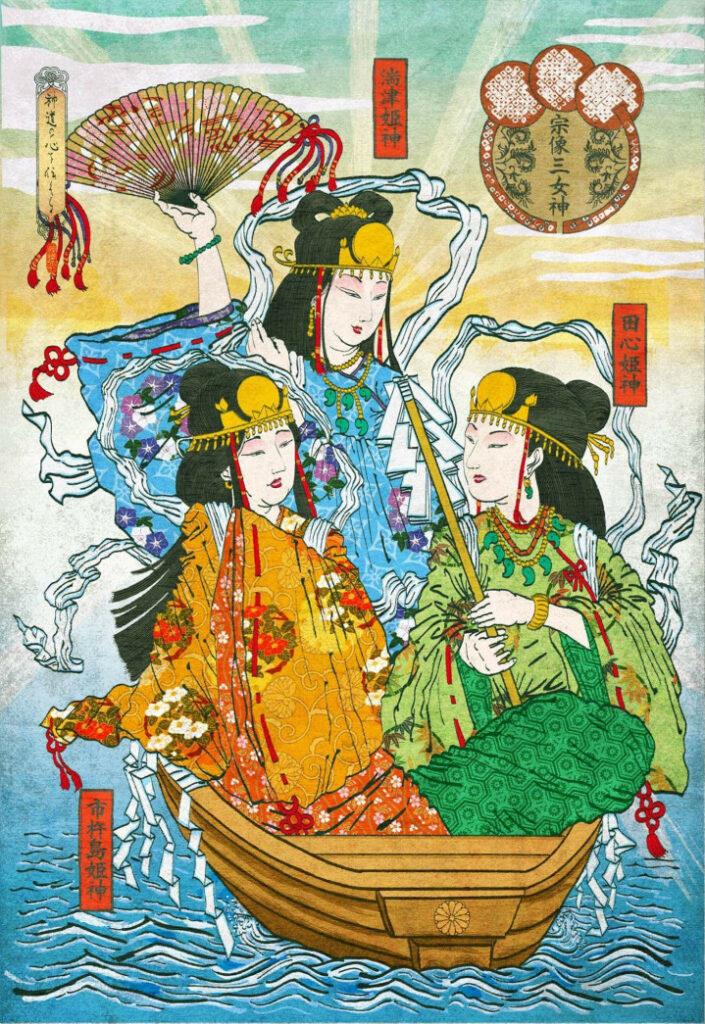
While the three goddesses work together as a protective trinity, each sister has her own distinct personality and areas of divine influence:
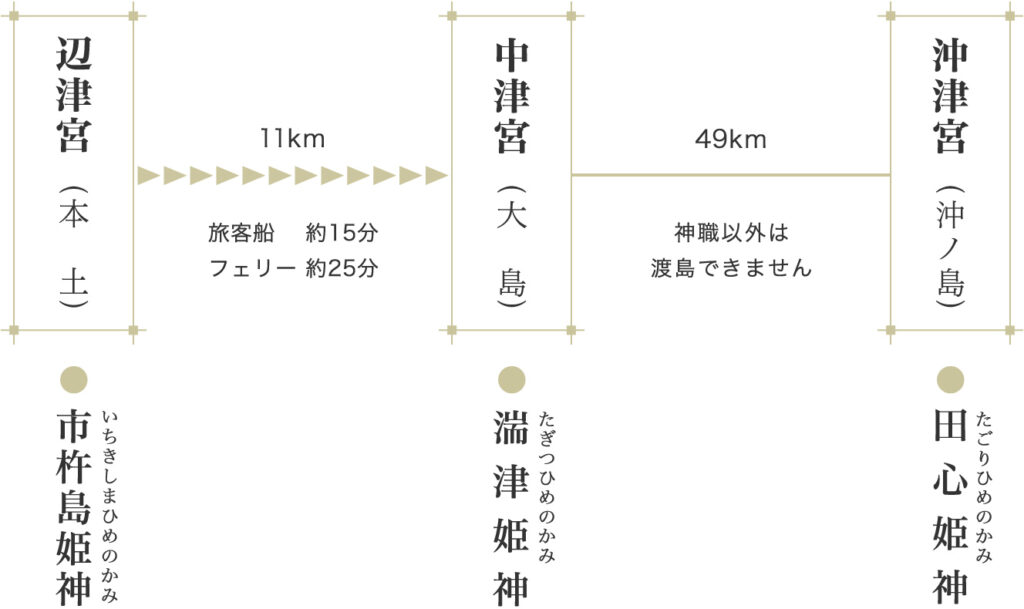
Tagorihime-no-Mikoto, the eldest sister, is traditionally enshrined at Okitsu-miya on the remote sacred island of Okinoshima in Fukuoka Prefecture. As guardian of the open ocean, she receives prayers for safe navigation across distant seas and protection during long ocean voyages. Think of her as the protector of deep-water sailors and those venturing far from shore.
Tagitsuhime-no-Mikoto, the middle sister, is enshrined at Nakatsu-miya on Oshima Island. Her domain is flowing waters—rivers, waterfalls, and rapids. She’s venerated for safety when traveling on waterways and for protection against floods and water-related disasters. If Tagorihime watches over the open sea, Tagitsuhime guards the rivers and coastal waters.
Ichikishimahime-no-Mikoto, the youngest sister, is enshrined at Hetsu-miya on the mainland in Munakata City, Fukuoka. She’s the most widely known of the three sisters, particularly famous for her blessings in the arts and learning. Worshippers pray to Ichikishimahime for talent in music, poetry, craftsmanship, and creative pursuits. She’s especially beloved by artists, musicians, and students.
Why These Three Goddesses Are Worshipped on Miyajima
The Connection Between Itsukushima Shrine and Munakata Taisha
You might be wondering: if these goddesses originated in Fukuoka at Munakata Taisha, how did they end up being worshipped on Miyajima Island in Hiroshima? The answer reveals fascinating insights into Japan’s ancient history and the spread of religious faith.
As political and economic power gradually shifted from Kyushu (Japan’s southernmost main island) toward the Yamato region (around present-day Nara and Osaka) during Japan’s early formation, the worship of the Munakata Three Goddesses spread along with it. The faith that began in Chikuzen (northern Fukuoka) expanded throughout the archipelago, particularly along important maritime trade routes.
Historical records confirm this early spread. The Nihon Sandai Jitsuroku, a historical text compiled in 901 AD, already mentions “Itsukishima Munakata Kosen-gami, Itsukushima Shrine in Hatsukaichi City” among six shrines, showing that branch shrines of Munakata Taisha had established themselves across Japan by this time.
What makes Itsukushima Shrine special is that it enshrines all three goddesses together in a single main hall, unlike Munakata Taisha where they’re separated across three different locations. On Miyajima, the three sea goddesses became associated not only with maritime safety but also with wealth, good fortune, and artistic pursuits—reflecting the island’s unique development as both a spiritual center and a cultural hub along the Seto Inland Sea shipping routes.
How Taira no Kiyomori Elevated the Goddesses’ Status
The worship of the three goddesses at Itsukushima Shrine truly flourished during the late Heian period (late 1100s) under the patronage of Taira no Kiyomori, one of the most powerful military leaders in Japanese history. Kiyomori’s rise to power was intimately connected to the sea—and to the goddesses who protected it.
By subduing pirates who plagued the Seto Inland Sea, organizing safer shipping routes, and accumulating enormous wealth through trade with Song Dynasty China, Kiyomori built his fortune and influence. He recognized that Itsukushima Shrine, strategically positioned along the vital Seto Inland Sea trade route, was the perfect place to pray for the safety of his overseas trading vessels and the continued success of his maritime ventures.
Through Kiyomori’s generous patronage—including the construction of the shrine’s famous corridor-style architecture extending over the water—the scope of the goddesses’ divine blessings expanded. On Miyajima, they came to be venerated not just for maritime safety but for prosperity in arts, commerce, and cultural pursuits. This broader interpretation of their powers continues today, making them meaningful deities for modern travelers and pilgrims who seek blessings for creativity, business success, and safe journeys.
The Fascinating Blend with Buddhism: Benzaiten Connection
During Japan’s long period of shinbutsu-shugo (Shinto-Buddhist syncretism), when the two religions were practiced together rather than separately, something fascinating happened to the worship of these goddesses—particularly the youngest sister, Ichikishimahime-no-Mikoto.
Ichikishimahime became identified with Benzaiten, one of Buddhism’s most popular goddesses. Benzaiten is associated with music, eloquence, wisdom, and wealth—qualities that aligned beautifully with Ichikishimahime’s own divine attributes. On Miyajima, Itsukushima Shrine and the nearby Daiganji Temple formed an integrated religious complex, and Benzaiten was worshipped alongside the three Shinto goddesses.
This continued until the Meiji government’s Separation of Shinto and Buddhism policy in the late 1800s, after which Benzaiten was moved to be enshrined exclusively at Daiganji Temple. Today, Daiganji is counted among Japan’s “Three Great Benzaiten Shrines,” and visiting it offers insight into the beautiful religious traditions that shaped Miyajima’s spiritual landscape.
This fusion with Benzaiten worship helped spread faith in the goddesses far beyond their original maritime associations. The identification with Benzaiten particularly emphasized blessings for artistic talent, craftsmanship, and prosperity—making the goddesses meaningful to a much wider range of worshippers including musicians, artists, merchants, and scholars.
What the Three Goddesses Mean for Visitors Today
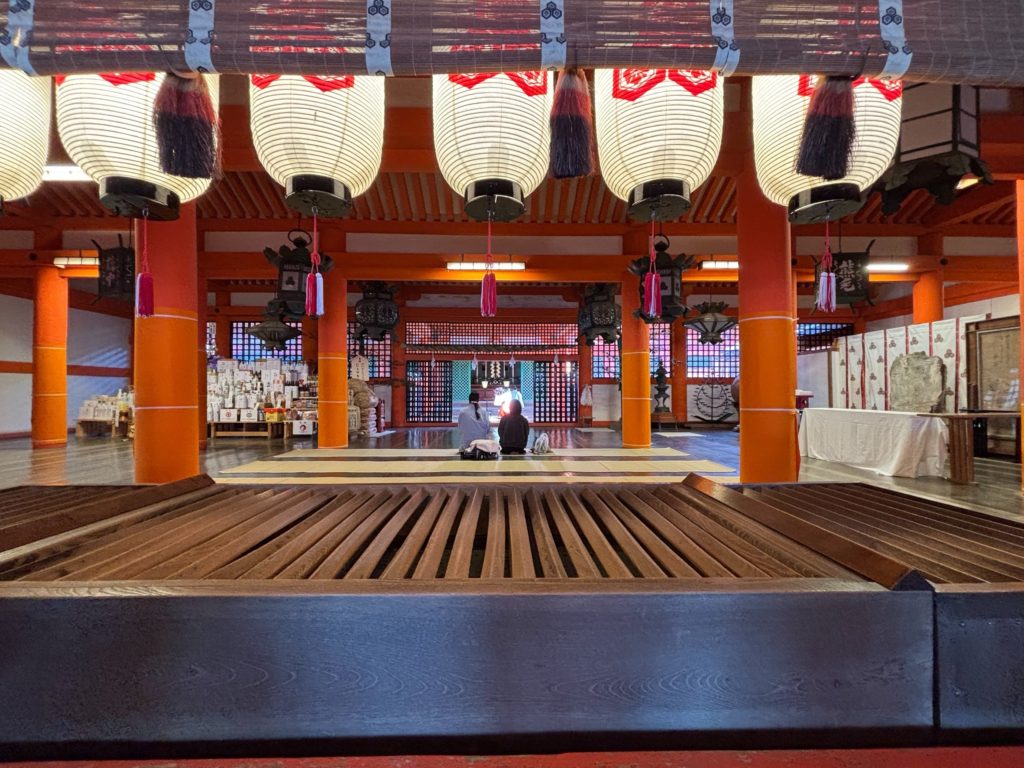
At Itsukushima Shrine today, faith in the three sea goddesses continues to thrive, preserving ancient maritime traditions while embracing meanings that resonate with modern visitors from around the world. There’s a beautiful local tradition that says the goddesses favored Miyajima as a place of peace and rest, blessing the island and the surrounding Ono Strait with abundant natural beauty—a belief that perfectly captures the serene, welcoming atmosphere that draws millions of travelers to this World Heritage site each year.
The Main Hall where the three goddesses are enshrined is architecturally impressive in its own right. Along with the three principal goddesses, thirty other deities are honored here. The hall measures approximately 8 ken (about 47 feet) across the front, 9 ken (about 57 feet) at the rear, and 4 ken (about 24 feet) deep. Its total floor area is said to be roughly twice that of the famous Izumo Taisha shrine—a testament to the importance of the worship conducted here.
When you visit, take a moment to appreciate that the solemn rituals performed in this hall represent an unbroken chain of devotion spanning more than 1,400 years. Whether you’re seeking blessings for safe travels, creative inspiration, business success, or simply want to connect with Japan’s ancient spiritual heritage, the three goddesses of Itsukushima welcome you with the same protective grace they’ve offered to countless pilgrims across the centuries.
Frequently Asked Questions
Why are the Munakata Three Goddesses called sea goddesses?
The three goddesses are called sea deities because of their mythological origin and ancient role. Born from a divine oath as protectors of maritime safety, they’ve safeguarded sea routes between Japan, China, and the Korean Peninsula since ancient times. They watched over sailors, ensured safe passage across dangerous waters, and facilitated the smooth flow of trade and cultural exchange across the seas. This maritime protection role has been central to their worship for thousands of years.
What’s the difference between how the goddesses are worshipped at Itsukushima Shrine versus Munakata Taisha?
At Munakata Taisha in Fukuoka, the three goddesses are enshrined separately across three distinct sacred sites—Okinoshima Island far offshore, Oshima Island closer to shore, and the mainland shrine—each representing different aspects of sea worship from deep ocean to coastal waters. In contrast, Itsukushima Shrine enshrines all three goddesses together in a single main hall. Additionally, on Miyajima their association with arts, crafts, culture, and prosperity has been especially emphasized, giving them a broader range of divine blessings beyond maritime safety.
Why is Ichikishimahime-no-Mikoto more famous than her sisters?
Ichikishimahime gained wider recognition because she’s the only one of the three sisters who became identified with the Buddhist goddess Benzaiten during the period of Shinto-Buddhist syncretism. This connection made her widely revered as a patron of music, arts, eloquence, and fortune—areas that appealed to a broad range of worshippers including artists, musicians, merchants, and scholars. She’s also frequently enshrined independently at shrines throughout Japan, further raising her profile compared to her sisters who are typically worshipped as part of the trio.
What kind of blessings can visitors pray for at Itsukushima Shrine?
While safe voyages and safe travel remain foundational blessings, the three goddesses are now associated with a wonderfully diverse range of benefits. Today’s visitors pray for creative inspiration and artistic talent, mastery of music or craftsmanship, business prosperity and financial success, academic achievement, and general good fortune. This makes them meaningful deities for students preparing for exams, artists seeking inspiration, entrepreneurs launching businesses, and of course travelers hoping for safe journeys throughout Japan and beyond.
When did worship of the three goddesses begin on Miyajima?
Worship of the Munakata Three Goddesses on Miyajima dates back to the shrine’s founding in 593 AD during the reign of Empress Suiko. This was a pivotal period in Japanese history when political power was shifting from Kyushu toward the Yamato region (central Japan), and the Munakata faith spread along crucial maritime trade routes. The establishment of Itsukushima Shrine represented the extension of this important sea deity worship to the strategically vital Seto Inland Sea region.
Summary
The Itsukushima Shrine goddesses—Ichikishimahime-no-Mikoto, Tagorihime-no-Mikoto, and Tagitsuhime-no-Mikoto—bring profound spiritual depth to any visit to Miyajima Island. Rooted in ancient Japanese mythology as protective sea deities born from a divine oath, these three sisters have been venerated at this sacred site for more than 1,400 years.
Their worship evolved and flourished through the patronage of powerful figures like Taira no Kiyomori and was enriched through syncretism with Buddhist traditions, particularly the identification of Ichikishimahime with the goddess Benzaiten. Today, their divine blessings extend from their original role as guardians of maritime safety to encompass artistic inspiration, cultural pursuits, prosperity, and safe travels.
As the principal deities of a UNESCO World Heritage site that welcomes millions of visitors from around the world each year, the three goddesses continue their ancient work—watching over travelers, inspiring artists, and connecting people to Japan’s rich spiritual heritage. Understanding their story transforms a visit to Itsukushima Shrine from a sightseeing stop into a meaningful encounter with living faith traditions that have shaped this sacred island for well over a millennium.
References and Sources
- Munakata Taisha Official Website: History and Origins
- Wikipedia: Munakata Sanjojin (Three Munakata Goddesses)
- Wikipedia: Itsukushima Shrine
- Wikipedia: Ichikishimahime
- World Heritage “Sacred Island of Okinoshima and Associated Sites”: Munakata Three Goddesses and Succession of Faith
- Japanese Mythology and History: What are the Munakata Three Goddesses? Their Birth, Names, Roles and Divine Blessings
- Japanese Mythology and History: Who is Ichikishimahime? One of the Munakata Three Goddesses, Deity of Itsukushima Shrine
- Miyajima Tourism Association: Daigan-ji Temple
- Wikipedia: Daigan-ji Temple (Hatsukaichi City)
- Miyajima Tourism Association: Itsukushima Benzaiten Grand Festival
- Miyajima Town History Compilation Committee, “Miyajima Town History: General History Edition,” Miyajima Town, 1992