
Itsukushima Shrine on Miyajima Island is famous for its breathtaking halls rising from the sea — but the sacred heart of the shrine is the three goddesses enshrined within it. Known as the Munakata Three Goddesses, these divine sisters are among the most important deities in Japanese mythology, worshipped for over 1,400 years as protectors of the sea, the arts, and safe passage across the waters. Understanding who they are and what they represent transforms a visit to Itsukushima Shrine from a sightseeing stop into a genuinely meaningful encounter with Japan’s ancient spiritual world.
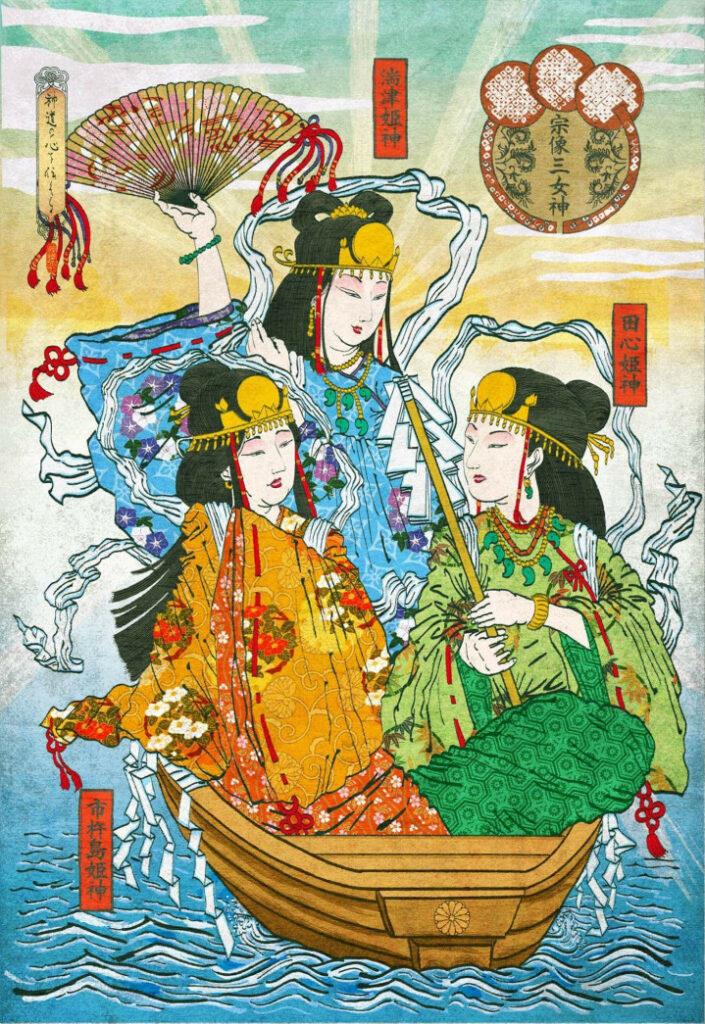
The three goddesses are Ichikishimahime (市杵島姫命), Tagirihime (田心姫命), and Tagitsuhime (湍津姫命) — sea deities revered since ancient times as guardians of ocean travel and maritime trade. Itsukushima Shrine has honored them as its principal deities since its founding in 593 AD, and over the centuries their divine roles have expanded to include the arts, commerce, and creative expression.
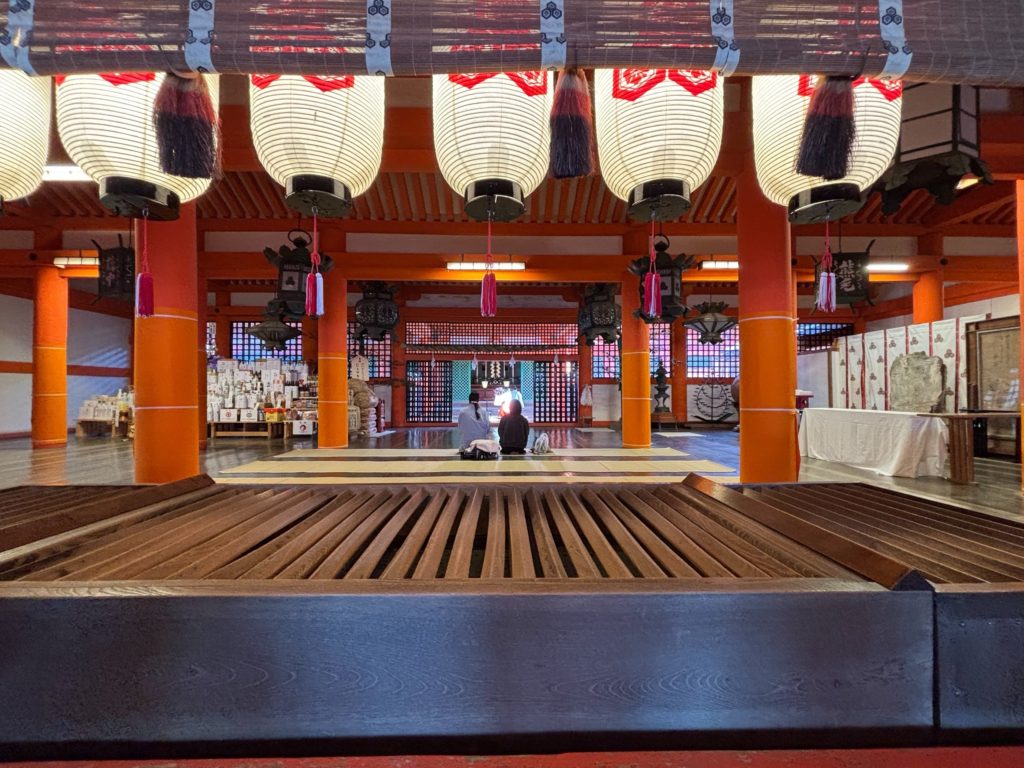
The Origins of the Three Goddesses in Japanese Mythology
Born from a Divine Oath Between Amaterasu and Susanoo
According to Japanese mythology recorded in the ancient chronicles, the Munakata Three Goddesses were born from a ritual oath between Amaterasu — the sun goddess and ruler of the heavens — and her brother Susanoo, the storm god. When Susanoo descended to the heavens, Amaterasu challenged his intentions by taking his ten-span sword, breaking it in her mouth, and breathing out a sacred mist from which the three goddesses were born.
This divine origin placed the three sisters at the center of Japanese cosmology from the very beginning. Because they emerged from an act of celestial creation between the most powerful deities in the pantheon, they were entrusted with one of the most vital responsibilities of the ancient world: protecting the sea routes between the Japanese archipelago and the Asian continent. In an era when maritime travel was both essential and deeply dangerous, this made them objects of intense and lasting devotion.
The Role and Character of Each Goddess
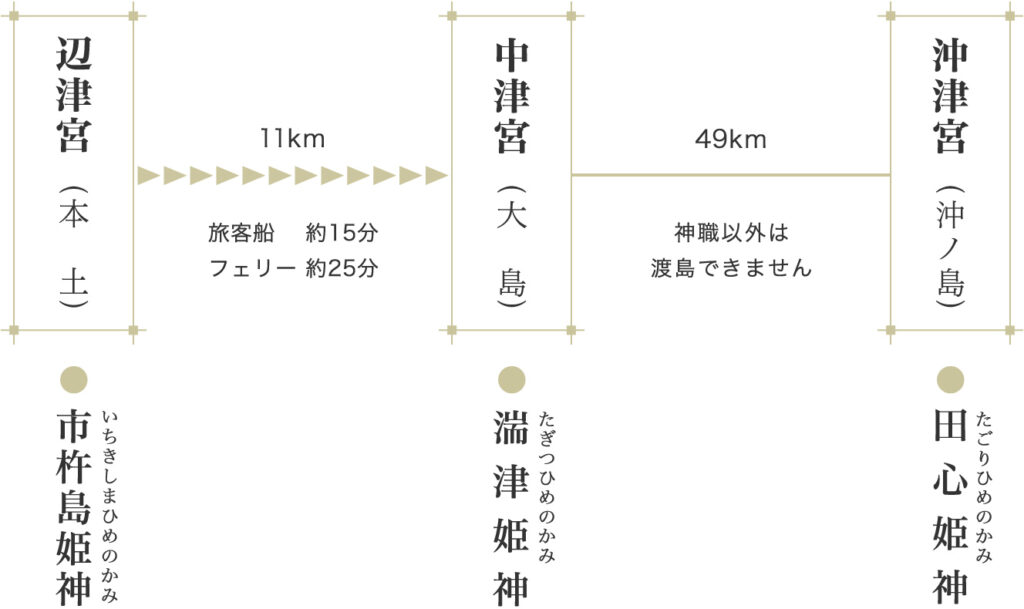
Each of the three sisters holds her own domain and is enshrined at a different location within the Munakata Grand Shrine complex in northern Fukuoka Prefecture — the original spiritual home of this divine trio.
Tagirihime (田心姫神), the eldest, is enshrined at Okinoshima, a remote and sacred island far out in the open sea. She governs the safety of vessels crossing the open ocean, and Okinoshima itself — now a UNESCO World Heritage Site — was the site of ancient offerings made by those seeking her protection on the most dangerous passages of all.
Tagitsuhime (湍津姫神), the middle sister, is enshrined on Oshima Island at Nakatsu-miya. She is associated with the power of water, governing rivers, rapids, and flowing streams, and is venerated as a guardian against water-related dangers and as a deity of purification.
Ichikishimahime (市杵島姫神), the youngest, is enshrined at the main sanctuary on the mainland at Hetsu-miya. Of the three sisters, she is perhaps the most widely recognized today. She is the patron of the arts, music, poetry, and learning — qualities that link her to the Buddhist goddess Benzaiten, with whom she became closely intertwined during Japan’s long era of religious syncretism. Her blessings are sought by artists, musicians, and anyone hoping to cultivate creativity and aesthetic refinement.
The Three Goddesses at Itsukushima Shrine
How the Goddesses Came to Miyajima
The three goddesses arrived on Miyajima from Munakata in northern Kyushu, carried westward as Japan’s political and cultural center gradually shifted from Kyushu to the Yamato region of central Honshu. Their migration reflected the expanding reach of the sea-deity tradition as maritime trade and political power became increasingly tied to the Seto Inland Sea corridor.
By 901 AD, the official chronicle Nihon Sandai Jitsuroku already recorded the shrine at Miyajima under a name explicitly linking it to the Munakata lineage — identifying it as a branch shrine of that ancient sea-deity tradition. This early historical record confirms that the goddesses had been venerated on Miyajima since at least the shrine’s founding in 593 AD, and that their worship spread far beyond their original homeland well before the Heian period.
At Itsukushima Shrine, the three goddesses are honored as deities of the sea and safe travel, as guardians of trade and commerce, and as patrons of the arts and creative skill. This broad spiritual portfolio reflects both the inherited Munakata tradition and the unique character that the shrine developed over centuries on the island of Miyajima.
Taira no Kiyomori and the Expansion of Their Worship
The devotion to the three goddesses reached a transformative peak during the late Heian period, when the powerful warlord and statesman Taira no Kiyomori became the shrine’s greatest patron. Kiyomori had built his extraordinary wealth and influence through control of the Seto Inland Sea — suppressing piracy, dominating the shipping trade, and conducting lucrative commerce with Song Dynasty China. For Kiyomori, the goddesses of Itsukushima were the divine forces behind his success, and he poured enormous resources into the shrine in gratitude.
It was under Kiyomori’s patronage that Itsukushima Shrine took on its current grand form — an elaborate, palace-like complex built over the sea. His devotion brought the shrine to national prominence and deepened the goddesses’ reputation beyond maritime safety alone. As the shrine became a center of aristocratic culture and artistic patronage under the Heian court, the goddesses’ identities expanded to encompass the arts, prosperity, and cultural refinement — qualities that have remained central to their worship ever since.
Ichikishimahime and the Buddhist Goddess Benzaiten
For many centuries, Japan’s native Shinto traditions and imported Buddhist teachings coexisted and intertwined in a practice known as shinbutsu-shūgō, or the blending of gods and Buddhas. Within this syncretic tradition, Ichikishimahime — the youngest of the three goddesses and the patron of arts and beauty — became closely identified with Benzaiten, the Buddhist goddess of music, eloquence, water, and good fortune.
At Miyajima, this union of goddess and bodhisattva was embodied in the close relationship between Itsukushima Shrine and the adjacent temple Daigan-ji, which together formed a vast sacred complex. The enshrined Benzaiten of Itsukushima was venerated alongside the three goddesses in a seamless blending of traditions.
This changed with the Meiji government’s 1868 order to separate Buddhism and Shinto. The Benzaiten deity was removed from the shrine grounds and relocated to Daigan-ji Temple, where she remains today. Daigan-ji is now recognized as one of Japan’s three great Benzaiten temples — a distinction that makes it well worth visiting when you explore Miyajima’s spiritual landscape. The historical bond between Ichikishimahime and Benzaiten still lingers in the cultural memory of the island, and both are worshipped within a short walk of each other to this day.
The Three Goddesses in the Modern Shrine
Today, the three goddesses continue to be worshipped at Itsukushima Shrine as living deities at the heart of one of Japan’s most visited sacred sites. Their spiritual portfolio — sea safety, safe travel, artistic inspiration, and prosperity — speaks as directly to modern visitors as it did to Heian-era aristocrats and medieval mariners.
A contemporary interpretation held by the shrine community is that the goddesses chose Miyajima as a gift to the world: a place of natural beauty and peace, where people from across Japan and around the globe might find rest and renewal. This reading aligns naturally with the island’s role as a place of exceptional scenic and spiritual beauty that draws millions of visitors each year.
The main hall (honden) enshrines not only the three goddesses but thirty additional deities alongside them, making Itsukushima Shrine one of the most densely sacred spaces in Japan. The hall itself is immense — with a floor area reportedly twice that of Izumo Taisha, one of Japan’s oldest and most revered grand shrines. The rituals performed within this vast sacred space carry on a tradition of devotion to the three goddesses that has continued unbroken for more than 1,400 years.
FAQ
Who are the three goddesses enshrined at Itsukushima Shrine?
The three goddesses are Ichikishimahime, Tagirihime, and Tagitsuhime — collectively known as the Munakata Three Goddesses. They are sea deities from Japanese mythology, born from a divine oath between the sun goddess Amaterasu and the storm god Susanoo, and have been worshipped at Itsukushima Shrine since its founding in 593 AD.
Why are they called sea goddesses?
In Japanese mythology, the three goddesses were specifically created to protect the sea routes between Japan and the Asian continent. From ancient times, they were invoked by sailors, traders, and anyone crossing open water, making maritime safety the foundation of their worship. That role has expanded over the centuries but remains central to their identity.
What is the difference between the three goddesses at Itsukushima and at Munakata Taisha?
At Munakata Taisha in Fukuoka — the original home of these goddesses — each of the three sisters is enshrined separately at a different location across three islands or sites. At Itsukushima Shrine on Miyajima, all three are enshrined together in a single main hall. The Miyajima tradition also places greater emphasis on the goddesses’ roles as patrons of the arts and commerce, reflecting the unique cultural history of the shrine.
What blessings are the goddesses associated with?
Sea safety and safe travel are the traditional blessings most closely associated with the three goddesses. At Itsukushima Shrine, their spiritual portfolio has broadened over the centuries to include artistic skill and creativity, commercial success and prosperity, and academic achievement. Ichikishimahime in particular — through her historic association with the Buddhist goddess Benzaiten — is especially popular among those seeking blessings for music, the arts, and creative endeavors.
What is the connection between Itsukushima Shrine and Daigan-ji Temple?
For much of their history, Itsukushima Shrine and the neighboring Daigan-ji Temple formed a unified sacred complex under the syncretic blending of Shinto and Buddhism. Ichikishimahime was identified with the Buddhist goddess Benzaiten, and the two traditions were worshipped together. After the Meiji government’s 1868 order to separate Buddhism and Shinto, the Benzaiten deity was relocated to Daigan-ji, where she is still enshrined today. Daigan-ji is now recognized as one of Japan’s three great Benzaiten temples.
When was Itsukushima Shrine founded?
According to tradition, Itsukushima Shrine was founded in 593 AD, the first year of Emperor Suiko’s reign. This places the origin of worship at Miyajima in the same era as Japan’s earliest contact with continental Buddhism and the formation of its early imperial state — making the shrine one of Japan’s most historically significant sacred sites.
Is it worth visiting Daigan-ji Temple when I’m at Miyajima?
Absolutely. Daigan-ji Temple sits just steps from Itsukushima Shrine and can easily be included in the same visit. As one of Japan’s three great Benzaiten temples and the historic keeper of the Benzaiten deity once enshrined alongside the three goddesses, it adds meaningful spiritual depth to your understanding of Miyajima’s sacred landscape. Most visitors walk past it without realizing its significance.
References
- Munakata Taisha Official Website: History and Origin
- Wikipedia (Japanese): Munakata Sanjoshin
- Wikipedia (Japanese): Itsukushima Shrine
- Wikipedia (Japanese): Ichikishimahime
- World Heritage “Sacred Island of Okinoshima”: The Munakata Goddesses and the Transmission of Faith
- Japanese Mythology and History: The Munakata Three Goddesses — Origins, Names, Roles, and Blessings
- Japanese Mythology and History: Ichikishimahime — Munakata Goddess and Deity of Itsukushima Shrine
- Miyajima Tourism Association: Daigan-ji Temple
- Wikipedia (Japanese): Daigan-ji Temple, Hatsukaichi
- Miyajima Tourism Association: Itsukushima Benzaiten Grand Festival
- Miyajima Town History Editorial Committee. Miyajima Town History: General History Volume. Miyajima Town, 1992.