
Why did one of Japan’s most dramatic battles unfold at the sacred site of Itsukushima Shrine on Miyajima Island? As you walk beneath the vermilion-lacquered corridors of this holy place, it’s natural to wonder how such a peaceful sanctuary became the stage for one of the Warring States period’s most decisive military engagements.
The Battle of Itsukushima erupted from a deadly power vacuum within the Ouchi clan and exploded into a decisive showdown between two ambitious warlords: Mori Motonari and Sue Harukata. This clash on October 1, 1555, wasn’t just another skirmish—it was a strategic masterpiece that would reshape the political landscape of western Japan. Understanding this pivotal moment in the Battle of Itsukushima adds profound depth to any visit to Miyajima, transforming your experience from simple sightseeing into a journey through the forces that shaped Japanese history.
The Road to Conflict: What Set the Stage for the Battle of Itsukushima
A Lord Betrayed: The Death of Ouchi Yoshitaka
To understand why the Battle of Itsukushima happened, we need to rewind four years to 1551 and a shocking act of betrayal known as the Tainei-ji Incident. Ouchi Yoshitaka, one of the most powerful feudal lords in the Chugoku region (the western part of Japan’s main island), met his end not on the battlefield but at the hands of his own trusted retainer.
Tō Takafusa—who would soon adopt the name Sue Harukata—orchestrated a coup that forced Yoshitaka to commit suicide. The reasons ran deep: after losing his eldest son, Ouchi Harumochi, the grieving lord had increasingly withdrawn from military affairs, focusing instead on cultural pursuits. This shift frustrated his more militaristic vassals, particularly Sue, who saw their lord’s changing priorities as weakness. After eliminating Yoshitaka, Sue installed a puppet ruler—Ouchi Yoshichika from the Otomo clan of Buzen—and effectively took control of the entire Ouchi domain, ruling through this figurehead while wielding real power himself.
Mori Motonari’s Impossible Choice
For Mori Motonari, the powerful local lord of Aki Province (part of present-day Hiroshima Prefecture), Sue’s coup created an unbearable situation. Motonari’s relationship with Ouchi Yoshitaka ran deep—the Ouchi lord had been his overlord for years, and their families were bound by marriage. Motonari’s eldest son, Takamoto, had wed Yoshitaka’s adopted daughter, cementing an alliance that went beyond mere political convenience.
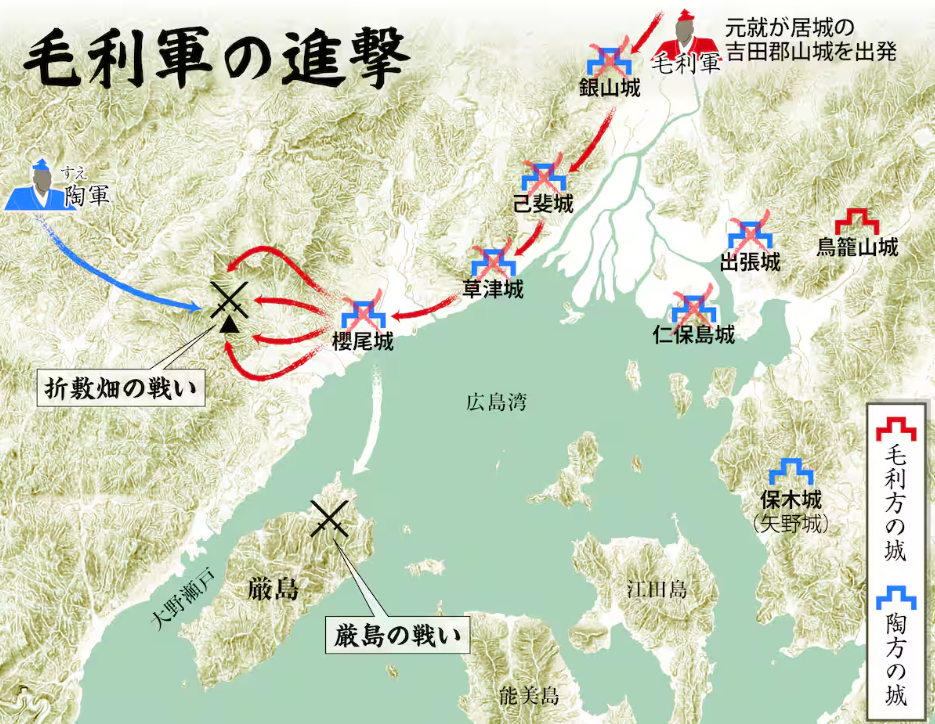
When Sue murdered Yoshitaka, Motonari faced a painful dilemma. Outwardly, he appeared to cooperate with the new regime, biding his time. But in May 1554, when a lord named Yoshimi Masayori of Iwami Province raised an army against Sue, Motonari made his move. He broke with Sue decisively, capturing four strategic castles including Sakurao Castle, and ultimately occupied Itsukushima itself. The die was cast—these two powerful men were now on an inevitable collision course toward the Battle of Itsukushima.
The Battle of Oshikibata: A Prelude to Greater Conflict
The tension between Motonari and Sue first erupted into open warfare in 1554 at the Battle of Oshikibata. Sue Koken (Sue Harukata’s name at that time) dispatched Miyagawa Fusacho with roughly 7,000 troops to crush Mori Motonari once and for all. What happened next would become legendary in Japanese military history.
Despite facing more than double his numbers—Motonari commanded only about 3,000 men—the Mori lord split his forces into multiple units and executed a series of devastating surprise attacks. In a single day, he routed Miyagawa’s army. This stunning victory accomplished two critical things: it established Motonari’s reputation as a brilliant tactician throughout the region, and it made clear to Sue Harukata that the Mori clan had become the primary obstacle to his ambitions of controlling the Chugoku region. The stage was now set for an even larger confrontation—the Battle of Itsukushima that would come the following year.
The Art of War: Tactical Brilliance at the Battle of Itsukushima
Setting the Perfect Trap
Mori Motonari faced a daunting challenge: Sue Harukata commanded vastly superior forces. A direct confrontation would be suicide. So Motonari devised one of the most ingenious strategies in Japanese military history—he would lure his enemy onto terrain where numbers meant nothing and turn Sue’s strength into his greatest weakness.
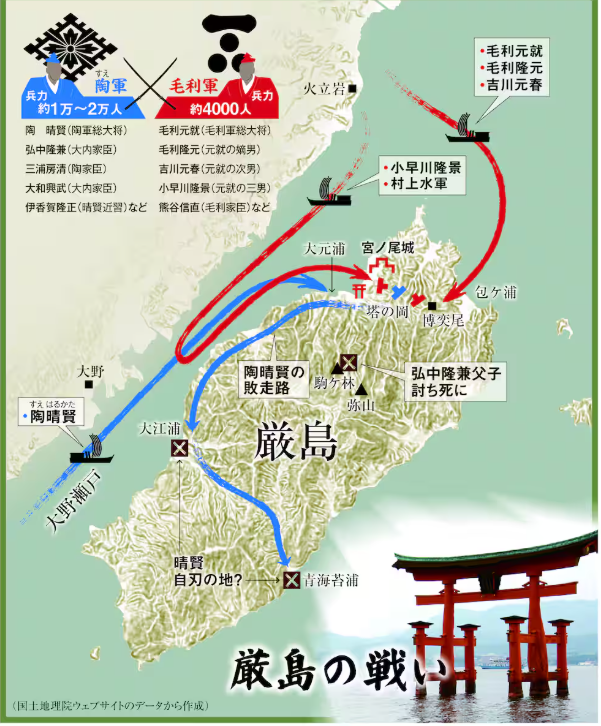
The key was Miyajima itself. Motonari deliberately constructed Miyao Castle on the island, creating an irresistible target that seemed vulnerable. Through carefully placed senior retainers he trusted, he spread the strategic suggestion through Sue’s intelligence networks: “The fastest way to defeat the Mori is to attack Itsukushima.” It was brilliant reverse psychology—make your enemy think your weakness is actually your strength.
Miyajima’s geography would do the rest. The island’s rugged coastline and limited flat areas made it nearly impossible to deploy large armies effectively. As an island, supply lines would be stretched thin and vulnerable. Most importantly, retreat would be difficult if things went wrong. Confident in his naval superiority and eager to crush the Mori, Sue Harukata took the bait. On September 21, 1555, his massive fleet—reportedly about 500 ships carrying approximately 20,000 troops—landed on Itsukushima, walking directly into Motonari’s carefully prepared trap.
Destroying the Enemy from Within
Among Motonari’s many strategic moves leading up to the Battle of Itsukushima, perhaps the most devastating was his campaign against Egara Fusae, one of Sue’s most capable senior retainers. When Motonari’s initial attempts to convince Egara to defect failed, he shifted to a more sinister approach: information warfare.
Motonari’s agents carefully planted rumors in Sue Harukata’s camp that “Egara Fusae is plotting rebellion.” These seeds of doubt took root in the suspicious atmosphere of Sue’s army. On March 16, 1555—months before the battle—Sue ordered Hironaka Takakane to execute Egara at Kohaku-in temple. The loss was catastrophic for Sue’s forces. Egara wasn’t just any retainer—he was an experienced commander with deep knowledge of Aki Province’s terrain and people. By eliminating one of his own best strategists based on planted misinformation, Sue had effectively defeated himself before the battle even began. The execution shattered morale and cohesion among Sue’s remaining commanders, creating internal divisions that would prove fatal during the Battle of Itsukushima.
Masters of the Sea: The Murakami Navy’s Decisive Role
No element was more crucial to Motonari’s victory at the Battle of Itsukushima than securing the cooperation of the Murakami naval forces, the legendary sea warriors who controlled the waters of the Seto Inland Sea. Without command of the sea around Miyajima, Motonari’s entire strategy would collapse.
Motonari brought the three main branches of the Murakami clan—Kijima, Noshima, and Inoshima—to his side through a combination of family ties and strategic interests. The key connection ran through Kobayakawa Takakage (Motonari’s son), whose adopted daughter had married into the Kijima Murakami clan. This marriage alliance, combined with shared interests in controlling the vital sea lanes of the Inland Sea, convinced the Murakami to throw their support behind the Mori.
Once committed, the Murakami naval forces transformed the battle. They established a naval blockade around Itsukushima, cutting off Sue’s supply lines and blocking any possibility of retreat. They also provided escort for Mori forces executing a daring night landing on the island, enabling the surprise attack that would shatter Sue’s army. In a battle fought on an island, control of the surrounding waters meant control of the outcome—and the Murakami gave Motonari that control.
A Battle That Changed Everything: The Impact of Itsukushima
The Battle of Itsukushima’s effects rippled far beyond the shores of Miyajima. For visitors interested in understanding Japanese history, this battle represents a crucial turning point—the moment when Mori Motonari transformed from a regional lord into one of the most powerful warlords of the Warring States period, setting in motion events that would reshape western Japan’s political landscape for generations.
Sue Harukata’s defeat was absolute and final. After his army’s collapse, he committed suicide at Oeura, and with him died the last remnants of Ouchi power. The Ouchi clan, which had dominated the region for decades, rapidly crumbled. Building on his triumph at Itsukushima, Motonari went on to defeat the rival Amago clan and emerged as the undisputed master of all ten provinces of the Chugoku region—an achievement that would have seemed impossible just a few years earlier.
But the battle’s significance extends beyond territorial gains. The Battle of Itsukushima demonstrated the power of psychological warfare, strategic deception, and intelligent use of terrain in ways that influenced military thinking throughout Japan. Motonari’s victory over vastly superior numbers through cunning and preparation earned the battle a place among the Three Great Surprise Attacks of the Warring States period, alongside the famous Battles of Kawagoe and Okehazama. His methods became studied examples of how intelligence, planning, and local knowledge could overcome raw military power—lessons that remain relevant today.
Lessons From Miyajima: What the Battle Means Today
The Battle of Itsukushima offers more than just a fascinating historical episode—it provides timeless insights that resonate in our modern world. Mori Motonari’s famous maxim, “Those who devise many plans win; those who devise few lose,” remains remarkably relevant to contemporary business strategy, crisis management, and competitive thinking. For travelers visiting Miyajima today, understanding this historical context transforms a walk through Itsukushima Shrine from a simple sightseeing experience into a profound journey through human strategy, determination, and the costs of ambition.
What happened after the battle reveals another dimension of Motonari’s character. Deeply troubled by having desecrated a sacred site with bloodshed, he ordered an extensive purification of Itsukushima Shrine. Workers washed the buildings and corridors with seawater and removed all blood-soaked earth from the grounds. This act of responsibility—taking personal ownership for restoring what his victory had tarnished—offers a powerful lesson in ethics and social duty that speaks across the centuries.
Today’s Miyajima, now designated a UNESCO World Cultural Heritage site, preserves the battlefield for modern visitors to explore. The island’s sacred landscape, the magnificent shrine, and the remains of wartime fortifications stand as reminders of the importance of protecting cultural heritage and passing historical understanding to future generations. When you visit, you’re walking through layers of history—ancient spirituality, medieval warfare, and centuries of careful preservation—all woven together on one extraordinary island.
Frequently Asked Questions
What was the most direct cause of the Battle of Itsukushima?
The immediate trigger was the violent power struggle that followed Ouchi Yoshitaka’s death in 1551. When Sue Harukata murdered his lord, Mori Motonari—who was bound to Yoshitaka through both political alliance and family marriage—refused to accept Sue’s authority. What began as resentment over betrayed loyalty escalated into an all-out fight for supremacy over the entire Chugoku region, culminating in the Battle of Itsukushima four years later.
Why did Mori Motonari choose to fight such a risky battle?
Motonari faced an unavoidable crisis with no safe options. Sue Harukata’s army vastly outnumbered his own forces—waiting passively or fighting conventionally would almost certainly mean the destruction of the Mori clan. Motonari’s genius was recognizing that he could turn his weakness into strength by choosing the battlefield. By luring Sue to Itsukushima, where the terrain and naval conditions favored the smaller, more agile Mori forces, and then executing a perfectly timed surprise attack, Motonari transformed what seemed like a suicide mission into a brilliant victory.
Why was Itsukushima chosen as the battlefield?
Miyajima offered unique natural advantages that could neutralize Sue’s numerical superiority. As an island with limited flat terrain, it prevented Sue from deploying his large army effectively. The rugged coastline made landing and supply operations difficult. Most crucially, with the Murakami navy’s support, the Mori could control the surrounding waters, cutting off Sue’s supply lines and blocking his retreat. For Motonari, Itsukushima was the one place where superior strategy could overcome superior numbers—making it not just a good choice, but perhaps the only viable option for victory.
How did the death of Egara Fusae affect the battle?
Egara Fusae’s execution was a devastating self-inflicted wound for Sue’s army. As one of Sue’s most capable commanders with extensive knowledge of Aki Province and its people, Egara would have been invaluable in the campaign against Motonari. By falling for Motonari’s information warfare and killing Egara based on planted rumors of rebellion, Sue eliminated one of his own best strategic assets. The purge also shattered trust and cohesion among Sue’s remaining commanders, creating internal divisions and paranoia that undermined their effectiveness during the Battle of Itsukushima.
Why did the Murakami naval forces cooperate with the Mori clan?
The alliance rested on both family connections and shared strategic interests. The head of the Kijima branch of the Murakami clan was married to the adopted daughter of Kobayakawa Takakage, who was Mori Motonari’s son—creating a direct family bond between the two clans. Beyond personal ties, the Murakami and Mori shared common interests in controlling the vital shipping lanes of the Seto Inland Sea. Supporting the Mori against Sue Harukata aligned with the Murakami’s own strategic goals for regional influence, making cooperation beneficial for both sides.
How did this battle impact the broader course of Japanese history?
The Battle of Itsukushima fundamentally reshaped the balance of power during Japan’s Warring States period. The Mori clan’s rise to dominance over the entire Chugoku region created a new power center in western Japan that would play crucial roles in later conflicts, including the pivotal events leading to the Battle of Sekigahara in 1600. Beyond territorial changes, the battle demonstrated the decisive importance of intelligence gathering, psychological warfare, and terrain selection in military strategy—principles that influenced how other warlords throughout Japan approached warfare. Motonari’s victory showed that careful planning and strategic thinking could overcome even overwhelming odds, a lesson that resonated throughout the remainder of the Warring States period.
Can you see traces of the battle when visiting Miyajima today?
Absolutely! Miyajima preserves numerous historic sites directly connected to the Battle of Itsukushima that visitors can explore today. Tower Hill (near the iconic Five-Story Pagoda) marks where Motonari established his command post during the battle. Hakegaura on the island’s coast is where Mori forces made their crucial night landing. The remains of Miyao Castle—the deliberately vulnerable fortress Motonari built to lure Sue into the trap—still exist. Throughout the island, you’ll find informational signboards placed by the Miyajima Tourist Association that help visitors trace the battle’s progression. As you walk through Itsukushima Shrine and explore the island, you’re literally following in the footsteps of one of Japan’s most brilliant military campaigns.
Summary
The Battle of Itsukushima emerged from a toxic combination of betrayal, ambition, and unavoidable conflict. What began with Sue Harukata’s murder of his lord, Ouchi Yoshitaka, escalated into a decisive showdown between two of the Warring States period’s most formidable warlords. Through masterful use of deception, terrain, naval power, and psychological warfare, Mori Motonari achieved what seemed impossible—defeating an enemy that outnumbered him nearly three to one.
This victory did more than secure Motonari’s survival; it catapulted him to dominance over western Japan and fundamentally altered the political landscape of the Warring States period. The battle stands as a testament to the power of strategic thinking, careful planning, and the intelligent use of local advantages. Today, understanding the Battle of Itsukushima adds profound depth to any visit to Miyajima, transforming the island’s sacred beauty into a living lesson about courage, strategy, and the forces that shaped Japan’s history.
References and Sources
- Wikipedia: Battle of Itsukushima
- Wikipedia: Tainei-ji Incident
- Wikipedia: Mōri Motonari
- Wikipedia: Ōuchi Yoshitaka
- Wikipedia: Murakami Suigun (Murakami Navy)
- Wikipedia: Battle of Oshikibata
- Sengoku History: Battle of Itsukushima (1555) – A Triumphant Surprise Attack That Led to Motonari’s Rise
- Sengoku History: Tainei-ji Incident (1551) – Sue Takafusa’s Coup Against Lord Ōuchi Yoshitaka
- Sengoku History: Battle of Oshikibata (1554) – Motonari’s Victory Before Breaking with Sue Harukata
- Rekishi-jin: The Fierce Naval Battle of Itsukushima – Victory Through Murakami Navy Tactics
- Busho Japan: Mōri Forces’ Surprise Attack at Itsukushima – Motonari Defeats Sue Harukata to Become Hegemon of Chūgoku Region
- Owada Tetsuo, “Mōri Motonari,” Chūōkōron-Shinsha, 2002
- Kawamura Shōichi, “Battle of Itsukushima,” Yōsensha, 2018
- Yamada Kuniaki, “Crisis Management of Sengoku Daimyō,” Kadokawa Sensho, 2009