
Itsukushima Shrine sits not on land, but directly over the tidal waters of the Seto Inland Sea — and that choice was no accident. For over a thousand years, the island of Miyajima has been considered so sacred that ordinary people were forbidden from setting foot on its soil. That deep sense of reverence, combined with the ambitions of one of Japan’s most powerful warlords, gave rise to one of the most breathtaking architectural achievements in the world: a shrine built over the sea itself.
If you’ve ever looked out at Itsukushima Shrine and wondered why it was built over water, the answer reaches back to the very origins of Japanese religious belief — and to a moment in the twelfth century when art, faith, and political power came together in spectacular fashion.
Why Was Itsukushima Shrine Built Over the Sea?
An Island Too Sacred to Walk On
Long before Itsukushima Shrine took the form we see today, Miyajima was already a place apart. The name “Itsukushima” itself carries the meaning of “island consecrated to the gods,” and the island was venerated as a divine realm in its entirety — not just a place where a shrine happened to stand, but a living sacred territory.
In the centuries before the Heian period, Miyajima was believed to be home to the deities who protected seafarers crossing the Seto Inland Sea. For the ancient people of this region, the island was too holy to approach directly. Setting foot on its soil was considered an act of profound irreverence. Instead, worshippers would approach by boat and offer prayers from the water — a practice known as yōhai, or distant worship. This tradition of sea-based veneration became the spiritual foundation upon which the entire shrine complex would eventually be built.
Archaeological evidence supports what the traditions have long preserved. Ancient ritual sites discovered on the island confirm that Miyajima functioned as a unified sacred precinct from very early times. Its geography — a mountainous, forested island encircled by sea — only deepened its character as a realm separated from the ordinary human world.
Taira no Kiyomori and the Vision of a Shrine at Sea
The grand shrine complex that visitors see today was commissioned in 1168 (the third year of the Nin’an era) by Taira no Kiyomori, the most powerful military leader of his age. Kiyomori served as the governor of Aki Province, which included the Miyajima area, and when he visited the island he was struck by its mysterious beauty and the depth of faith surrounding it. He resolved to rebuild the modest existing shrine into something that had never been attempted before.
Kiyomori’s motivations were both spiritual and strategic. The Taira clan had built much of its power through control of the Seto Inland Sea, dominating maritime trade and military movement across these waters. For Kiyomori, securing the blessing of Itsukushima’s gods — deities associated with the sea, storms, and safe passage — was not merely a matter of personal devotion. It was essential to the Taira’s continued dominance.
His architectural solution was extraordinary. Drawing on the elegant shinden-zukuri residential style of the Kyoto aristocracy, Kiyomori adapted those refined techniques to an ocean setting, designing a complex of shrine buildings, corridors, and gate structures that would appear to float on the surface of the water at high tide. The result was a sacred space unlike anything that existed before — a place where the boundary between the human world and the world of the gods seemed to dissolve with the rising and falling of the tide.
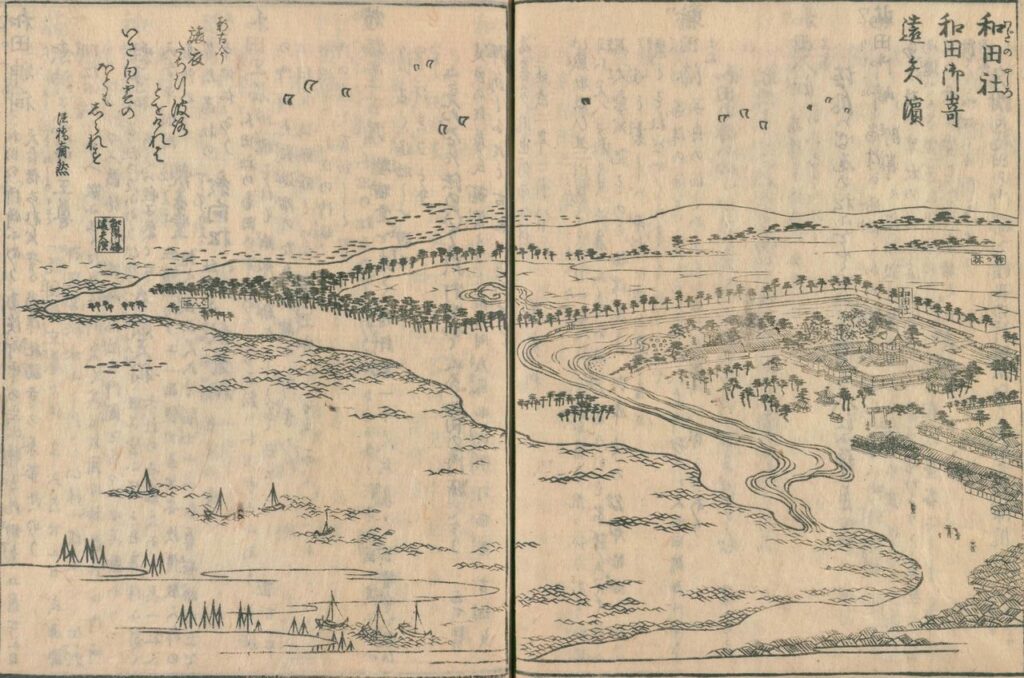
Engineering a Shrine That Stands in the Sea
Building for the Tides
The most impressive aspect of Itsukushima Shrine — beyond its beauty — is that it has endured for nearly nine centuries in one of the most demanding environments imaginable. The Seto Inland Sea experiences tidal fluctuations of up to four meters, and the shrine is fully exposed to the sea’s seasonal storms and high waves. Keeping a complex wooden structure standing in these conditions required engineering solutions that were genuinely revolutionary for their time.
The supporting pillars, made from camphor wood, were driven deep into the seabed and designed to flex under the pressure of water and waves rather than resist them rigidly. Connecting each pillar to its neighbors are horizontal beams called nuki, which distribute stress across the entire structure and allow the buildings to move as a unified whole rather than suffer isolated damage. This flexible approach to marine construction proved far more effective than any rigid foundation could have been.
The floorboards of the walkways and corridors were deliberately laid with gaps between them. When large waves surge beneath the buildings, the water can pass upward through the floor and dissipate harmlessly rather than building pressure against the structure from below. Even the roof tiles are fixed using specialized techniques designed to resist the powerful coastal winds. Every element of the construction reflects a sophisticated understanding of how to coexist with natural forces rather than simply fight against them.
The Corridors and the Experience of Walking on Water
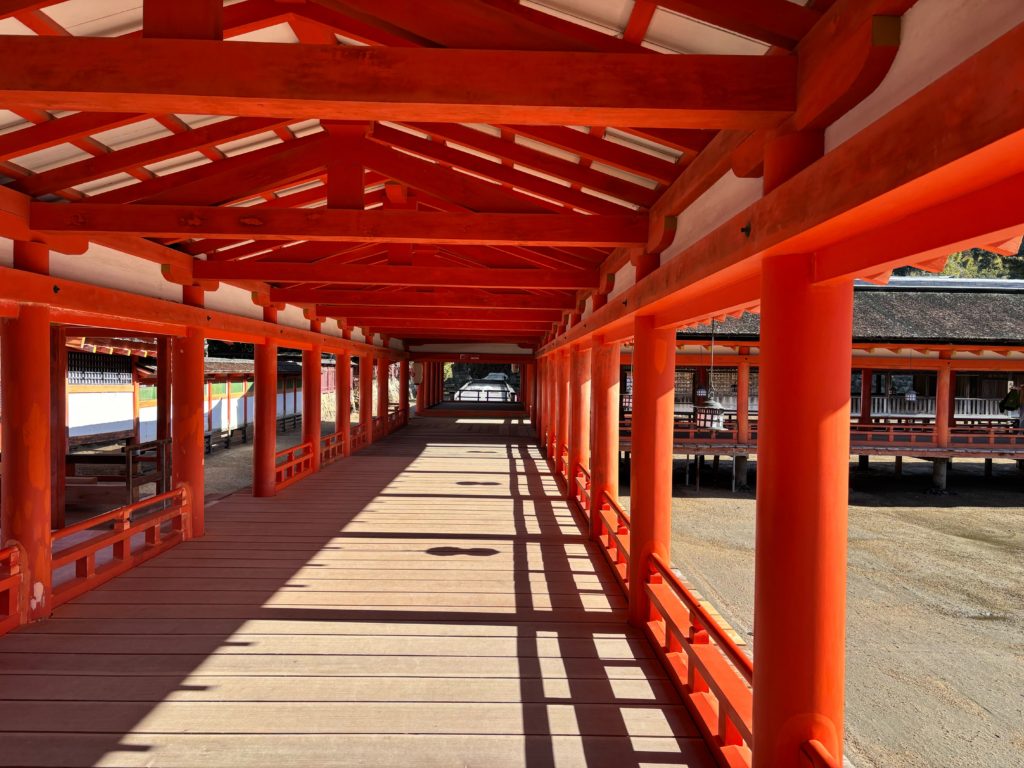
The covered corridors connecting the various buildings of Itsukushima Shrine stretch for approximately 280 meters, arranged symmetrically around the main hall. At high tide, these vermilion-painted walkways appear to skim the surface of the water, resembling a floating bridge connecting the mortal world to a divine one. At low tide, the seabed is exposed, and visitors can walk directly beneath the shrine structures along a very different kind of path — giving the site a dual character that changes entirely depending on when you visit.
The height of the corridors above the waterline was calculated precisely against tidal patterns so that the walkways remain accessible even at the highest tides, while still achieving the visual effect of floating when the water rises. The choice of materials throughout — camphor, cypress, and cedar, all selected for their resistance to salt water and humidity — reflects not just practical wisdom but a commitment to maintaining the shrine’s beauty across centuries of continuous use.
The visual effect of the entire complex — the deep red of the lacquered pillars, the blue-green patina of the copper roofs, the grey-green of the sea and sky — earned the shrine the poetic nickname of “the palace of the dragon king rising from the sea.”
The Cultural Legacy of a Shrine Built Over the Sea
Itsukushima Shrine’s placement over water was revolutionary in the history of Japanese religious architecture. Prior to Kiyomori’s construction, shrines were overwhelmingly built on land — on mountainsides, inside forests, or at the edges of rivers. Creating a sacred space within a dynamic marine environment was an entirely new idea, and its influence rippled outward across Japanese culture for centuries.
The shrine quickly became a center of aristocratic cultural life as well as religious devotion. The Taira clan and their noble associates would make ceremonial pilgrimages by boat, and these visits were as much cultural events as acts of worship — featuring elegant performances of gagaku court music played on the water, recitations of poetry, and the presentation of lavishly decorated scrolls of Buddhist sutras. The famous Heike Nōkyō, a set of ornately decorated sutras donated by the Taira clan, survives today as one of the great treasures of the shrine and a testament to the extraordinary cultural investment they made here.
As the centuries passed, the fame of Itsukushima’s sea-born architecture inspired the construction of shrines on or near water across Japan. The worship of Itsukushima’s deities — traditionally associated with maritime safety — also spread widely, and hundreds of branch shrines were established along the coastlines and islands of the Seto Inland Sea and beyond.
The shrine survived major historical upheavals intact: the patronage of the Mōri clan during the Sengoku period, the stewardship of the Asano domain during the Edo period, and the disruptions of the Meiji government’s separation of Buddhism and Shinto in the nineteenth century. Through all of this, the essential structure and spiritual character of the sea-borne shrine were preserved. In 1996, UNESCO’s designation of Itsukushima Shrine as a World Heritage Site gave international recognition to what Japan had long understood: this is a monument of universal human value.

What the Shrine Teaches the Modern World
It might seem surprising that a medieval Japanese shrine has anything to say to contemporary architecture and environmental science — but Itsukushima Shrine has become a touchstone for exactly those conversations.
As rising sea levels and increasingly severe storms put coastal structures around the world at risk, the shrine stands as a nearly thousand-year demonstration of what it means to build with the sea rather than against it. Its flexible construction principles, its use of naturally resilient materials, and its deliberate design allowing water to pass through the structure rather than assault it are all approaches that modern engineers study with genuine interest.
There is also the ecological dimension. The shrine’s pillars and substructure have functioned for centuries as an artificial reef, providing habitat for fish and supporting the growth of seaweed and marine life. Far from damaging the marine environment, the shrine appears to have enriched it — an early example of what contemporary designers would call a symbiotic relationship between human construction and natural ecosystems.
Perhaps most powerfully, Itsukushima Shrine reminds its visitors — more than four million of whom come each year — of something easily lost in the modern world: that the natural world is not merely a backdrop for human activity, but a living presence worthy of reverence. The way the shrine changes with every tide, never looking quite the same twice, makes that message impossible to ignore.
Summary
Itsukushima Shrine was built over the sea because the island of Miyajima itself was too sacred to walk upon. Ancient reverence for the island as a divine realm, combined with Taira no Kiyomori’s vision of a floating sacred city, produced an architectural masterpiece that has endured for nearly nine centuries. Its innovative construction techniques allowed it to coexist with the tides and storms of the Seto Inland Sea, its cultural influence shaped Japanese religious architecture for generations, and its UNESCO World Heritage designation confirmed what visitors have always felt standing before it: this is one of the most extraordinary places human beings have ever built.
FAQ
Why was Itsukushima Shrine built over the water instead of on land?
The island of Miyajima was considered so sacred in ancient times that people believed setting foot on its soil was an act of disrespect toward the gods. Worshippers would approach by boat and pray from the sea. When Taira no Kiyomori rebuilt the shrine in 1168, he honored this tradition by constructing the shrine buildings and corridors directly over the tidal waters, preserving the idea that the island itself should remain untouched.
Who built Itsukushima Shrine in its current form?
The grand sea-borne complex that visitors see today was commissioned by Taira no Kiyomori in 1168. Kiyomori was the most powerful military leader in Japan at the time, and the shrine served both as an act of devotion and as a symbol of the Taira clan’s dominance over the Seto Inland Sea.
How has the shrine survived storms and tides for nearly 900 years?
The shrine was built using remarkably sophisticated marine engineering. Deep camphor-wood pillars flex under water pressure, horizontal beams distribute stress across the entire structure, and the floorboards are intentionally gapped to let wave water pass upward harmlessly rather than build destructive pressure. The materials — camphor, cypress, and cedar — were also chosen for their natural resistance to salt water.
Does the shrine look different at high tide versus low tide?
Yes, dramatically so. At high tide, the shrine buildings and corridors appear to float on the surface of the sea, and the famous Great Torii Gate seems to rise directly from the water. At low tide, the seabed is exposed and visitors can walk out to the base of the torii on foot. Both experiences are memorable, and many visitors try to time their visit to see both.
When was Itsukushima Shrine designated a UNESCO World Heritage Site?
Itsukushima Shrine, along with the surrounding natural landscape of Miyajima, was inscribed on the UNESCO World Heritage List in 1996. The designation recognized both the outstanding universal value of the shrine’s architecture and its remarkable harmony with the natural environment of the island.
Is the shrine still maintained using traditional building techniques?
Yes. The shrine undergoes regular repair and maintenance work using traditional materials and methods, consistent with its centuries-long history. This ongoing cycle of renewal is itself part of the shrine’s cultural heritage, and it is one reason the complex has survived so well despite its challenging marine environment.
How many visitors does Itsukushima Shrine receive each year?
Itsukushima Shrine attracts more than four million visitors and worshippers each year, making it one of the most visited cultural and religious sites in Japan. It is considered one of the three most scenic views in Japan — a designation known as Nihon Sankei — alongside Amanohashidate and Matsushima.
References and Sources
- Agency for Cultural Affairs — Cultural Heritage Online: Itsukushima Shrine (World Heritage)
- Agency for Cultural Affairs — National Cultural Properties Database: Itsukushima Shrine Main Hall, Offering Hall, Worship Hall
- Miyajima Tourism Association: World Cultural Heritage Registration
- Miyajima Tourism Association: Itsukushima Shrine
- Itsukushima Shrine Official Website
- Hiroshima Culture Encyclopedia: The Taira Clan and Itsukushima Culture
- Hatsukaichi City Official Tourism Site: World Heritage Itsukushima Shrine
- Wikipedia: Itsukushima Shrine
- Miyajima Town History Editorial Committee, Miyajima Town History: General History Volume, Miyajima Town, 1992.
- Fukuyama Toshio, The Architecture of Itsukushima Shrine, Chūō Kōron Bijutsu Shuppan, 1988.