
Miyajima has two high tides and two low tides on most days, roughly six hours apart. You can walk out to the Great Torii when the tide is 100 cm or lower, and Itsukushima Shrine appears to float when it reaches 250 cm or higher. Choose your date in the tide schedule below to see that day’s high and low tide times and the hours when you can walk to the torii or see the floating shrine. It uses Japan Meteorological Agency predictions for 2026 and 2027.
When is the best time to see Itsukushima Shrine floating on the water? Can you really walk out to the Great Torii Gate? These are the most common questions visitors ask before coming to Miyajima. The answer to both depends entirely on the tides—and understanding them can transform a good trip into an unforgettable one.
Miyajima’s tides are the key to experiencing everything this island has to offer. The Seto Inland Sea rises and falls twice daily, with water levels varying by up to 3 meters (about 10 feet) during spring tides. This dramatic tidal range is exactly what the 12th-century architect Taira no Kiyomori had in mind when he designed a shrine that would appear to float on the sea—a vision that still captivates visitors over 800 years later.

Miyajima tide schedule: high and low tide times by date
Levels are for Hiroshima (station Q8); the chart datum is 200.0 cm below mean sea level. Tides at Miyajima run slightly earlier than at Hiroshima Port.
All times are Japan time (JST). The 100 cm and 250 cm guides are explained on this page.
How Tides Work in the Seto Inland Sea
The Science Behind the Tides
Tides are primarily caused by the moon’s gravitational pull on Earth’s oceans. As the Earth rotates, the moon’s gravity creates a bulge of water on the side facing the moon, while centrifugal force creates another bulge on the opposite side. The sun also affects tides, though its influence is about half as strong as the moon’s.
The Seto Inland Sea is a long, narrow body of water connected to the Pacific Ocean through the Bungo Channel, Kii Channel, and Kanmon Straits. This unique geography causes tidal waves to interact in complex ways, creating significant variations in water levels across the region. Near Miyajima, these conditions produce tidal swings of up to 3 meters during spring tides—perfect conditions for the shrine’s dramatic transformations.
Spring Tides, Neap Tides, and Everything In Between
During new moons and full moons, the sun, moon, and Earth align, combining their gravitational forces to create spring tides—the highest highs and lowest lows of the tidal cycle. During quarter moons, the sun and moon are at right angles to Earth, partially canceling each other out and producing neap tides with much smaller variations.
For Miyajima visitors, spring tides offer the best of both worlds in a single day: a shrine floating majestically on the sea at high tide, and dry sand all the way to the torii gate at low tide.
The Magic Numbers: 100cm and 250cm
What These Tide Levels Mean for Your Visit
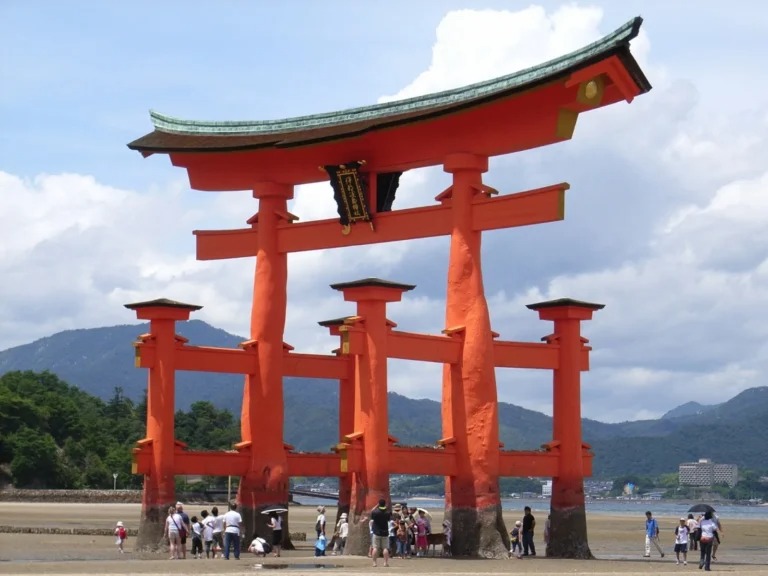
Two numbers matter most when planning your Miyajima itinerary: 100cm and 250cm. When the tide drops below 100cm, the sandy flats emerge and you can walk right up to the base of the Great Torii Gate. When the tide rises above 250cm, seawater floods beneath the shrine buildings, creating that iconic floating appearance.
These measurements use Hiroshima Port as a reference point, and actual conditions at Miyajima may arrive slightly earlier. Always check both the time and the water level on tide charts—a “high tide” that only reaches 200cm won’t give you the floating shrine effect, and a “low tide” at 150cm will still leave too much water to walk to the torii.
How to Read a Miyajima Tide Chart
The Miyajima Tourism Association publishes annual tide tables showing hourly water levels from 6am to 11pm. These charts include the tide type (spring, neap, or moderate) along with specific water level predictions. Start by checking your travel date’s tide type, then identify the time windows when levels drop below 100cm or rise above 250cm.
Want to understand why the shrine appears to float? Learn more about the visual effect:
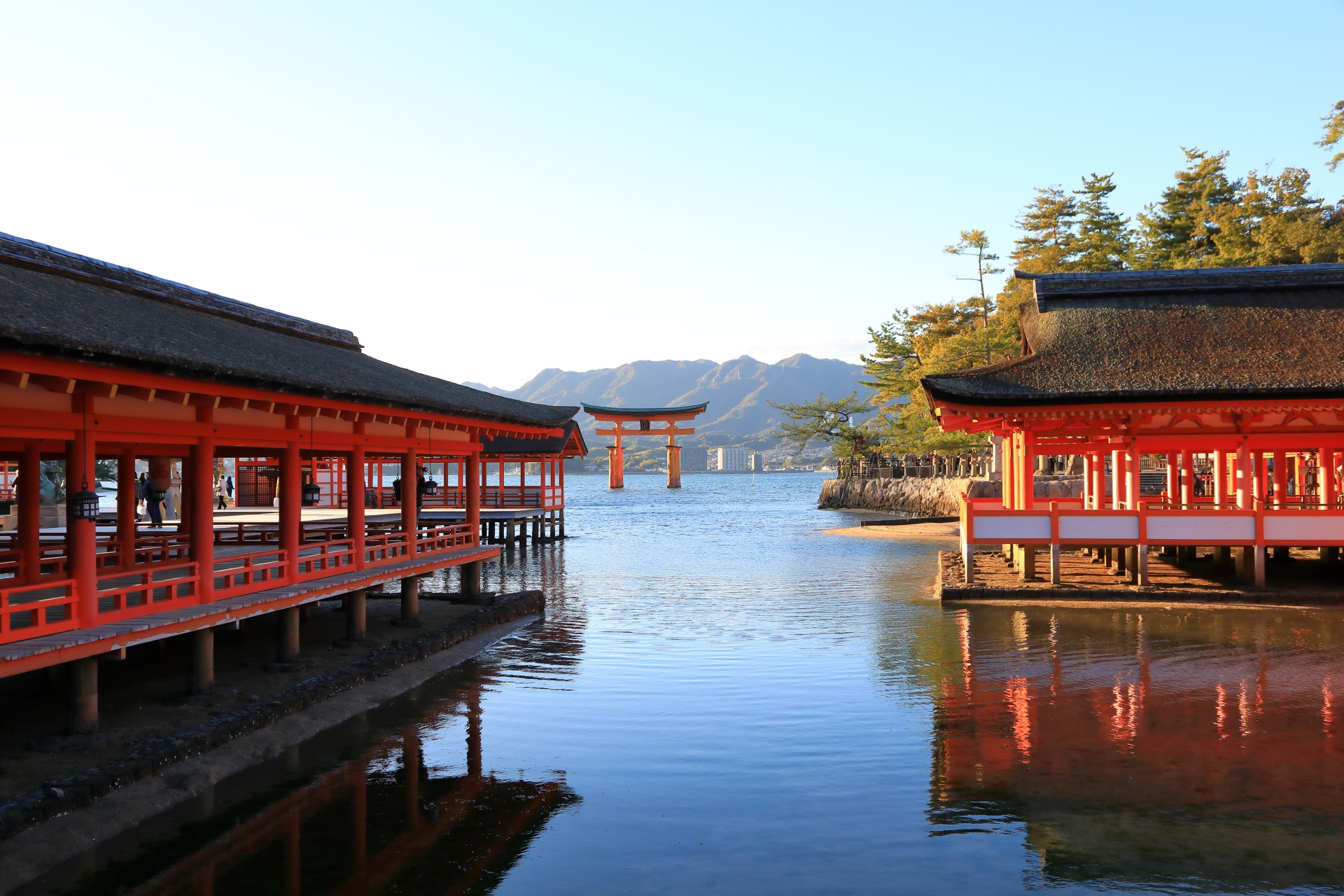
Many visitors wonder why the shrine seems to hover above the water. The mystical sight at high tide is the result of ingenious design combining human craftsmanship with natural forces…
High Tide vs. Low Tide: Two Different Experiences
High Tide: The Floating Shrine Experience
When water levels exceed 250cm, Itsukushima Shrine transforms into something resembling a mythical palace rising from the sea. The vermilion buildings reflect on the blue water, and walking along the covered corridors feels like strolling just above the waves. During the highest spring tides, seawater can rise to within inches of the corridor floorboards—a dramatic demonstration of how precisely the shrine was engineered to coexist with the sea.
High tide is also when you can take a rokai boat ride, a traditional sculling boat that passes directly beneath the Great Torii Gate. These small vessels, propelled by a single oar, offer a perspective impossible at any other time. Evening cruises are particularly popular, with larger boats offering views of the illuminated shrine and torii glowing against the night sky. Times, fares and booking for the night cruise are in Miyajima at night.
Low Tide: Walk to the Torii Gate
When the tide drops below 100cm, an entirely different Miyajima reveals itself. The sandy seafloor emerges, allowing visitors to walk across what was recently underwater all the way to the Great Torii Gate. Standing at its base, you can appreciate the true scale of this 16.6-meter (54-foot) structure and examine its remarkable construction: the massive camphor wood pillars aren’t buried in the ground at all—they stand on their own weight alone.
Low tide also reveals the Mirror Pools (Kagami no Ike), three freshwater springs within the shrine grounds that never run dry regardless of the surrounding saltwater. Counted among the Eight Scenic Views of Itsukushima, these mysterious pools only appear when the tide recedes—a hidden treasure for those who time their visit right.

Engineering Genius: How the Shrine Survives the Tides
Itsukushima Shrine’s architecture represents one of the world’s most innovative solutions for building in a tidal environment. The corridor floors feature narrow gaps called mesukashi that allow water pressure to escape during high tides rather than pushing against the structure. The main stage platform goes even further—its floorboards aren’t nailed down at all, designed to lift away during extreme waves rather than resist and break.
Equally impressive is the netsugi repair technique that has kept these buildings standing for over 800 years. When saltwater rots the base of a pillar, carpenters cut away only the damaged section and splice in new wood, avoiding the need to rebuild entire structures. This traditional maintenance method continues today, ensuring that the UNESCO World Heritage Site remains both authentic and structurally sound for future generations.
FAQ
How many high tides and low tides are there each day?
Miyajima experiences two high tides and two low tides approximately every 24 hours. High and low tides alternate roughly every 6 hours, with the complete cycle (high to high) taking about 12 hours and 25 minutes. Because of the moon’s orbit, tide times shift later by about 50 minutes each day.
How do I know when spring tides occur?
Spring tides happen around new moons and full moons—check any lunar calendar or the Miyajima Tourism Association’s annual tide tables. In the Miyajima Tourism Association’s annual tide table, the “tide type” column shows whether each day is a spring, middle or neap tide.
Does the tide need to be exactly 100cm to walk to the torii gate?
The Miyajima Tourism Association says you can walk to the Grand Torii when the tide level drops below 100cm. What matters is not whether it is low tide, but whether the level goes below 100cm that day. On days when it doesn’t, you can get close to the torii by rowboat (rokaibune) during the day or by sightseeing boat at night (Miyajima Tourism Association).
Are the tide chart times accurate for Miyajima?
Tide tables typically show predictions for Hiroshima Port, and actual conditions at Miyajima may arrive slightly earlier. Weather conditions can also cause minor variations. Build some buffer time into your plans rather than cutting it close.
Can I see both high tide and low tide in one day?
Absolutely. With roughly 6 hours between tidal extremes, you can easily experience the floating shrine in the morning and walk to the torii gate in the afternoon (or vice versa). Fill the time in between with Miyajima’s temples, hiking trails, local food, and shops—there’s plenty to do while waiting for the tide to turn.
Is visiting during neap tides a bad idea?
Not at all. Neap tides offer a different experience—less dramatic changes but more time to enjoy middle-range water levels. You’ll miss the extremes, but you’ll also likely encounter fewer crowds, since many visitors specifically target spring tide dates. The shrine is beautiful regardless of tide conditions.
What’s the best time of year for tides at Miyajima?
Any spring tide period offers excellent conditions. Summer visits combine good tides with long daylight hours, while winter brings fewer tourists and crisp views of the shrine against clear skies.
Plan Your Visit Around the Tides
Miyajima’s tides aren’t just a quirk of nature—they’re fundamental to experiencing this island the way it was meant to be seen. The shrine floating at high tide when levels exceed 250cm, the walk to the torii gate when waters drop below 100cm: these aren’t competing experiences but two halves of a complete Miyajima visit.
Check the tide tables before you go, and if possible, plan for a full day on the island so you can witness both transformations. Staying one night on the island makes that much easier; see where to stay in Miyajima. For over 800 years, Itsukushima Shrine has risen and fallen with the sea twice daily—a rhythm that continues today and connects every visitor to centuries of pilgrims who stood on the same shores, watching the same eternal dance between architecture and ocean.