
Imagine the sound of ancient court music drifting across the Seto Inland Sea on a summer night. This is the Kangensai Festival—a magnificent boat ritual held annually at Itsukushima Shrine on Miyajima Island, continuing a tradition that dates back to the Heian period nearly 900 years ago.
Kangensai is Itsukushima Shrine’s grandest ceremony, originating when the powerful warlord Taira no Kiyomori transformed aristocratic musical entertainment into a sacred Shinto ritual. Ornately decorated ceremonial boats glide across the moonlit sea while musicians perform gagaku (ancient Japanese court music)—a scene straight from a Heian-era scroll painting. Ranked among Japan’s Three Great Boat Festivals alongside Osaka’s Tenjin Matsuri and Matsue’s Horan-Enya, Kangensai continues to captivate visitors from around the world.
The Historical Origins of Kangensai
Taira no Kiyomori Brings Heian Court Culture to Miyajima
The origins of Kangensai trace back to 1146, when Taira no Kiyomori was appointed governor of Aki Province. In the capital of Kyoto, aristocrats enjoyed an elegant pastime called “kangen no asobi”—floating on boats across ponds and rivers while musicians performed gagaku. This sophisticated entertainment featured an ensemble of three wind instruments (flute, shō mouth organ, and hichiriki reed pipe), three percussion instruments (taiko drum, kakko drum, and shōko gong), and three stringed instruments (wagon zither, biwa lute, and sō koto).
Kiyomori’s deep devotion to Itsukushima Shrine inspired him to transplant this refined court tradition to Miyajima—but with dramatic changes. Instead of calm ponds, he chose the vast Seto Inland Sea as the stage. Instead of casual entertainment, he transformed it into a solemn religious ceremony to honor the gods. Through Kiyomori’s vision, what was once aristocratic amusement became a sacred Shinto ritual.
Evolution from the Heian to Kamakura Periods
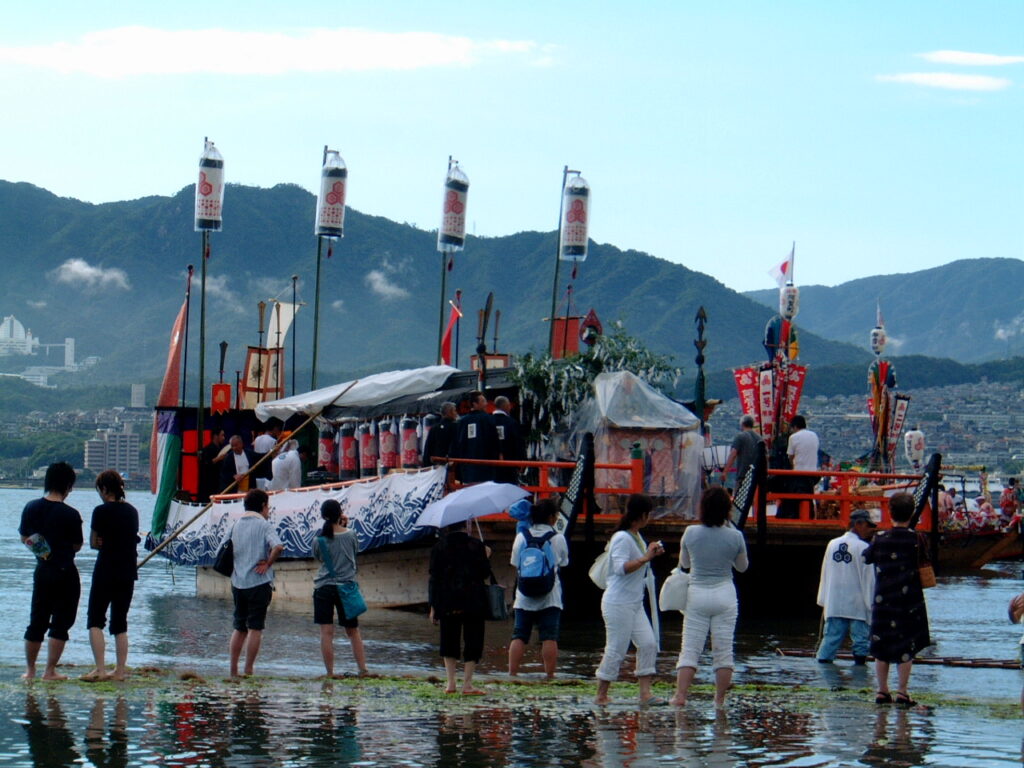
During the Heian period, the entire island of Miyajima was considered sacred ground where no humans could reside. Priests who conducted rituals lived on the mainland at Jigozen and traveled by boat to perform ceremonies. When rough weather prevented sea crossings, a secondary shrine at Jigozen served as an alternate venue.
This historical arrangement explains why the ceremonial boat visits Jigozen Shrine during Kangensai—it’s a ritual journey retracing the ancient connection between the mainland shrine and the island sanctuary. After the Kamakura period, when permanent residents began living on the island, the festival took its current form: departing from Itsukushima Shrine, visiting Jigozen Shrine, then returning home. This evolution marks a significant turning point in Miyajima’s history.
The Ceremonial Boat: Design and Significance
One of Japan’s Three Great Boat Festivals
Kangensai ranks among Japan’s Three Great Boat Festivals, alongside Osaka’s Tenjin Matsuri and Matsue’s Horan-Enya. It is also counted among the “Three Great River Festivals.” What sets Kangensai apart is its spectacular World Heritage setting—the combination of Itsukushima Shrine’s National Treasure buildings with the natural beauty of the Seto Inland Sea creates an atmosphere found nowhere else on Earth.
The festival’s maritime scale transforms what began as refined aristocratic entertainment into something far more dramatic and mystical. As the ceremonial boat sails across the open sea rather than sheltered rivers, bonfires and paper lanterns flicker against the darkness while ancient music echoes across the water. This scene has transported viewers to Heian-era elegance for over a millennium.
Craftsmanship of the Ceremonial Boat
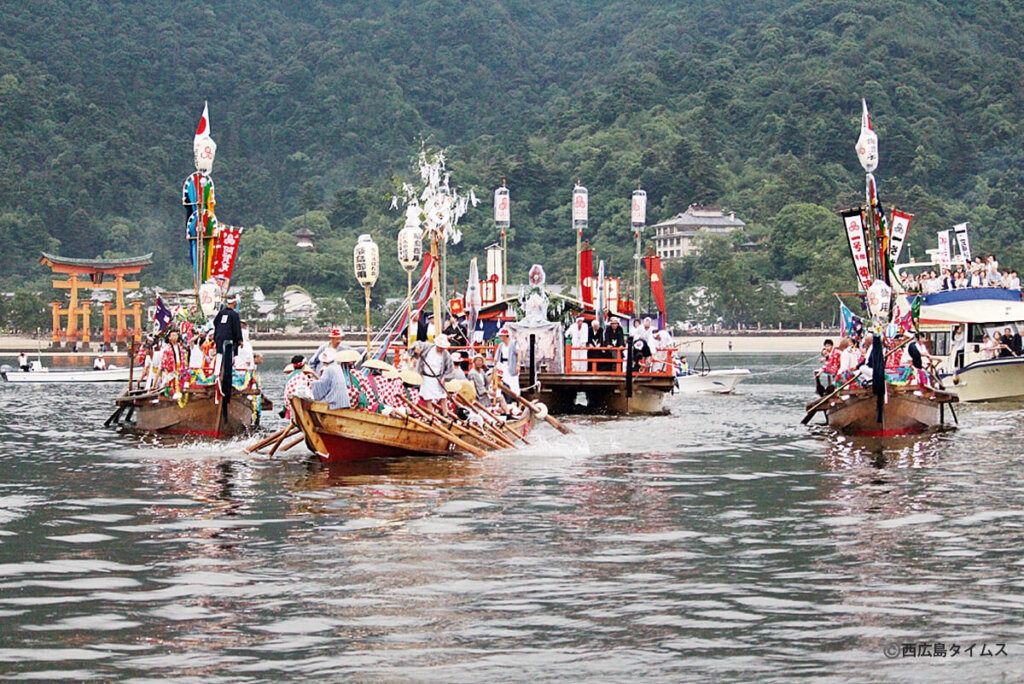
The ceremonial vessel used today consists of three traditional Japanese boats lashed together in a unique configuration. Originally, a single large boat made the journey alone, but the current three-boat design evolved over centuries. These vessels are constructed on Kurahashi Island in Kure City using traditional Japanese boatbuilding techniques, though with special features befitting a sacred vessel.
The boat features numerous decorative rafters, copper fittings that conceal nail heads, and an elongated prow. Bonfires burn in iron baskets on either side of the bow, while the stern carries four tall paper lanterns and more than twenty decorative lanterns. When this illuminated vessel emerges from the darkness of the nighttime sea, the effect is nothing short of magical.
Festival Rituals and Route Details
Why the Festival Falls on the 17th Day of the Sixth Lunar Month
Kangensai is always held on the 17th day of the sixth month by the traditional lunar calendar. This date—typically falling between mid-July and early August by the Western calendar—never changes because it offers ideal conditions for a maritime ceremony.
This date coincides with spring tides, when water levels are high enough for the ceremonial boat to navigate safely. The nearly full moon provides beautiful illumination across the water. While the seventh and eighth lunar months also offer favorable tides and moonlight, they fall during typhoon season when storms are more likely. The sixth lunar month thus represents the optimal combination of high tides, bright moonlight, and minimal storm risk—a testament to ancient wisdom about natural cycles.
The Ceremony’s Progression
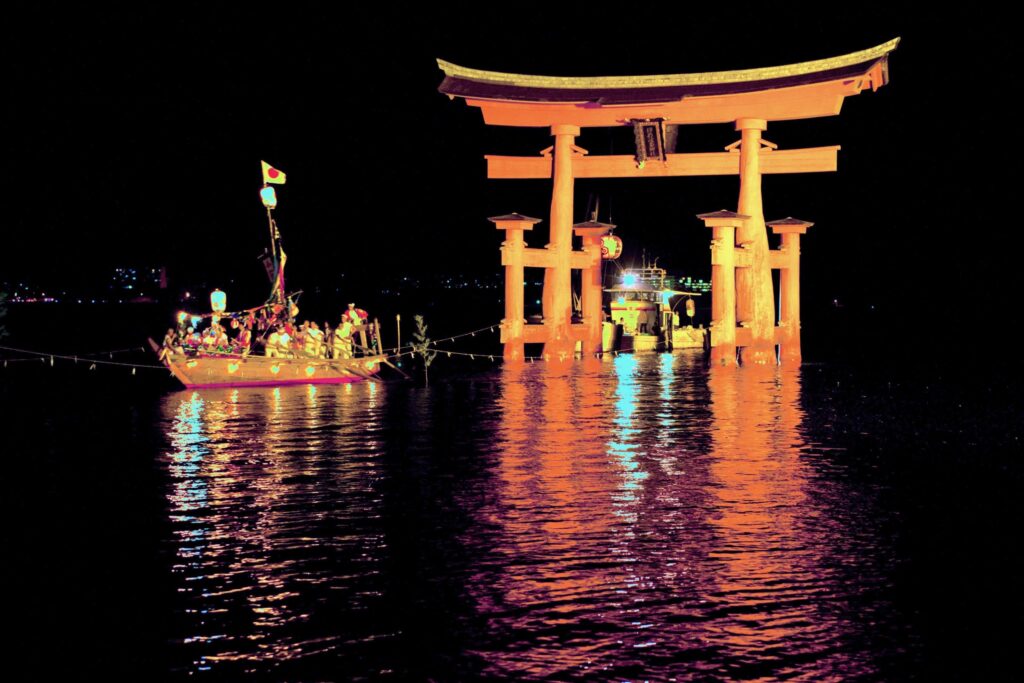
Kangensai begins at 3:00 PM with the Hatsurei-sai ceremony at Itsukushima Shrine’s main hall. The sacred object is transferred to the ceremonial boat waiting offshore near the great torii gate. Around 4:00 PM, a ceremony takes place in front of the torii, after which the boat sails toward Jigozen Shrine on the mainland while musicians perform gagaku.
En route, the boat pauses at Hotateiwa Rock, waiting for the tide to rise. When conditions are right, an escort boat arrives from Jigozen Shrine to guide the ceremonial vessel. Upon arrival at Jigozen, priests perform rituals and musicians play on the beach. Following this ceremony, the boat circles three times before departing for Nagahama Shrine back on Miyajima. After additional ceremonies at Nagahama Shrine and Ōmoto Shrine, the boat passes through the great torii gate and performs the final ceremony before Marōdo Shrine (also called Kyaku Shrine).
The Climactic Three Turns at Masugata
The most dramatic moment of Kangensai comes when the ceremonial boat enters the masugata—a narrow water basin enclosed by Itsukushima Shrine’s corridor and Marōdo Shrine—and rotates three times while musicians continue playing. This confined space barely accommodates the large vessel, making the slow, synchronized turns to the rhythm of gagaku an impressive feat of seamanship.
As firelight illuminates the boat and music fills the air, the vessel turns gracefully through the sacred waters. The crowd’s excitement and applause echo through the sea-scented corridors while a bright moon shines overhead. Around 11:00 PM, the sacred object returns to the main hall, concluding approximately eight hours of this remarkable maritime gagaku performance.
The Living Heritage of Kangensai
Kangensai represents an invaluable cultural treasure, preserved for over a thousand years since the Heian period. This is the only festival in the world where gagaku—Japan’s oldest orchestral music—is performed on the open sea, making its cultural significance immeasurable. As the premier ceremony of World Heritage-listed Itsukushima Shrine, Kangensai plays a crucial role in sharing Japanese traditional culture with global audiences.
The people who sustain this festival deserve recognition: boat builders on Kurahashi Island who construct the vessels, rowing teams from Eba and Aga who propel the escort boats, musicians who perform the ancient gagaku, and priests who conduct the sacred rituals. At Nagahama Shrine, locals and visitors alike receive free paper lanterns to join the procession welcoming the ceremonial boat—a heartwarming tradition that keeps this ancient festival connected to the community.
In recent years, observation boats allow visitors to experience Kangensai from the water, offering new ways to participate in this cultural event. More than a static historical relic, Kangensai is a living tradition that breathes with contemporary life, illuminating Miyajima’s summer nights just as it has for a millennium.
FAQ
When is the Kangensai Festival held?
Kangensai is held annually on the 17th day of the sixth month by the traditional lunar calendar. By the Western calendar, this typically falls between mid-July and early August—the exact date varies each year. In 2025, it fell on July 11. In leap years according to the lunar calendar, the festival may occur twice.
Why is the festival held on the lunar calendar date?
As a maritime ritual, tidal conditions and moonlight are critical. The 17th day of the sixth lunar month offers spring tides with high water levels for safe boat navigation and a nearly full moon for beautiful illumination. This timing also avoids typhoon season, making it the optimal date for an outdoor sea festival.
What is the best moment to watch during Kangensai?
The highlight is the three turns at masugata, occurring around 10:30 PM. Watching the ceremonial boat rotate three times while musicians play in the narrow waters between Itsukushima Shrine’s corridor and Marōdo Shrine is truly spectacular. The sight of the lantern-lit boat sailing through the darkness is equally unforgettable.
Where are the best viewing spots?
The shrine corridors offer the best view of the climactic three turns at masugata. You can also see the boat up close at Jigozen Shrine or Nagahama Shrine. Observation boats are available by reservation, letting you experience the festival from the water. The lantern procession at Nagahama Shrine is free and open to everyone.
What should I know about access on the festival day?
Ferries and the island become very crowded on festival day. Arrive on Miyajima by early afternoon to secure a good position. Although the festival extends past normal ferry hours, special late-night boats operate for the occasion. Staying overnight eliminates timing concerns entirely.
What is the connection between Taira no Kiyomori and Kangensai?
Kangensai originated in 1146 when Taira no Kiyomori was appointed governor of Aki Province. He adapted “kangen no asobi”—musical boat outings enjoyed by Kyoto aristocrats—into a sacred ceremony for Itsukushima Shrine’s deities. His vision of staging courtly elegance on the vast Seto Inland Sea created a festival that has endured for nearly nine centuries.
Where is the ceremonial boat built?
The three traditional boats that form the ceremonial vessel are constructed on Kurahashi Island in Kure City. While built using standard Japanese wooden boat techniques, they feature special decorations unique to sacred vessels. This craft represents an important tradition in preserving wooden boatbuilding skills for future generations.
Can international visitors attend Kangensai?
Absolutely. Kangensai is open to all visitors. No tickets are required to watch from shore or the shrine corridors. Observation boat tickets typically require advance reservation and may have Japanese-language booking systems—check with your hotel or the Miyajima Tourist Association for assistance. The visual spectacle and music transcend language barriers.
Summary
Kangensai is Itsukushima Shrine’s grandest ceremony, tracing its origins to Taira no Kiyomori, who transformed refined Heian court entertainment into a sacred boat ritual nearly 900 years ago. Ranked among Japan’s Three Great Boat Festivals alongside Osaka’s Tenjin Matsuri and Matsue’s Horan-Enya, this World Heritage festival unfolds across the vast Seto Inland Sea—an unparalleled stage for ancient gagaku music.
Every year on the 17th day of the sixth lunar month—when spring tides ensure high water and the near-full moon illuminates the sea—Kangensai runs from 3:00 PM until approximately 11:00 PM. The ornately decorated ceremonial boat sails by firelight and lantern glow, with musicians performing as the vessel visits Jigozen Shrine, Nagahama Shrine, and Ōmoto Shrine. The climax comes when the boat enters the narrow masugata basin and rotates three times to the rhythm of ancient court music.
This thousand-year tradition brings together Japan’s oldest orchestral music, traditional wooden boatbuilding, and sacred Shinto rituals into a comprehensive cultural experience. More than a historical artifact, Kangensai is a living festival that continues to illuminate Miyajima’s summer nights, connecting modern visitors to the elegance of Heian-era Japan.
References and Sources
- Miyajima Tourist Association: Kangensai
- Wikipedia: Kangensai
- Government of Japan HIGHLIGHTING Japan: Elegant Boat Festival with Traditional Music on the Sea
- GOOD LUCK TRIP: Kangensai – Highlights, Schedule, Access & Area Information
- Kure City Official Website: Itsukushima Shrine Kangensai Ceremonial Boat
- NPO Japan Festival Network: Itsukushima Shrine Boat Kangen (Kangensai)
- Japan Knowledge: Kangensai | Encyclopedia Nipponica
- Miyajima Town History Compilation Committee, “Miyajima Town History: General History,” Miyajima Town, 1992