
Miyajima, home to the UNESCO World Heritage Itsukushima Shrine, has been a sacred island since the Heian period when Taira no Kiyomori expanded the shrine into its current form. By the warring states period (Sengoku era), however, the shrine had fallen into disrepair and the island’s importance had faded. Everything changed in 1555 when the warlord Mori Motonari won a decisive victory here in the Battle of Miyajima (Itsukushima no Tatakai). Deeply troubled by having defiled sacred ground with warfare, Motonari undertook massive restoration of the shrine and became its devoted patron. This guide explores Motonari’s deep connection to Miyajima, the specific locations where the battle unfolded, and how this brilliant commander used the island’s terrain to defeat an army nearly ten times his size.
Mori Motonari and Itsukushima Shrine: The Warlord Who Saved a Sacred Site
Itsukushima Shrine traces its origins to 593 CE and was transformed into its magnificent floating form by Taira no Kiyomori in the late 12th century. After the Taira clan’s downfall, the shrine gradually declined through the turbulent Sengoku period as Japan fractured into competing domains.
Mori Motonari reversed this decline after his victory in the 1555 Battle of Miyajima. Deeply ashamed of having brought bloodshed to sacred ground, he immediately began extensive restoration work. The dead and wounded from both armies were quickly removed to the mainland. Bloodstained soil was scraped away and cast into the sea. Sections of the shrine’s corridors stained with blood were torn out and replaced with new planks.
In 1571, following an incident where two brothers accused of treason were killed inside the main hall, Motonari completely rebuilt the Honden (main sanctuary). This structure survives today as one of Japan’s largest shrine buildings at approximately 270 square meters (2,900 square feet). Motonari and his eldest son Takamoto also rebuilt the great torii gate, and the stone pillars of the Hirabutai stage platform are attributed to Motonari’s donation.
After the battle, the Mori clan’s devotion to Itsukushima Shrine only deepened. Motonari allocated roughly ten percent of the revenue from the valuable Iwami silver mines to fund shrine maintenance—a remarkable commitment that demonstrated his faith was genuine, not merely political. The shrine that had guided him to victory became venerated as a source of martial fortune. Even Toyotomi Hideyoshi later visited to pray for success before his military campaigns.
Motonari’s relationship with Itsukushima Shrine went far beyond strategic patronage. Most of the shrine buildings visitors see today date from his era of restoration. The beauty of Miyajima as we know it was preserved by this 16th-century warlord.
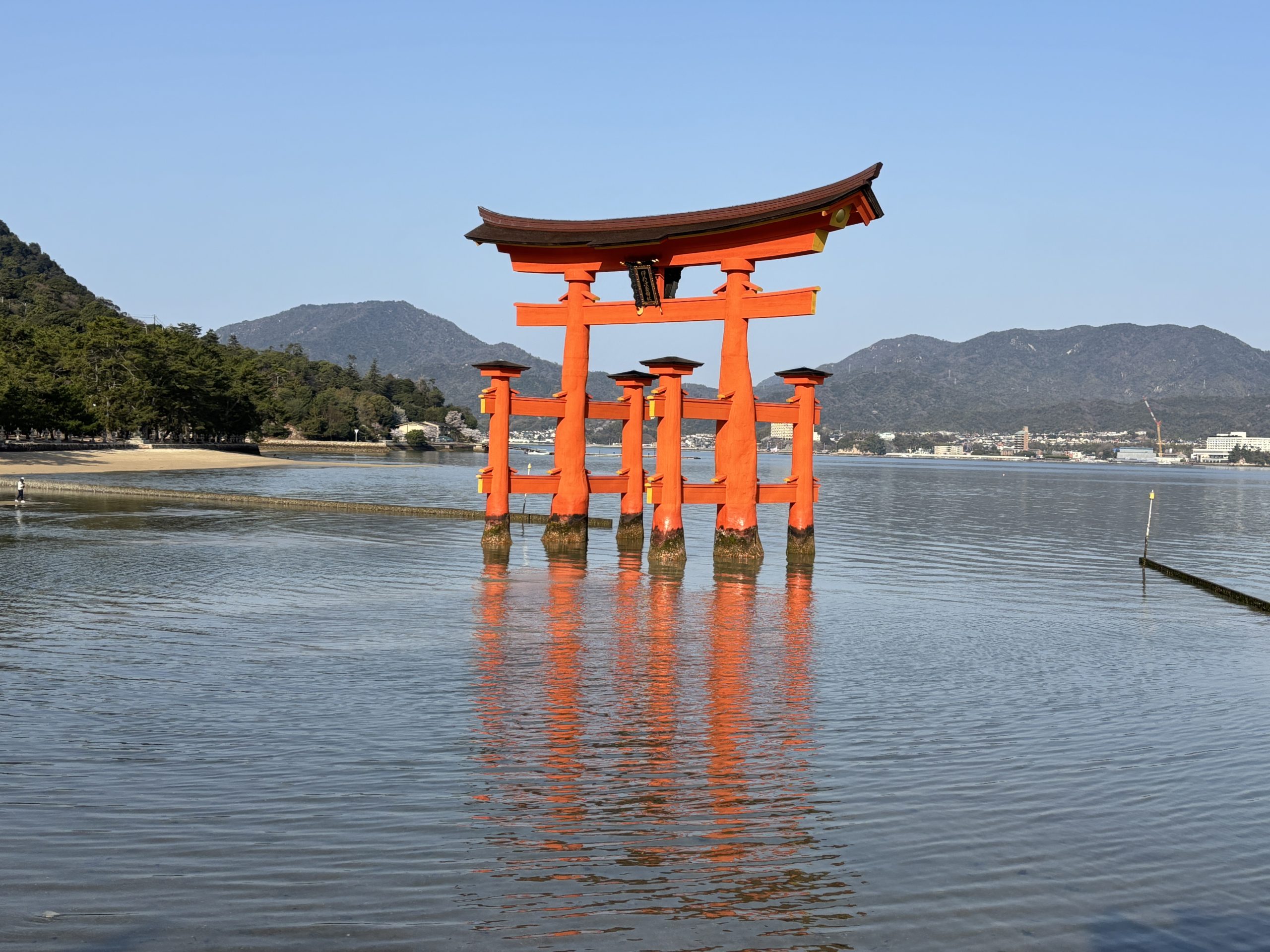
The great torii gate of Itsukushima Shrine standing in the sea has captivated visitors for centuries. More than a simple entrance marker, it represents…
Battle of Miyajima Historic Sites: Key Locations on the Island
Tsutsumigaura: Where Mori’s Army Landed
Tsutsumigaura is a cove on Miyajima’s northeastern shore where Motonari’s main force of approximately 2,000 soldiers landed on the stormy night of October 15, 1555. They crossed in darkness during a violent typhoon, a desperate gamble that caught the enemy completely off guard. Today the area is part of Tsutsumigaura Nature Park, and a memorial stone marks Motonari’s landing spot.
When Motonari asked what this place was called, he was told “The cove is Tsutsumigaura, and the ridge above is Bakuchi-o.” The word “utsu” (to strike) appears in related words for both drums and gambling, leading Motonari to declare this an omen: “The time has come to strike and win!” He set his army’s passwords as “utsu” (strike) and “katsu” (win). After landing, he ordered all boats sent back—a declaration of do-or-die commitment that left no possibility of retreat.
Bakuchi-o Ridge: The Launch Point for the Surprise Attack
Bakuchi-o is a mountain ridge reached by climbing a steep trail from Tsutsumigaura. Mori’s army ascended this treacherous four-kilometer (2.5-mile) path through darkness and rain, reaching the ridge around 6:00 AM. From here they could look down directly at the enemy’s headquarters on Tō-no-oka hill.
According to tradition, when Motonari heard the name Bakuchi-o (Gambling Ridge), he encouraged his men: “Long ago, Minamoto no Yoshitsune landed at a place called Victory Cove and defeated the Taira. Now we have climbed Gambling Ridge. Gambling also means to strike—we have already won this fight!” This wordplay on auspicious omens lifted his soldiers’ spirits for the attack ahead.
Tō-no-oka: Sue’s Headquarters
Tō-no-oka is the hill east of Itsukushima Shrine where the five-story pagoda and Toyokuni Shrine (Senjōkaku) stand today. Sue Harukata established his headquarters here on October 6, 1555, with a commanding view of Miyao Castle below. This advantageous position would prove to be his undoing.
On the morning of October 16, Mori’s forces came pouring down from Bakuchi-o ridge with a thundering war cry. The surprise attack from behind threw Sue’s headquarters into chaos. Trapped with too many soldiers in too little space, the massive Sue army could neither fight effectively nor retreat, and collapsed into disorder.
Ōmoto-no-ura: Where Sue’s Army Landed
Ōmoto-no-ura is located west of Itsukushima Shrine, near today’s Miyajima Aquarium. On October 6, 1555, Sue Harukata landed here with a fleet of 500 ships and approximately 20,000 soldiers. The Sue forces spread across the island from Daishō-in Temple to Mount Misen, with warships filling the waters offshore.
After his defeat, Sue fled back to Ōmoto-no-ura hoping to escape by ship to Yamaguchi and rebuild his forces. But the Murakami navy had blockaded the harbor, forcing him to flee farther west along the coast.
Ōe-ura and Takayasu-ga-hara: Where Sue Harukata Died
Ōe-ura, a cove on Miyajima’s western coast, is where Sue Harukata met his end. With only a handful of retainers remaining, he reached this shore seeking a boat, but found none—the Murakami navy had sealed off all escape routes. With no options left, he composed a death poem: “What is there to regret, what to resent? From the beginning, this was my fate to meet.” His retainer Ikaga Fusaaki served as his second, and Sue took his own life. He was 35 years old. His head was discovered by Mori forces several days later and buried at Tōun-ji Temple in Hatsukaichi on the mainland.
Miyao Castle: The Decoy Fortress
Miyao Castle was built on the promontory at Ari-no-ura by Motonari specifically to lure Sue Harukata to Miyajima. In May 1555, he stationed 500 soldiers under Kohi Naoyuki and Tsuboi Motomasa in this deliberately vulnerable-looking fortification. Sue’s army attacked the castle repeatedly, but the defenders held out stubbornly, frustrating the overconfident commander and keeping him focused on this single objective while Motonari prepared his trap.
Why the Battle of Miyajima Happened: Historical Background
The Death of Ōuchi Yoshitaka and Motonari’s Decision
In 1551, Ōuchi Yoshitaka—the powerful lord who dominated western Japan and northern Kyushu—was killed in a coup by his own retainer Sue Harukata (the Daineiji Incident). Yoshitaka had devoted himself to culture and temple patronage, alienating his military-minded vassals. Sue installed Ōuchi Yoshinaga (originally a younger son of the Ōtomo clan) as puppet ruler while he controlled the domain.
For Mori Motonari, an ally of Yoshitaka, this crisis presented both danger and opportunity. Initially showing submission to Sue, he quietly expanded his territory throughout Aki and Bingo provinces, building strength for the inevitable confrontation.
The Breaking Point: Battle of Oshikibata
In May 1554, Yoshimi Masayori of Iwami Province raised his banner against the Sue, and Motonari openly broke with his former overlords. He captured Sakurao Castle and three other fortresses, seizing Miyajima itself.
Enraged, Sue ordered Miyagawa Fusanaga to destroy Motonari. At the Battle of Oshikibata near Sakurao Castle, Motonari’s 3,000 soldiers crushed an army of 7,000. This stunning victory established Motonari’s reputation and made war with Sue inevitable.
Why Miyajima Became the Battlefield
Miyajima was not merely a religious site—it was a critical strategic location for controlling maritime trade in the Seto Inland Sea. Taira no Kiyomori had used it as a trading base for commerce with Song China centuries earlier. Whoever held this island dominated the region’s shipping lanes.
Facing an army nearly ten times his size, Motonari knew that conventional warfare on open ground meant certain defeat. He needed to neutralize Sue’s numerical advantage. An island battle would cut Sue off from reinforcements. The rugged terrain would prevent the massive army from deploying effectively. Limited flat ground would turn overwhelming numbers into a liability rather than an asset.
Motonari studied the island’s geography carefully and devised a plan to lure Sue into this natural trap.
The Battle: How Miyajima’s Terrain Decided Victory
Sue’s Landing and Deployment: From Ōmoto-no-ura to Tō-no-oka
On October 6, 1555, Sue Harukata landed at Ōmoto-no-ura (near today’s Miyajima Aquarium) with 500 ships and approximately 20,000 soldiers. Miura Fusakiyo and Yamato Okitake led the vanguard, while Sue established his headquarters on Tō-no-oka hill overlooking Miyao Castle.
The enormous army spread across the island from Daishō-in Temple to Mount Misen, with warships filling every harbor. Yet packing 20,000 men into this small island would prove catastrophic—there was simply no room to maneuver when disaster struck.
Crossing in the Storm: The Landing at Tsutsumigaura
On October 15, Motonari divided his forces into three groups. The first was his main force of roughly 2,000 under himself, his son Takamoto, and his second son Motoharu. The second was approximately 1,500 under his third son Kobayakawa Takakage. The third was the Murakami navy.
As evening approached, a violent storm swept in with thunder and driving rain. Rather than delay, Motonari declared it “an auspicious day” and explained that the storm was heaven’s protection. He launched the crossing at 6:00 PM.
Motonari’s main force sailed with only the commander’s vessel showing a signal fire, slipping quietly around Miyajima’s eastern coast. They landed at Tsutsumigaura around 9:00 PM. After sending all boats back to demonstrate their do-or-die commitment, the army began the treacherous climb toward Bakuchi-o ridge in the darkness, with Kikkawa forces leading the way.
Meanwhile, Kobayakawa Takakage’s detachment boldly sailed directly toward the great torii gate at the front of the enemy position. When challenged, they claimed to be reinforcements from Munakata and Akizuki in Chikuzen—ally territories. The ruse worked, and they waited offshore near the torii for the signal to attack.
The Attack from Bakuchi-o: How Miyajima’s Steep Terrain Changed Everything
Through the storm and darkness, Mori’s forces climbed the brutal four-kilometer trail. The conditions made the march agonizing, but also meant Sue’s sentries never spotted them. By dawn they had reached Bakuchi-o ridge overlooking the enemy headquarters.
At around 6:00 AM on October 16, war cries erupted from the ridge as Mori’s main force charged down the mountain into Sue’s rear. At the same moment, Kobayakawa’s force attacked from the torii gate while the garrison of Miyao Castle sallied forth. Sue found himself surrounded.
The Murakami navy struck the Sue fleet offshore, burning ships and cutting off escape. Sue’s forces, caught off guard after a sleepless night in the storm, were too tightly packed to move. Contemporary accounts describe how “Sue and Hironaka retreated toward the western mountains without loosing a single arrow”—the army simply collapsed without organized resistance. Miyajima’s confined terrain had completely negated Sue’s overwhelming numbers.
The Death of Sue Harukata: Suicide at Ōe-ura
After losing his headquarters on Tō-no-oka, Sue fled toward the shrine and then west to Ōmoto-no-ura. Hoping to escape by ship to Yamaguchi, he found the harbor blocked by Murakami warships. With only a handful of retainers remaining, he continued west along the coast to Ōe-ura, where he found no escape.
He composed his final poem: “What is there to regret, what to resent? From the beginning, this was my fate to meet.” With his retainer Ikaga Fusaaki as his second, Sue took his own life at age 35. His head was found several days later and taken to Tōun-ji Temple in Hatsukaichi for burial.
Meanwhile, Hironaka Takakane, who had fought Kikkawa forces near Daishō-in before retreating up Mount Misen with 100-300 men, made a final stand at a rocky area called Ryūgababa on Komagabayashi peak. Surrounded by Kikkawa forces, he fought fiercely until falling on October 18. The total number of enemy dead reportedly reached 4,785.
After the Battle: Purifying Sacred Ground and Rebuilding the Shrine
The battle began at dawn on October 16 and was essentially over by 2:00 PM the same day. But for Motonari, more important work remained—making amends for having defiled sacred ground.
Filled with remorse for the violence done to Miyajima, Motonari immediately began restoring the island’s sanctity. The dead and wounded from both armies were transported to the mainland as quickly as possible. Soil stained with blood was scraped up and thrown into the sea. Blood-soaked sections of the shrine corridors were torn out and replaced with fresh planks. Everything else was washed clean with seawater to restore the shrine to its pre-battle condition.
After this victory, the Mori clan’s standing in western Japan rose dramatically, and their devotion to Itsukushima Shrine deepened with each passing year. Motonari undertook major restoration work, and in 1571 he completely rebuilt the main sanctuary. Together with his son Takamoto, he also reconstructed the great torii gate.
The shrine that had granted Motonari victory came to be revered as a source of martial fortune by samurai across Japan. Toyotomi Hideyoshi visited during his Kyushu campaign to pray for military success and commissioned construction of the Daiky dō (today’s Senjōkaku, or “Hall of a Thousand Tatami Mats”). Following Taira no Kiyomori’s earlier patronage and Motonari’s dramatic triumph, Itsukushima Shrine entered a new era of prosperity that would continue into the early modern period.
FAQ
What was the relationship between Mori Motonari and Itsukushima Shrine?
After winning the Battle of Miyajima in 1555, Motonari was deeply troubled by having brought warfare to sacred ground. He ordered immediate cleanup of all bloodstained soil and damaged shrine buildings, then undertook major restoration work. In 1571 he completely rebuilt the main sanctuary (Honden), which survives today as one of Japan’s largest shrine halls. He and his son also rebuilt the great torii gate. Motonari’s genuine faith in the shrine—demonstrated by allocating roughly 10% of silver mine revenues to its maintenance—transformed Miyajima from a declining religious site into a flourishing pilgrimage destination.
Where can I visit Battle of Miyajima historic sites?
Key locations include Tsutsumigaura (Mori’s landing site, with a memorial stone), Bakuchi-o ridge (the mountain path used for the surprise attack), Tō-no-oka (Sue’s headquarters, now the location of the five-story pagoda and Senjōkaku), Ōmoto-no-ura (Sue’s landing site, near Miyajima Aquarium), Ōe-ura (where Sue committed suicide), and the site of Miyao Castle. The approximately four-kilometer mountain trail from Tsutsumigaura over Bakuchi-o ridge is hikeable today, allowing visitors to trace Motonari’s overnight march.
How did the Battle of Miyajima unfold?
Sue landed on October 6, 1555 with about 20,000 troops and set up headquarters on Tō-no-oka hill. On the stormy night of October 15, Motonari’s 2,000-man main force landed secretly at Tsutsumigaura and climbed through darkness to Bakuchi-o ridge. At dawn on October 16, they attacked downhill from behind while a second force attacked from the sea near the torii gate. Caught in a pincer movement with no room to maneuver, Sue’s massive army collapsed within hours.
Why did Mori Motonari win the Battle of Miyajima?
Motonari’s victory came from masterful use of terrain. By luring Sue’s 20,000 soldiers onto a small island with limited flat ground, he nullified their numerical advantage. The storm provided cover for his secret landing. The steep mountain approach allowed his smaller force to attack from an unexpected direction. The Murakami navy blocked any escape. Every element—the weather, the timing, the geography—worked together in a carefully calculated plan that turned overwhelming odds into a decisive victory.
What happened to Mori Motonari after the Battle of Miyajima?
The victory at Miyajima became the foundation for Motonari’s conquest of western Japan. He invaded Suō Province and destroyed the Ōuchi clan in 1557 by forcing Ōuchi Yoshinaga to commit suicide. In 1566 he eliminated the Amago clan. From a minor local lord, Motonari rose to control six provinces—Aki, Bingo, Suō, Nagato, Iwami, and Izumo—becoming the dominant power in the Chūgoku region with territory worth approximately 1.2 million koku (a measure of rice production indicating domain wealth).
Can I walk the same route Mori’s army took during the battle?
Yes, the mountain trail from Tsutsumigaura to Bakuchi-o ridge is accessible as a hiking path. The roughly four-kilometer route takes you through the same steep terrain that Motonari’s soldiers climbed in darkness during a storm. It’s a moderately challenging hike that offers impressive views and a tangible connection to the 1555 battle. Start from Tsutsumigaura and allow 2-3 hours for the climb.
Is this battle related to the samurai history I might have heard about?
The Battle of Miyajima is considered one of the three great surprise attacks in samurai warfare (alongside Okehazama and Kawanakajima). It demonstrates classic elements of Japanese military strategy: using terrain to offset numerical disadvantage, employing deception and psychological warfare, coordinating land and naval forces, and exploiting weather conditions. For anyone interested in samurai history, Miyajima offers a rare opportunity to walk an actual battlefield that remains largely unchanged after nearly 500 years.
Summary
The relationship between Mori Motonari and Miyajima was forged through one of Japan’s most dramatic battles. Using a brilliant strategy that exploited the island’s steep terrain, Motonari landed secretly at Tsutsumigaura, climbed through a storm to Bakuchi-o ridge, and launched a devastating surprise attack that destroyed an army nearly ten times his size.
After his victory, Motonari’s remorse at having defiled sacred ground led him to undertake extensive restoration of Itsukushima Shrine. He replaced bloodstained soil and building materials, rebuilt the main sanctuary in 1571, and reconstructed the great torii gate. Most of the shrine complex visitors see today dates from Motonari’s era of patronage. The beauty of Miyajima as we know it was preserved—and in many ways created—by this 16th-century warlord.
The Battle of Miyajima launched Motonari’s rise to become the supreme power in western Japan, while Itsukushima Shrine gained renown as a source of martial fortune that attracted pilgrimage from warriors across the country. The story of Miyajima and Mori Motonari preserves a remarkable chapter in samurai history—a tale of strategy, devotion, and the deep bond between a warrior and a sacred island that continues to resonate today.
References
- Battle of Miyajima – Wikipedia (Japanese)
- Itsukushima Shrine – Wikipedia (Japanese)
- Mori Motonari’s Battle of Miyajima – Iwaso Ryokan
- Battle of Miyajima – Miyajima Tourist Association
- Battle of Miyajima Historic Site Markers – Hatsukaichi City
- Understanding Itsukushima Shrine – Dive Hiroshima
- Battle of Miyajima Battlefield – Touken World