
Rising from the waters of the Seto Inland Sea, Itsukushima Shrine’s great torii gate is one of Japan’s most photographed landmarks and a powerful symbol of the country’s cultural heritage. Far more than a scenic photo opportunity, this vermilion gateway represents nearly a millennium of Japanese history, religious tradition, and architectural ingenuity.
The O-torii has stood in the waters off Miyajima for approximately 900 years, since its original construction during the era of Taira no Kiyomori. The current structure—rebuilt in 1875 and now designated a National Important Cultural Property—is the ninth torii to occupy this sacred spot. Standing 16.6 meters (54 feet) tall and weighing roughly 60 tons, it ranks among Japan’s “Three Great Torii Gates” alongside those at Kasuga Grand Shrine in Nara and Kehi Shrine in Fukui. Most remarkably, the massive structure has no foundation—it stands in the sea purely through its own weight.
This guide explores the torii’s fascinating history from its 12th-century origins to the present day, reveals the engineering secrets behind its seemingly impossible construction, and explains why this gateway continues to hold such profound meaning for Japanese culture and visitors from around the world.

A 900-Year History: The Torii Through the Ages
Heian Period Origins: Taira no Kiyomori’s Vision
The story of Itsukushima Shrine’s great torii begins around 1168, during the late Heian period. Taira no Kiyomori, the powerful warlord who controlled much of western Japan as Governor of Aki Province, undertook a massive renovation of the shrine, transforming it into the spectacular over-water sanctuary we see today. As part of this project, he commissioned the first torii to stand in the sea.
Kiyomori’s decision to place the torii in the water served both religious and practical purposes. Miyajima—literally “shrine island”—was considered so sacred that buildings could not touch the island’s soil. By positioning the shrine buildings on platforms over the water and placing the torii gate offshore, the island’s sanctity remained intact. The brilliant vermilion structure also served as a highly visible navigational marker for ships traversing the Seto Inland Sea, including the merchant vessels of the lucrative Japan-Song China trade that Kiyomori championed.
Historical records suggest that the original plaques (gakumen) mounted on the torii were calligraphed by two of the era’s most revered figures: the master calligrapher Ono no Michikaze on one side and the Buddhist monk Kukai (Kobo Daishi) on the other—a testament to the shrine’s exceptional cultural and religious prestige.
Medieval Reconstructions: Kamakura Through Muromachi
Standing in the open sea, the torii was repeatedly damaged by typhoons and storm surges, necessitating multiple rebuilds throughout the medieval period. The second torii was reconstructed in 1286, only to be toppled by a great wind in 1325. Depictions in the illustrated scroll Ippen Hijiri-e (“Pictorial Biography of the Holy Ippen”) confirm that this medieval torii was already a vermilion-painted myojin-style structure—the classic curved-top design familiar today.
A 1240 document titled “Report on Completed and Uncompleted Structures at Itsukishima Shrine” lists “one great torii” among finished buildings, suggesting reconstructions occurred even more frequently than previously believed. A 1371 rebuilding used timber transported from what are now Saeki Ward and Hatsukaichi City, indicating that even in medieval times, sourcing wood for the massive structure required coordinating resources from across the region.
The Sengoku and Edo Periods: Evolution to the “Ryobu” Style
A pivotal reconstruction in 1547, sponsored by the powerful daimyo Ouchi Yoshitaka, likely introduced the distinctive ryobu torii (dual-pillar) design still used today. This style features four supporting strut pillars in addition to the two main columns, greatly increasing stability. Yoshitaka also presented a plaque inscribed by Emperor Go-Nara—this nationally designated Important Cultural Property is now displayed in the shrine’s Treasure Hall.
In 1561, the Mori clan—successors to power in the region—sponsored another reconstruction using timber from islands in the Inland Sea and as far away as Iwakuni. This torii stood for an impressive 155 years before finally collapsing from natural deterioration in 1716.
The eighth torii, completed in 1801, used camphor wood sourced from Wakayama Prefecture and several locations around Hiroshima. Records suggest that a massive camphor tree measuring 3.5 meters in diameter was felled on Ujina Island near Hiroshima. However, this structure met a dramatic end in 1850 when a fierce typhoon and storm surge destroyed it—the plaque reportedly washed all the way to Atada Island.
The Current Ninth Torii: From 1875 to Today
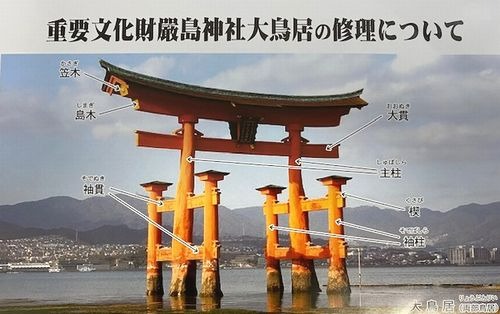
The torii standing today was completed on July 18, 1875, through the efforts of merchant Koizumi Jinemon and others. Long believed to be the eighth iteration, recent research has confirmed it is actually the ninth. Nearly 150 years old, it continues to serve as Itsukushima Shrine’s enduring symbol.
Official recognition of the torii’s significance came in 1899 when it was designated a National Important Cultural Property. In 1963, two historical wooden plaques (munafuda) recording previous constructions were added as supplementary items. The crowning honor came in 1996, when Itsukushima Shrine and its torii were inscribed on the UNESCO World Heritage List.
Following severe damage to the shrine from Typhoon 19 in 1991, local citizens formed the “Miyajima Millennium Committee” to ensure future preservation. Because suitable camphor trees take many decades to mature, the committee began cultivating replacement timber in the “Eternal Forest” on national land within the island—a remarkable multigenerational effort to protect heritage.
From June 2019 to December 2022, the torii underwent its first major restoration in over 70 years. Craftsmen repaired termite damage to the main pillars by inserting fitted timber sections and reinforcing them with stainless steel bands and carbon fiber wrapping. A new UV-resistant paint formula combining chemical pigments with acrylic resin restored the torii’s brilliant vermilion color. This “Reiwa-era Great Restoration” has given the gate renewed vibrancy for generations to come.
Engineering Marvel: How the Torii Stands in the Sea
The Ryobu Torii Structure
Itsukushima’s great torii is a ryobu torii—a style featuring six pillars total: two massive main columns (shuhashira) and four smaller supporting struts (sodebashira). The main and supporting pillars are connected at two heights by horizontal crossbeams (sashinuki) and secured with wooden wedges. This configuration provides exceptional stability against the lateral forces of waves and wind.
The main pillars are made of camphor wood (kusunoki), with the current torii using specimens from Miyazaki and Kagawa Prefectures. Each main pillar measures approximately 10 meters (33 feet) in circumference at its base—making this one of the largest wooden torii gates in all of Japan. Camphor was chosen deliberately: the wood is denser than most species, highly resistant to rot, and naturally repels insects—ideal qualities for a structure standing in saltwater.
The four supporting struts are made of Japanese cedar. The overall height reaches 16.6 meters (54 feet), with the top crossbeam spanning 24.2 meters (79 feet). The total estimated weight is 60 tons.
Standing by Weight Alone: The Foundation-Free Secret
The torii’s most astonishing feature is that it has no foundation whatsoever—no pilings driven into the seabed, no concrete base. It stands solely through its own immense weight.
The key is in the roof structure. The box-like area beneath the roof is hollow, filled with approximately 276 stones that act as ballast. These stones serve the same purpose as water in the ballast tanks of a ship—they lower the center of gravity and prevent the structure from tipping. Historically, each stone was inscribed with a single character from the Heart Sutra, reflecting the syncretic blend of Shinto and Buddhist belief that characterized pre-Meiji Japan. While modern stones no longer bear these inscriptions, they continue their essential stabilizing function.
Visitors can experience the tidal transformation firsthand. At high tide, the torii appears to float ethereally on the water. At low tide (generally when the water level drops below 100 cm/3.3 feet), you can walk across the exposed seabed to stand at its base. The tidal range in Hiroshima Bay can reach 4 meters (13 feet)—the engineering must accommodate this dramatic daily environmental swing.

Symbolic Ornamentation: Yin-Yang and Shinto-Buddhist Fusion
Careful observers will notice directional symbolism in the torii’s decorative metalwork. The eastern hardware features a sun emblem, while the western side bears a moon—representing the cardinal directions in the yin-yang cosmology that influenced Japanese religious thought. Similar sun and moon symbols appear on lanterns throughout Itsukushima Shrine.
The plaques mounted on the torii also tell a story. The seaward (north-facing) side reads “Itsukushima Jinja” in formal characters, while the shrine-facing (south) side uses the archaic reading “Itsukishima Jinja”—a remnant from when the shrine was dedicated to the deity Itsukishima Daimyojin. Each plaque measures approximately 2 meters tall by 1.2 meters wide (about 6.5 × 4 feet), excluding the ornate frame.
The entire structure is painted vermilion (traditionally called ni-nuri), though the exposed wood ends are finished in ochre. Vermilion has long been associated with sacredness in Japan and was highly visible from sea, serving both spiritual and practical navigational purposes. The dramatic contrast of the red torii against the blue sea and green slopes of Mount Misen creates the iconic landscape that has enchanted visitors for centuries.
Sacred Significance: Gateway to the Divine
A Boundary Between Worlds
In Shinto tradition, a torii gate marks the boundary between the everyday world and sacred space—it is quite literally the threshold of the divine realm. By placing the torii in the sea, Itsukushima Shrine visually proclaims that the entire island is sacred ground.
This belief shaped centuries of customs. Miyajima was considered so holy that births and deaths were forbidden on the island—pregnant women and the terminally ill were taken to the mainland. Even today, there is no cemetery on the island. The offshore torii allowed pilgrims to enter this sacred space via boat, passing beneath the gate as a ritual purification before worship.
The tradition continues in modified form. During the summer Kangen-sai Festival—one of Japan’s most important Shinto ceremonies—decorated boats carrying portable shrines still pass beneath the torii, recreating the ancient approach to the divine island.
Guardian of Sea Travelers
Itsukushima Shrine enshrines the three Munakata goddesses: Ichikishimahime, Tagorihime, and Tagitsuhime. These deities have been revered since ancient times as protectors of maritime travel and commerce. For the countless sailors, merchants, and pilgrims who navigated the Seto Inland Sea over the centuries, the vermilion torii was both a sacred offering to the sea goddesses and a practical beacon guiding their way.
When Taira no Kiyomori promoted international trade with Song Dynasty China, the torii’s role as a navigation marker gained commercial as well as religious importance. Ships laden with silk, ceramics, and spices would have oriented themselves by this sacred landmark. The torii’s designation as one of Japan’s “Three Great Torii” reflects this dual significance—spiritual symbol and maritime heritage combined.
Artistic Inspiration Across Centuries
The torii’s visual impact has inspired Japanese artists for generations. Utagawa Hiroshige’s famous woodblock print series “Famous Views of the Sixty-odd Provinces” features the Miyajima torii during the Kangen-sai Festival, capturing the scene that has enchanted visitors since the Edo period.
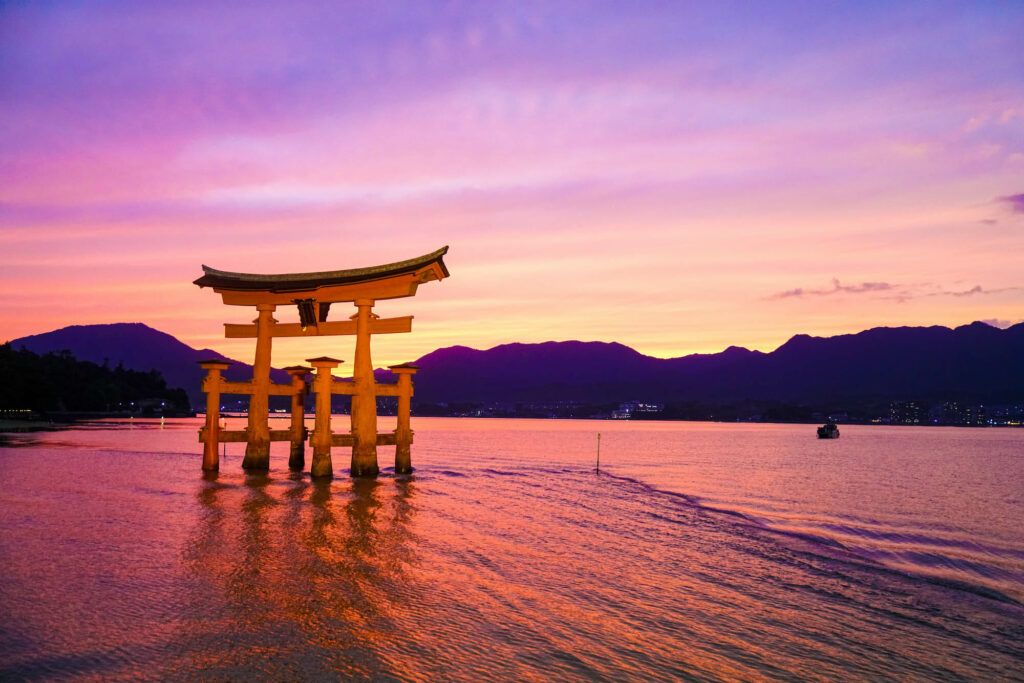
Today, photographers flock to capture the torii in every possible condition: silhouetted against fiery sunsets, illuminated at night, reflected in tidal pools at low tide, or appearing to hover on morning mist. The interplay of architecture and nature—changing with seasons, weather, and tides—offers endless variations on a timeless theme.
UNESCO’s World Heritage inscription specifically recognized this quality, citing “the landscape created by the construction of religious buildings in harmony with the natural environment” as representing “a masterpiece of human creative genius.”
The Torii Today: Heritage Preserved for the Future
After nearly a millennium, Itsukushima Shrine’s great torii remains one of Japan’s most beloved cultural treasures. Its dual designation as a National Important Cultural Property and UNESCO World Heritage Site underscores its exceptional value, making its protection a national priority.
The 2019–2022 restoration exemplified modern conservation philosophy: applying the latest preservation technologies while respecting traditional methods. Termite damage was addressed, UV-resistant coatings were applied, and structural reinforcements were added—all without compromising the torii’s historical integrity or spiritual character.
Perhaps most remarkable is the forward-looking work of the Miyajima Millennium Committee. Because suitable camphor trees require 50 to 100 years to reach usable size, today’s conservators are planting timber for torii that won’t be built until the 22nd century or beyond. The “Eternal Forest” and “Cypress Bark Forest” projects ensure that future generations will have the materials needed to maintain this tradition.
For the millions of visitors who come to Miyajima each year, the torii serves as a gateway to understanding Japanese culture. At the 2023 G7 Hiroshima Summit, world leaders posed for photographs before the torii, beaming this image of Japan to a global audience. Whether seen from a ferry approaching the island, from the shrine’s corridors at high tide, or up close at low tide, the great torii of Itsukushima offers an experience that transcends language and culture.
The torii’s repeated destruction and reconstruction over nine centuries mirrors Japan’s broader history of disaster and renewal. Each time storms have toppled the gate, communities have come together to rebuild it—a pattern that continues today with systematic planning for future preservation. Protecting the torii is not merely about conserving a single monument; it is about maintaining a living connection to Japanese cultural identity.
FAQ
How old is the current Miyajima torii gate?
The current torii was completed in 1875, making it nearly 150 years old. While it has been called the “eighth generation” for many years, recent historical research confirmed it is actually the ninth torii to stand in this location since Taira no Kiyomori commissioned the original around 1168.
How does the torii gate stand in the water without a foundation?
The torii has no pilings or concrete base—it stands purely through its own 60-ton weight. Heavy camphor wood was chosen for the main pillars, and approximately 276 stones fill the hollow area beneath the roof, lowering the center of gravity like ballast in a ship. The six-pillar ryobu torii design adds additional lateral stability.
When can I walk out to the torii gate?
You can walk to the base of the torii at low tide, generally when the water level drops below 100 cm (about 3.3 feet). Tide times vary daily, so check the tide tables on the Miyajima Tourist Association website before your visit. The difference between high and low tide can be as much as 4 meters (13 feet).
Why is the torii painted red?
Vermilion (shu or ni) has been associated with sacred spaces in Japan since ancient times—it’s believed to have protective and purifying properties. The bright color also made the torii highly visible from the sea, serving as a navigational landmark for ships. The 2019–2022 restoration used specially formulated UV-resistant paint to maintain this vibrant color longer.
What do the plaques on the torii say?
The seaward (north) side displays “嚴嶋神社” (Itsukushima Jinja), while the shrine-facing (south) side reads “伊都岐嶋神社” (Itsukishima Jinja)—an older reading of the name. Each plaque measures about 2 meters by 1.2 meters (6.5 × 4 feet). A historic plaque inscribed by Emperor Go-Nara in the 16th century is now preserved in the Treasure Hall.
What type of wood is used for the torii?
The two main pillars are camphor wood (kusunoki), sourced for the current torii from Miyazaki and Kagawa Prefectures. Camphor is dense, naturally rot-resistant, and repels insects—essential qualities for a structure standing in seawater. The four supporting struts are Japanese cedar (sugi).
Is the torii part of the World Heritage Site?
Yes. When Itsukushima Shrine was inscribed as a UNESCO World Heritage Site in 1996, the great torii was specifically included as an integral component. UNESCO praised the “landscape created by religious buildings in harmony with nature” as a masterpiece of human creativity.
Summary
For approximately 900 years, the great torii of Itsukushima Shrine has stood in the waters off Miyajima, marking the entrance to one of Japan’s most sacred sites. The current ninth-generation structure, completed in 1875 and designated both a National Important Cultural Property and a UNESCO World Heritage component, embodies nearly a millennium of Japanese religious tradition, architectural innovation, and cultural continuity.
Rising 16.6 meters above the sea and weighing some 60 tons, the torii stands without any foundation—supported entirely by its own weight, with massive camphor-wood pillars and stone ballast providing stability against tides, typhoons, and earthquakes. Its distinctive ryobu six-pillar design, directional yin-yang symbolism, and vibrant vermilion paint reflect the synthesis of Shinto belief, Buddhist influence, and Chinese cosmology that shaped premodern Japanese spirituality.
As a boundary marker between the mundane and sacred, a beacon for mariners, and an artistic icon that has inspired woodblock artists and Instagram photographers alike, the torii carries multiple layers of meaning. Modern conservation efforts—including the 2019–2022 restoration and the visionary project to cultivate replacement timber for future centuries—ensure that this remarkable structure will continue to welcome visitors to the “Island of the Gods” for generations to come.
To stand before the great torii, whether floating on the morning tide or revealed at low water, is to connect with a tradition stretching back to the days of samurai and court nobles. It is a reminder that Japan’s most powerful cultural symbols endure not by accident but through the dedicated efforts of those who understand their irreplaceable value.
References & Sources
- Wikipedia (Japanese): Itsukushima Shrine O-torii
- Miyajima Tourist Association: O-torii
- Miyajima Kankou: Itsukushima Shrine Great Torii
- Cultural Heritage Online: Itsukushima Shrine O-torii
- Earth Museum Motoujina: The O-torii and Ujina Island Camphor
- Itsukushima Shrine Official Site: Restoration Status
- Eight Mysteries of Miyajima, the Island of the Gods
- Wikipedia (Japanese): Itsukushima Shrine