
Standing in the sea for over 800 years, Itsukushima Shrine has survived countless typhoons, storm surges, and natural disasters while maintaining its breathtaking beauty. Behind this remarkable endurance lies a sophisticated system of traditional restoration techniques passed down through generations of master craftsmen.
This article explores the evolution of restoration methods that have kept Itsukushima Shrine intact through the centuries. From major repairs during the Meiji, Taisho, Showa, and Reiwa eras to the specialized skills of palace carpenters and bark roofers, you’ll discover how ancient wisdom continues to preserve this UNESCO World Heritage Site.
Engineering Wisdom for a Sea-Based Structure
Understanding Itsukushima Shrine’s restoration technology begins with a revolutionary concept: the entire structure was designed with repair in mind. Built in a harsh marine environment, the shrine cannot escape damage from typhoons and high tides. However, by strategically combining fragile and resilient elements, builders minimized the impact of major disasters.
A Flexible Design Philosophy
The corridor floorboards are laid with small gaps between them, allowing seawater to pass through during high tides rather than forcing the structure to resist the water’s power. The wooden pillars supporting the elevated floors feature a jointing system called netsugi, allowing damaged sections to be replaced without disturbing the entire pillar. During severe storms, removable floor sections can be taken up to release water pressure.
This philosophy of working with nature rather than against it has enabled Itsukushima Shrine to survive through regular, targeted repairs over eight centuries—a testament to the foresight of its original designers.
Major Restoration Projects Through History
Since its founding, Itsukushima Shrine has undergone numerous large-scale restoration projects. The major repairs of the Meiji, Taisho, Showa, and Reiwa eras each brought together the best techniques and knowledge of their time.
Meiji-Taisho Major Repairs (1901-1919)
Following the Meiji Restoration, Itsukushima Shrine faced an existential crisis. Under government policies separating Shinto and Buddhism, the shrine buildings were deemed “Buddhist” and scheduled for destruction. Only through the direct appeal of Tanamori Nosaka Motonobu—the shrine’s guardian equivalent to today’s chief priest—were the structures spared from burning. However, all decorative paint considered Buddhist was stripped away, leaving the buildings in unpainted wood.
After the shrine’s designation as a National Treasure in the late Meiji period, major repairs were conducted from 1901 to 1919. This restoration corrected errors from the religious separation era, including the removal of incorrectly installed chigi (forked finials) and katsuogi (cylindrical logs), returning the shrine closer to its original appearance.
Showa Major Repairs (1948-1957)
In September 1946, the Makurazaki Typhoon devastated Miyajima. Landslides from the mountains behind the shrine buried the western floor sections under approximately 15,000 cubic meters of debris. Soil removal continued until 1948, followed by major repairs lasting until 1957.
Beyond disaster recovery, this restoration strengthened the entire shrine structure. Despite the urgent nature of the work, craftsmen applied traditional techniques with meticulous care, establishing the foundation for the shrine’s current appearance.
Ongoing Repairs Since the Heisei Era
Typhoon 19 in 1991 caused severe damage to the Left Music Pavilion, Noh stage, dressing rooms, and bridge corridor, requiring extensive restoration. Since 1991, the Hiroshima-based construction company Masuokagumi has continuously handled restoration work at Itsukushima Shrine, including recovery from Typhoon 18 damage in 2004 and preservation of various subsidiary shrines.
Tracing these major repairs reveals the challenges each era faced and how craftsmen responded. The religious separation of the Meiji period and the Makurazaki Typhoon of the Showa era stand as crucial turning points in the preservation of restoration techniques—experiences that form the foundation of modern conservation methods.
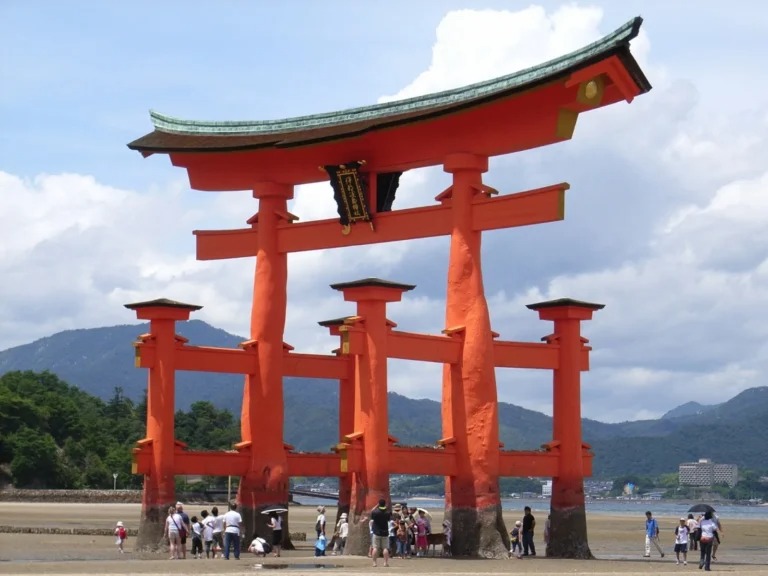
The iconic great torii gate of Itsukushima Shrine has stood in the sea for approximately 900 years since the era of Taira no Kiyomori, rebuilt multiple times throughout its history…
Traditional Techniques of Palace Carpenters
At the heart of Itsukushima Shrine’s restoration work are the miyadaiku—palace carpenters who specialize in the construction and repair of shrines and temples. These craftsmen possess advanced skills and knowledge quite different from those required for ordinary building construction.
The Art of Wood Joinery
The signature technique of palace carpenters is kigumi, or wood joinery. Using almost no nails or metal hardware, craftsmen assemble structures by interlocking wooden pieces cut with precisely fitted protrusions and cavities. This method requires calculating the strength and direction of forces acting on the building, selecting appropriate wood, and applying suitable processing.
Even within a single tree, wood strength varies depending on which section is cut. Carpenters must read the wood’s natural characteristics and anticipate how it will change over decades. Such knowledge cannot be learned from textbooks alone—it requires years of hands-on experience touching and observing wood.
The Shrine’s Dedicated Master Carpenter
Itsukushima Shrine maintains dedicated palace carpenters on site. Master carpenters like Shingo Mifune, who lived on Miyajima for 18 years as chief carpenter, hold the prestigious certification of “Cultural Property Wooden Construction Chief Technician”—a qualification possessed by only about 200 people nationwide. These skilled craftsmen handle daily maintenance and restoration work.
Becoming a fully qualified palace carpenter requires a minimum of ten years, with mastery demanding even longer. Beyond architecture, the profession requires broad knowledge spanning religious studies and history. This high level of specialization makes training successors a significant challenge.
Preserving Hinoki Bark Roofing
The beautiful roofs that characterize Itsukushima Shrine’s buildings are created through hiwadabuki—a uniquely Japanese traditional roofing technique using hinoki cypress bark. In 2020, this craft was registered as a UNESCO Intangible Cultural Heritage under “Traditional skills, techniques and knowledge for the conservation and transmission of wooden architecture in Japan.”
Bark Harvesting by Motokawashi Specialists
Hinoki bark is harvested from living cypress trees at least 70 to 80 years old. Specialists called motokawashi use a special spatula to peel away the bark while carefully avoiding damage to the tree’s growth layer. Once harvested, the bark regenerates in 8 to 10 years. The “black bark” from second and subsequent harvests is considered higher quality than the initial “rough bark.”
Motokawashi climb trees over 20 meters tall using ropes to perform this dangerous work. Mastering these skills requires extreme dedication—currently only about 25 registered motokawashi actively practice this craft nationwide. Only about 20% of those who begin training achieve professional-level competency.
Roof Installation by Hiwadabuki Craftsmen
Harvested bark is processed by hiwadabuki craftsmen into roofing materials through a preparation process called koshirae, which accounts for about three-quarters of their work. The bark is shaped into dozens of different forms depending on where it will be used on the roof.
When installing the roof, work begins at the eaves and proceeds upward, securing the bark with bamboo nails. The standard overlap between layers is 1.2 centimeters, with bamboo nails driven in every five layers. A completed roof reaches approximately 10 centimeters thick and lasts 30 to 40 years.
The Challenge of Material Supply
Approximately 700 buildings designated as Important Cultural Properties feature hinoki bark roofing, requiring about 3,500 square meters of bark annually for maintenance. However, actual supply reaches only about 1,740 square meters per year—less than half the necessary amount.
Contributing factors include declining numbers of large-diameter hinoki trees suitable for bark harvesting, fewer forest owners permitting harvesting, and the shortage of trained motokawashi. The Kinki-Chugoku Regional Forest Office and other national forest agencies have designated “Hinoki Bark Harvesting Forests” to provide stable supply and training grounds for new bark harvesters.
The Reiwa Great Torii Restoration (2019-2022)
The large-scale restoration of the great torii gate from June 2019 to December 2022 attracted widespread attention as the first major repair in approximately 70 years. This project demonstrated the cutting edge of cultural property restoration, combining traditional techniques with modern technology.
Discovering Unexpected Deterioration
The current torii gate (the 9th generation), rebuilt in 1875, stands approximately 16.6 meters tall and weighs about 60 tons—making it one of Japan’s largest wooden torii. Initial plans estimated 18 months for completion. However, surveys revealed severe damage from termites and decay-causing fungi invisible from the outside. Cavities measuring 40 to 50 centimeters in diameter and approximately 4 meters deep were discovered inside the main pillars, extending the project to three and a half years.
Blending Traditional and Modern Methods
Master carpenter Yoshiyuki Murase, who led the palace carpenter team, reflected that “the damage was greater than anyone imagined.” Yet approximately 10,000 craftsmen gathered from across Japan over the project’s duration, applying their collective wisdom and experience. Work included removing unusable materials, cutting away weakened sections, and filling gaps with fitted wood pieces.
The restoration involved completely re-roofing with hinoki bark, repairing the lacquered plaques, reapplying vermillion paint, and addressing modern concerns through seismic reinforcement. Traditional techniques were honored while incorporating the latest earthquake-resistant technology.
Training Ground for Young Craftsmen
The restoration site served as an invaluable training opportunity. Twenty-six-year-old Yui Ichinomiya was entrusted with vermillion painting and led younger colleagues as site leader. Despite the physically demanding and painstaking nature of the work, young craftsmen found pride in “carrying forward structures inherited from the past to future generations.”
During construction, scaffolding was covered with wide-mesh netting (10-centimeter squares) allowing visibility during daylight hours. Evening illumination of the scaffolding created what visitors called a “mystical construction site”—demonstrating thoughtful consideration for tourists and worshippers throughout the project.
Modern Challenges and Future Preservation
Itsukushima Shrine’s restoration techniques face various challenges in the modern era. Overcoming these obstacles and passing skills to the next generation remains the responsibility of our time.
The Serious Problem of Successor Shortage
Both palace carpenters and bark harvesters require lengthy training periods. A palace carpenter needs a minimum of ten years to become fully qualified; a bark harvester requires ten years for basic competency and over twenty years to achieve mastery. With fewer young people willing to endure such extended apprenticeships, the shortage of skilled successors grows increasingly critical.
Difficulties in Securing Materials
The declining availability of large hinoki trees suitable for bark harvesting and fewer forest owners permitting harvesting create significant material supply challenges. Initiatives like the “Hinoki Bark Harvesting Forests” in national forests and forest management agreements aim to ensure stable supply, but these efforts still fall short of meeting demand.
Renewed Recognition of Traditional Crafts
Modern society tends to favor fast, cost-efficient construction methods, placing traditional techniques at an economic disadvantage. However, the 2020 UNESCO Intangible Cultural Heritage registration provided an opportunity to internationally recognize the value of these skills.
Cultural properties like Itsukushima Shrine serve as venues where palace carpenters, bark roofers, and decorative painters transmit their techniques to the next generation through regular restoration projects. Beyond simple building maintenance, these projects represent crucial opportunities to protect and pass on Japan’s traditional craftsmanship.
FAQ
How often is Itsukushima Shrine restored?
The hinoki bark roofing has a lifespan of 30 to 40 years and is replaced on this cycle. Emergency repairs follow natural disasters such as typhoons. Daily maintenance is performed by dedicated palace carpenters who live and work on Miyajima year-round.
How can someone become a palace carpenter?
There are two main paths: attending a specialized school with a traditional architecture program (3 to 4 years) or apprenticing directly with a palace carpenter workshop. Becoming fully qualified takes a minimum of ten years, with mastery requiring even longer. The profession demands patience, physical stamina, flexibility, and a genuine commitment to preserving tradition.
Where does the hinoki bark come from?
Bark is harvested from living hinoki cypress trees at least 70 to 80 years old. Supply comes from designated “Hinoki Bark Harvesting Forests” in national forests such as those managed by the Kinki-Chugoku Regional Forest Office, as well as from private forests. However, current supply falls significantly short of demand.
What was the biggest challenge during the 2019-2022 torii restoration?
The discovery of termite and fungal damage far exceeding initial expectations proved most challenging. Cavities measuring 40 to 50 centimeters in diameter and approximately 4 meters deep were found inside the main pillars—invisible from external inspection. Craftsmen had to remove compromised materials and fill gaps with fitted wood while maintaining traditional methods and adding modern seismic reinforcement.
Can visitors watch restoration work in progress?
During the great torii restoration (2019-2022), scaffolding was covered with wide-mesh netting that allowed daytime visibility. Evening illumination created memorable views. For future projects, check the official Itsukushima Shrine website for current construction status and viewing opportunities.
Why are these traditional techniques considered UNESCO heritage?
In 2020, “Traditional skills, techniques and knowledge for the conservation and transmission of wooden architecture in Japan” was inscribed on UNESCO’s Representative List of the Intangible Cultural Heritage. This recognition encompasses hinoki bark roofing, wood joinery, and other specialized crafts essential for maintaining Japan’s historic wooden structures—acknowledging both their technical excellence and their role in cultural continuity.
How can these traditional skills be preserved for the future?
Current preservation efforts include training programs coordinated between forest management bureaus and craft preservation associations, observation tours for students at forestry schools and local schools, and using major restoration projects as hands-on training opportunities for young craftsmen. International recognition through UNESCO has also raised awareness and support for preservation initiatives.
Summary
The restoration techniques of Itsukushima Shrine represent the crystallization of Japanese traditional craftsmanship passed down for over 800 years. Behind the remarkable preservation of these sea-based shrine buildings lies a design philosophy of coexisting with nature, palace carpenters’ wood joinery expertise, bark roofers’ specialized skills, and the distinctive concept of “architecture built with repair in mind.”
The major restorations spanning the Meiji, Taisho, Showa, and Reiwa eras document how craftsmen of each generation overcame disasters and challenges while simultaneously transmitting their techniques to successors. The 2019-2022 great torii restoration particularly demonstrated how traditional and modern technologies can work together at the forefront of cultural property conservation.
Today, challenges including successor shortages and material supply difficulties threaten the continuity of these traditional techniques. Recognizing these challenges across society and providing support is essential to preserving irreplaceable cultural heritage for the future. The restoration techniques of Itsukushima Shrine represent more than construction methods—they embody the Japanese relationship with nature, aesthetic sensibilities, and the ongoing commitment to protecting and transmitting cultural heritage.
References and Sources
- World Heritage “Itsukushima Shrine” Repair and Preservation | Ocean Newsletter | Ocean Policy Research Institute
- Itsukushima Shrine Great Torii Large-Scale Restoration | Masuokagumi
- Connecting to Future Generations: The Vermillion Symbol – 3.5-Year Record of Miyajima Great Torii Revival | Television Shin-Hiroshima
- Raising People, Entrusting Skills, Connecting Heian Era to Future Generations | Cherishing Miyajima for Another 1000 Years
- Hinoki Bark Roofing – Wikipedia
- Hinoki Bark Roofing | Tomoi Shrine Architecture
- Hinoki Bark – Special Forest Products Supporting Cultural Properties | Japan Special Forest Products Promotion Association
- Hinoki Bark Roofing / Shingle Roofing | Cultural Heritage Online
- Hinoki Bark Harvesting | Cultural Heritage Online
- “Hinoki Bark Forest” Forest Management Agreement Initiatives | Chubu Regional Forest Office
- Itsukushima Shrine – Wikipedia
- Construction Status and Plans | Itsukushima Shrine Official Site