Miyajima in Aki Province has been revered since ancient times as “the island that serves the gods.” Why has the mystical sight of its beautiful vermilion-lacquered shrine buildings floating on the sea continued to captivate people for over 1,400 years? The answer lies in the grand historical narrative woven by the powerful, the devout, and the cultured figures of each era.
Miyajima’s history is a living museum reflecting the shifts in Japan’s politics, religion, and culture. Beginning with ancient nature worship, through the Heian period’s grand construction by the Taira clan, the preservation of faith under the Kamakura and Muromachi shogunates, protection by the Mori clan during the Warring States period, the expansion of popular worship in the Edo period, the upheaval of the Meiji Restoration’s separation of Shinto and Buddhism, and finally to its modern designation as a World Heritage Site—Miyajima has been involved in every major turning point in Japanese history.
This article comprehensively explains Miyajima’s history from its founding in the first year of Empress Suiko’s reign (593) to the modern Reiwa era, examining four perspectives: historical development, cultural aspects, religious significance, and political-economic impact. It is designed for international travelers planning a trip to Miyajima, offering context that enriches your visit to Itsukushima Shrine and the Great Torii.
Let’s Trace Miyajima’s History Chronologically
Ancient Times: From the Mythological Era to the Asuka Period
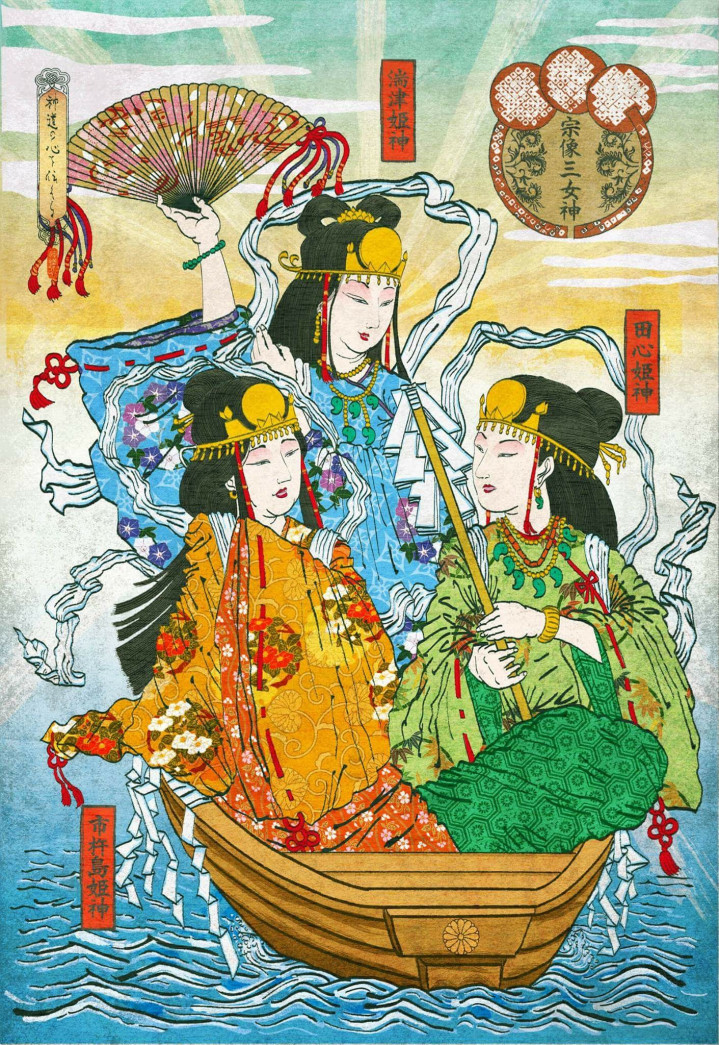
Miyajima’s story reaches back to the mythic age, before written records. According to the Kojiki and Nihon Shoki, worship began when the Munakata Three Goddesses—Ichikishimahime-no-Mikoto, Tagorihime-no-Mikoto, and Tagitsuhime-no-Mikoto—born from a sacred oath (uke) between Amaterasu Omikami and Susanoo-no-Mikoto, came to dwell here. Since ancient times they have been revered as guardian deities of maritime safety and transportation.
The mystical mountainous landscape, with Mount Misen as its main peak, provided the backdrop for the island itself being revered as a divine entity. Mount Misen, standing at 535 meters, was cloaked in primeval forests so dense they seemed dark even at midday, while clusters of giant rocks formed a sacred scenery. Sensing the island’s spiritual power, ancient people worshipped the whole island as “Itsukushima”—the island that serves the gods.
According to shrine tradition, in the first year of Empress Suiko’s reign (593 AD), Saeki Kuramoto, a leader of the Saeki clan, received an oracle and built the shrine’s main hall at its present location. The Saeki were ancient nobles of Aki Province, entrusted with managing Miyajima, a crucial hub for Seto Inland Sea traffic. The original hall was simple and built over the sea out of reverence for the sacred land of the island.
For more details on the founding, check the article below
When you visit Itsukushima Shrine, the sight of its “floating” torii g...
Nara and Heian Periods: Interaction with the Capital and Expansion of Worship
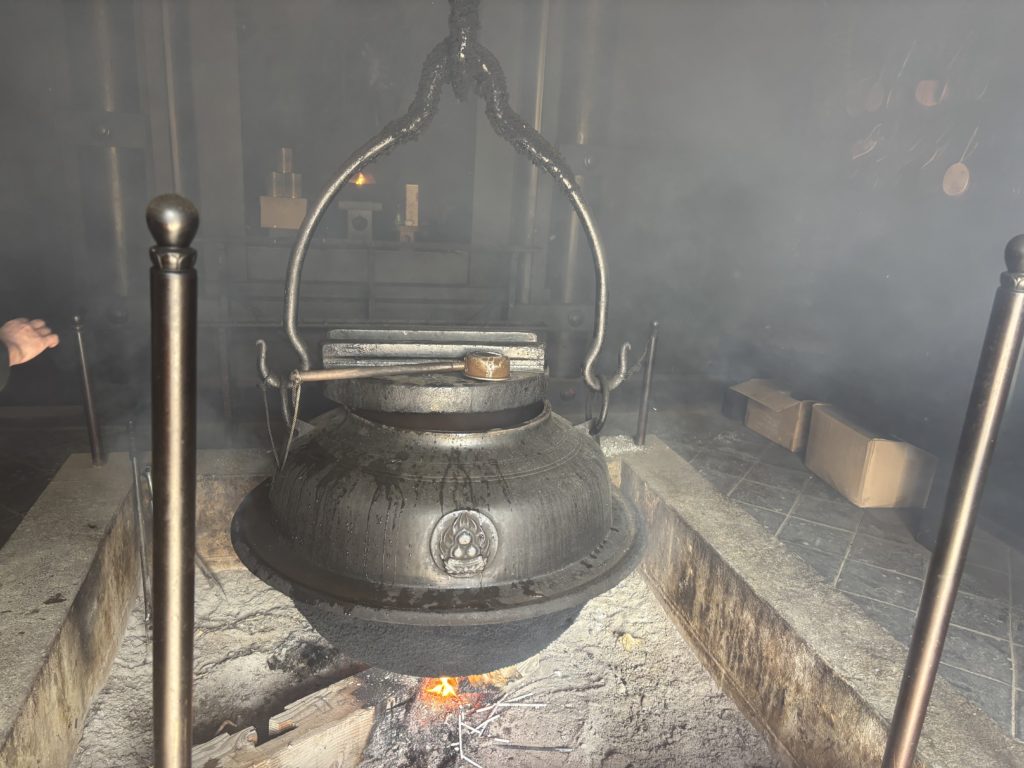
In 806, Kobo Daishi Kukai, returning from Tang China, visited Miyajima. Feeling the island’s spiritual energy, he built a hall on Mount Misen. The flame from the homa ritual performed during his 100-day gomuji ascetic practice is the “Eternal Flame” that still burns today in the Misen Sacred Fire Hall. This flame later became the seed for the “Flame of Peace” at Hiroshima Peace Memorial Park, carrying more than 1,200 years of history into the present.
With Kukai’s founding on Mount Misen, Miyajima became a sacred site of Shinto-Buddhist syncretism. Princess Ichikishimahime was identified with the Buddhist goddess Benzaiten, and the principal deity of Itsukushima Shrine was designated as the Eleven-Faced Kannon. From this era, offerings rooted in the Lotus Sutra and Amida faith flourished, drawing the attention of Kyoto’s nobility to Miyajima.
By the mid-Heian period, aristocrats led by the Fujiwara clan made pilgrimages to Itsukushima. Fujiwara no Michinaga recorded his offerings to the shrine, marking the flow of court culture to Miyajima. During this time, gagaku court music and bugaku court dance were introduced, laying the foundation for Miyajima’s distinctive performing arts culture.
Late Heian Period: Taira no Kiyomori’s Grand Reconstruction and Cultural Golden Age
The most crucial turning point in Miyajima’s history was the grand reconstruction led by Taira no Kiyomori. Appointed Governor of Aki Province in 1146, Kiyomori showed deep devotion to Itsukushima Shrine, and by 1168 (the third year of the Nin’an era), he completed the magnificent shrine complex we admire today. This project elevated Miyajima from a provincial shrine to a cultural center rivaling the capital.
Kiyomori’s reasons for championing Miyajima were multifaceted. Politically, it demonstrated control of the Seto Inland Sea; militarily, it served as a guardian for the Taira naval forces; and personally, it reflected his profound faith during his rise to become the first warrior to attain the position of Grand Minister of State. His renovation was a comprehensive undertaking that intertwined politics, economy, and culture, far beyond mere religious patronage.
The “Heike Nokyo” sutras, dedicated in 1164, are the most tangible proof of Kiyomori’s faith. These 33 volumes of decorated sutras—each transcribed by one of 32 members of the Taira clan, led by Kiyomori—are National Treasures and the pinnacle of Heian illuminated sutras. With lavish gold and silver, elegant frontispiece paintings, and intricate metal fittings, they exemplify the highest craftsmanship of the era.
Under Kiyomori’s strong patronage, Emperor Go-Shirakawa visited Itsukushima Shrine in 1174 (Joan 4), followed by Emperor Takakura in 1176 (An’ei 2). These imperial visits elevated Miyajima to the “Nikko of the West,” bringing an influx of courtly culture. The essence of Heian culture converged here: shrine architecture influenced by shinden-zukuri palace style, the transplantation of court music, and the splendid Kangen-sai festival celebrated even in The Tale of the Heike.
During this era, Miyajima radiated a cultural brilliance worthy of “Heian-kyo on the Sea.” Kiyomori’s daughter, Empress Dowager Tokuko, also paid pilgrimage. Through the journeys of Taira noblewomen, refined female court culture was transplanted to Miyajima. The sight of waka poetry gatherings and kangen music echoing through sea-lapped corridors symbolized the cultural zenith of the age.
For more details on the Taira no Kiyomori era, check the article below
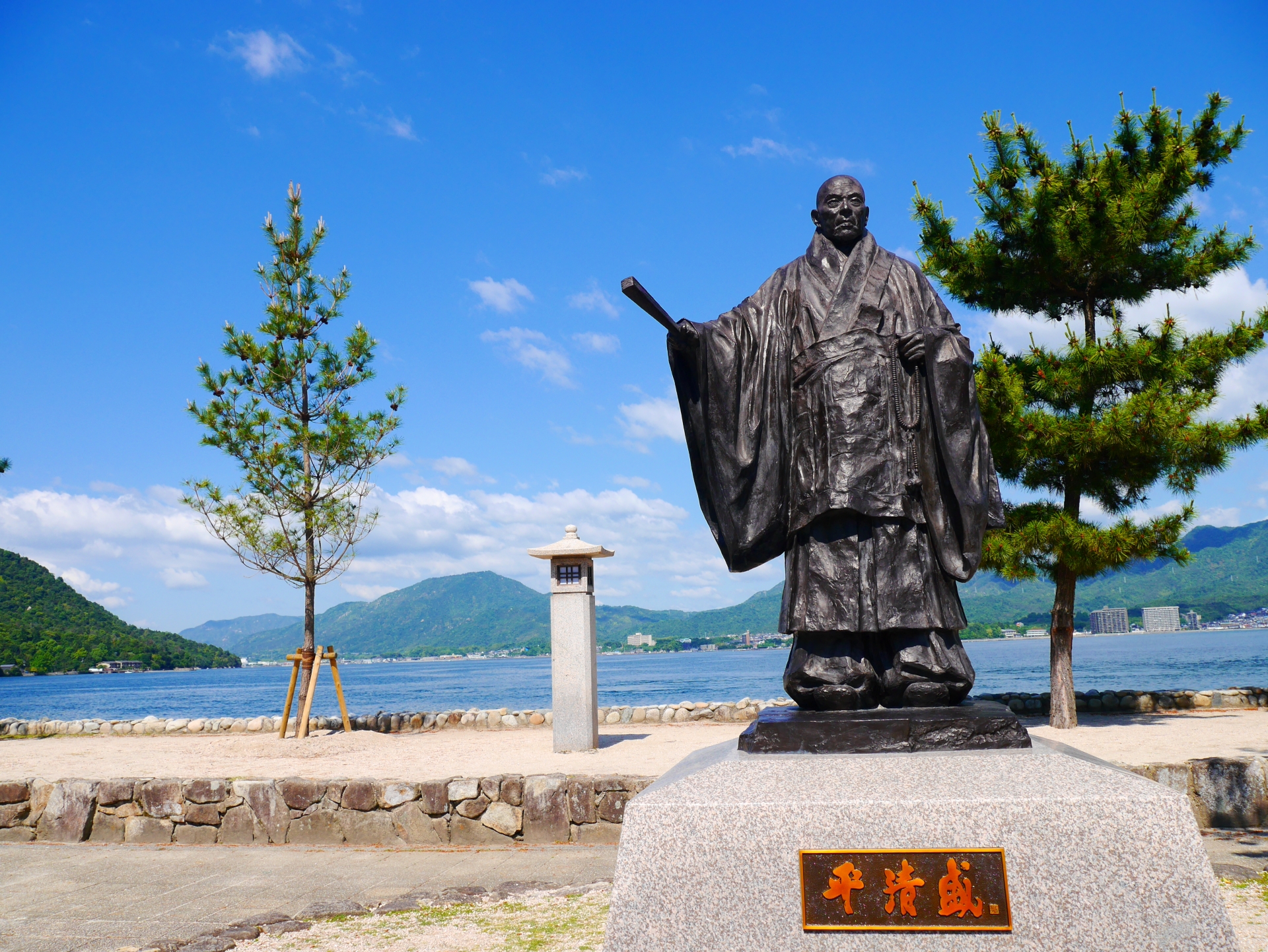
Taira no Kiyomori, the first warrior to rise to the rank of Grand Mini...
Kamakura and Muromachi Periods: Maintaining Faith and Cultural Development Under the Military Government
After the Heike clan’s fall in the Genpei War, Miyajima entered a new chapter. The Kamakura Shogunate recognized the importance of Itsukushima Shrine and continued protective policies without erasing the Heike legacy. Minamoto no Yoritomo himself sent envoys with offerings in 1192 (Kenkyu 3), ensuring Miyajima’s status under samurai rule.
A notable policy of this era protected the entire island as shrine grounds. A shogunate decision in 1251 (Kencho 3) strictly prohibited logging, hunting, and land reclamation on Miyajima, safeguarding its natural environment. Thanks to this, the Misen Primeval Forest survives in near-pristine condition today.
In the Muromachi period, Noh theater was formally introduced to Miyajima. Performers from the Kanze and Konparu schools visited Itsukushima, staging dedication performances on the floating Noh stage. The current stage, built in 1568, is Japan’s oldest floating Noh stage and a treasured cultural asset. The fusion of Noh—the essence of Muromachi culture—with Heian-era gagaku and bugaku completed Miyajima’s distinctive performing arts culture.
The current five-storied pagoda was built in 1407 for Kongo-in, then a sub-temple of Daisho-in. Blending Zen and traditional Japanese styles, its sweeping curved eaves showcase the excellence of Muromachi-period architecture while adding majesty to Miyajima’s skyline.
Warring States Period: The Rise of the Mori Clan and the Battle of Itsukushima
The most dramatic event on Miyajima during the Warring States period was the Battle of Itsukushima in 1555. Far more than a local clash, it reshaped the political landscape of the Chugoku region and influenced the course of Japanese history.
After Ouchi Yoshitaka’s death, his retainer Sue Harukata seized power, but Mori Motonari rebelled. Outnumbered, Motonari devised a daring plan that leveraged Miyajima’s complex terrain. He built a castle at Miyanoo in northern Miyajima to lure Sue’s forces. Then, taking advantage of a violent storm before dawn on October 1, he secretly landed at Hakoga-ura. From there, he launched a swift assault down the Hokudo slope, routing the Sue army.
This victory gave Mori Motonari the foothold to unify the Chugoku region, laying the foundation for his rise as a major warlord. Viewing the victory as divine favor, Motonari deepened his reverence for Itsukushima Shrine, funding repairs and enriching its rituals. Under Mori protection, Miyajima’s cultural traditions survived the era’s upheaval.
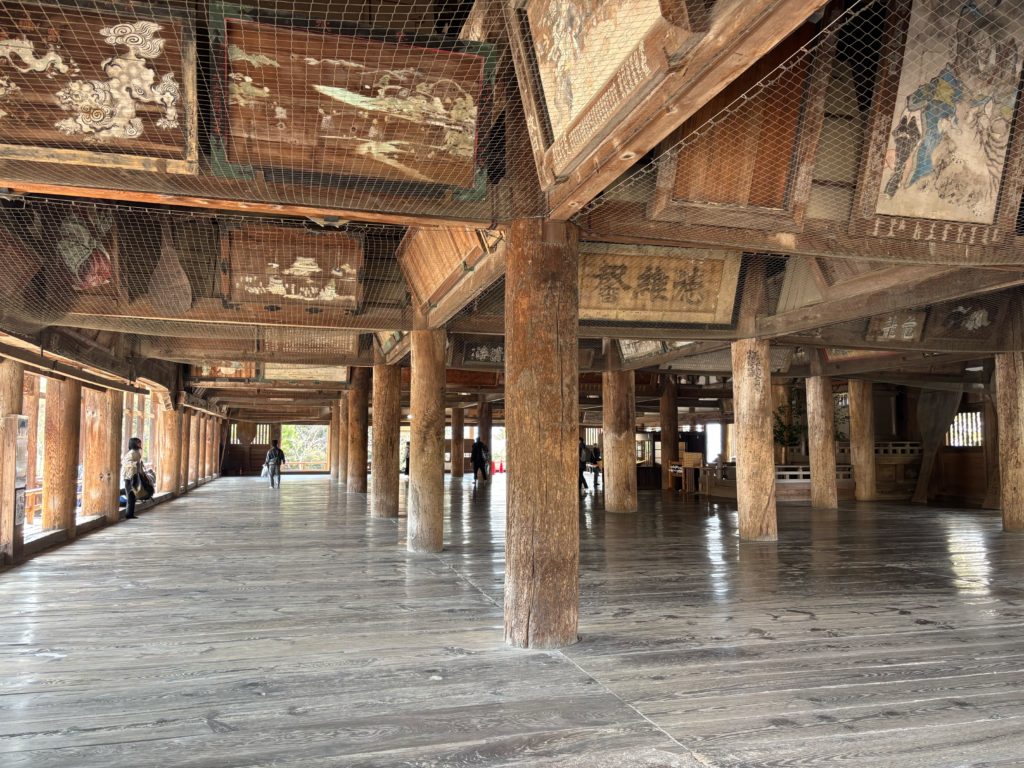
In 1587, Toyotomi Hideyoshi visited Miyajima and ordered construction of the Daikyo-do Hall (Senjokaku). Planned as a grand memorial to Taira no Kiyomori with a scale of 857 tatami mats, it was left unfinished after Hideyoshi’s sudden death in 1595 (Bunroku 4). Today, this colossal, unfinished wooden hall powerfully conveys the architectural ambition of the Momoyama period.
Edo Period: The Asano Domain’s Protection Policy and the Expansion of Popular Worship
After the Battle of Sekigahara in 1600 (Keicho 5), Masanori Fukushima became daimyo of Hiroshima with 498,000 koku from Aki and Bingo. He designated Itsukushima Shrine as the domain’s chief guardian shrine. In 1602 (Keicho 7), he repaired the Heike Nokyo and dedicated a lacquered chest adorned with ivy maki-e. During these repairs, Tawaraya Sotatsu produced new cover paintings, completing the Heike Nokyo as we see it today.
In 1619 (Genna 5), when Asano Nagamasa became lord of Hiroshima, a more systematic protection policy began. Generation after generation, the Asano clan treated Itsukushima as the spiritual pillar of their domain, funding regular repairs, maintaining rituals, and confirming shrine lands. Many of the buildings you see today reflect work carried out during the Asano era—knowledge that enriches any visit to Itsukushima Shrine for culture travelers.
A notable Edo-period figure was the monk Seishin, active during the Kanbun era (1661–1673). Formerly a rice merchant in Hiroshima, Seishin became a monk at Komyo-in on Miyajima and dedicated himself to improving island life. His achievements—creating the rice paddle inspired by Benzaiten’s biwa, digging wells to relieve water shortages (Seishin Tsuri-i), and constructing gangi (wooden wharves)—are still appreciated by locals.
From the mid-Edo period onward, improved transport and the growing economic power of commoners made Miyajima famous nationwide as a travel destination. The name “Aki no Miyajima” spread widely, and even the comic travelers Yaji and Kita from Tokaidochu Hizakurige visited. Utagawa Hiroshige’s print of Itsukushima in “Famous Places in the Sixty-odd Provinces” broadcast Miyajima’s beauty and spurred a surge in pilgrims.
During this era Miyajima flourished as a temple town. Inns, souvenir shops, and eateries lined the streets, while crafts like Miyajima woodwork matured. Oyster cultivation was organized, laying the foundation for Hiroshima-style oysters that travelers still seek out on Miyajima today.
In 1866 (Keio 2), during the Bakumatsu, ceasefire negotiations for the Second Choshu War were held at Daiganji Temple. Talks between Katsu Kaishu, the shogunate’s Navy Commissioner, and Hirosawa Masatomi of Choshu remain a notable scene in late Edo history.
Meiji Era: A Time of Great Change and the Path to a New Miyajima
The Meiji Restoration brought Miyajima’s greatest transformation. The Shinto-Buddhist Separation Edict of 1868 (Meiji 1) dismantled a syncretic system that had endured for over 1,200 years. A government advisor judged the main hall “Buddhist in style” and even ordered its demolition.
Local stakeholders, led by the chief priest, confronted the crisis. They petitioned the government in Tokyo, arguing the shrine’s historical and cultural value. Their efforts averted destruction, but all painted decorations deemed “Buddhist” were stripped, and structures were restored to “white wood.” New chigi (gable poles) and katsuogi (log billets) were added, lending a more distinctly Shinto appearance.
The Daikyo-do Hall (Senjokaku) had its inner sanctuary ornaments removed, its Buddhist statues taken away, and was converted into the subsidiary Toyokuni Shrine. The five-storied pagoda was affiliated with Toyokuni Shrine, further reducing Buddhist elements on the island. Temples such as Daisho-in and Daiganji were separated from Itsukushima Shrine and became independent religious corporations.
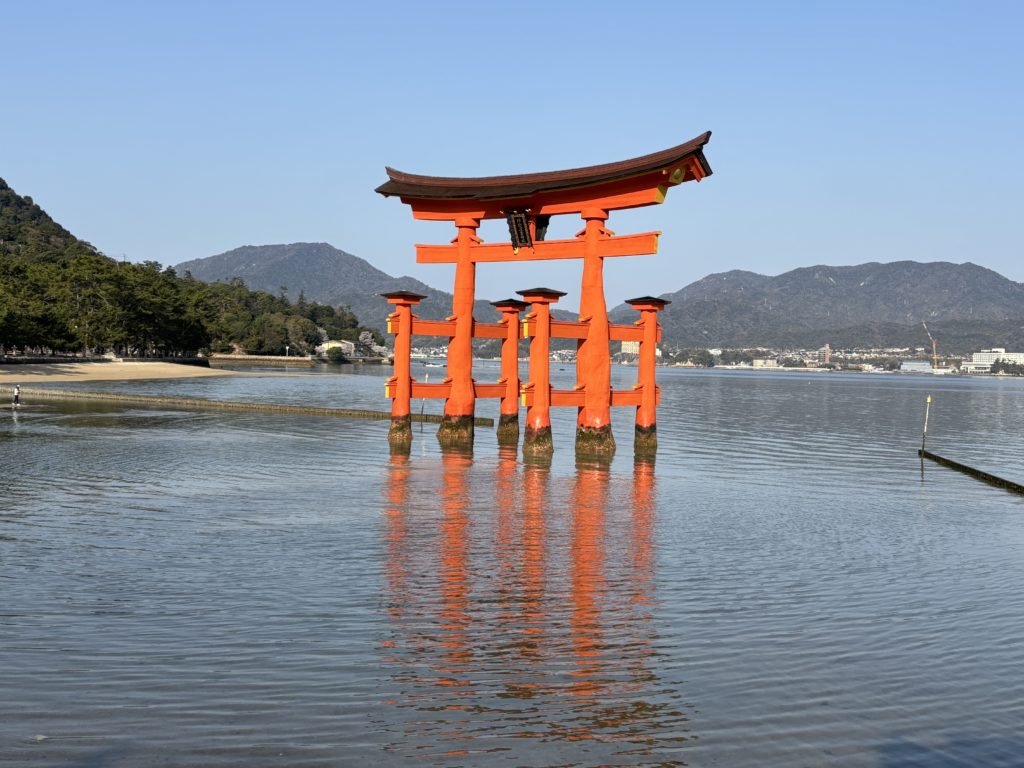
Yet change also brought renewal. In 1875 (Meiji 8), the current Great Torii was rebuilt. Standing 16.6 meters tall and using natural camphor for its main pillars, the gate symbolized the Meiji government’s technical prowess and respect for Miyajima. The eighth generation since the Heian period, it was designated an Important Cultural Property (then National Treasure) in 1899 (Meiji 32).
The Meiji period also saw the birth of modern cultural property protection. With the Ancient Shrines and Temples Preservation Act of 1897, Miyajima’s treasures, including the Heike Nokyo, were designated National Treasures, laying the groundwork for today’s preservation system.

Taisho and Showa Eras: Development of Cultural Property Protection and the Impact of War
During the Taisho period, cultural property preservation gained momentum on Miyajima. Central was the creation of an exquisitely detailed replica of the Heike Nokyo. In 1920 (Taisho 9), led by cultural figures such as Masuda Don’o and Takahashi Soan, and financed by Okura Kihachiro and others, this unprecedented project began.
The replica, completed over five and a half years by the painter Chimi Tanaka—praised for “divine craftsmanship”—is indistinguishable from the original and remains vital for research and exhibitions. The project pioneered replica-making as preservation, shaping later conservation philosophy.
In the early Showa era, improved transport infrastructure dramatically increased tourism. The opening of the Miyajima Line (now the Hiroshima Electric Railway Miyajima Line) in 1929 (Showa 4) enabled day trips from Hiroshima City, positioning Miyajima as a modern sightseeing destination for domestic and international visitors.
During the Pacific War, Miyajima acquired military importance due to its proximity to the Kure Naval Base. Naval training facilities and munitions production were established, and many soldiers and workers were stationed on the island. Even so, local efforts evacuated and safeguarded Itsukushima Shrine’s cultural assets, sparing them from war damage.
In the postwar reconstruction, Miyajima became a symbol of peace. The “Flame of Peace” in Hiroshima Peace Memorial Park was kindled from Mount Misen’s “Eternal Flame,” embodying Japan’s wish for peace after the war.
The Cultural Properties Protection Law of 1950 (Showa 25) dramatically strengthened preservation. Core shrine structures became National Treasures and Important Cultural Properties; the island and surrounding waters were designated Special Historic Sites and Special Places of Scenic Beauty; and the Misen primeval forest became a Natural Monument—establishing a comprehensive protection framework.
Contemporary Era: World Heritage Registration and International Recognition
The defining event of the Heisei era was Miyajima’s inscription as a UNESCO World Cultural Heritage site in December 1996 (Heisei 8). This achievement reflected years of local effort and rising global awareness of cultural heritage preservation.
The path began with Tentative List entry in 1992. The Agency for Cultural Affairs, Hiroshima Prefecture, Hatsukaichi City, and local stakeholders collaborated on promotion, leading to formal nomination in September 1995. At the 20th World Heritage Committee in Mexico in December 1996, Itsukushima Shrine was inscribed as a cultural property meeting four evaluation criteria.
With World Heritage status, Miyajima became an international travel destination, drawing over 4 million visitors annually. Overseas visitors, especially from Europe and North America, often praise it as “the most beautiful place in Japan”—and it is now a must-see on many Japan itineraries.
Rapid growth in tourism has also created new challenges. Sustainable tourism policies are urgently needed to address rising maintenance costs for shrine buildings and the Great Torii, congestion on the island, and impacts on the natural environment.
The large-scale restoration of the Great Torii that began in 2021 symbolizes the fusion of traditional craftsmanship and modern technology. After its first major overhaul in about 70 years, the gate regained its vivid vermilion in 2023—welcoming visitors once more as the face of Miyajima.
Modern Miyajima carries a dual mission: preserve traditional culture while adapting to contemporary society. Through digital archiving of cultural assets, multilingual visitor information, and environmentally conscious operations, it continues to evolve as a sacred site fit for the 21st century.

Miyajima’s History by Theme
Miyajima’s Development Through the Lens of Religious History
Miyajima’s religious history encapsulates Japan’s evolution of belief. From ancient nature worship to the systematization of Shinto, from the arrival of Buddhism and centuries of syncretism to the Meiji separation of Shinto and Buddhism, and on to today’s religious diversity—the defining characteristics of each era are etched into Miyajima.
Worship of the Munakata Three Goddesses began as a practical faith praying for safe voyages and abundant fishing. Ichikishimahime-no-Mikoto, Tagorihime-no-Mikoto, and Tagitsuhime-no-Mikoto each preside over aspects of maritime protection and were revered as deities woven into daily life. This primitive Shinto faith became the foundation of Miyajima’s religious culture.
In the Heian period, Shinto-Buddhist syncretism transformed Miyajima into a complex religious space. Ichikishimahime became identified with Benzaiten, gaining new devotion as a deity of music, performing arts, and scholarship. The Eleven-Faced Kannon, designated as the honji-butsu (fundamental Buddha) of Itsukushima, has 33 manifestations corresponding to the 33 chapters of the Lotus Sutra—prompting dedication of the 33 volumes of the Heike Nokyo collection.
Kobo Daishi’s establishment on Mount Misen introduced mountain asceticism (shugendo). Rigorous practices rooted in Shingon esoteric doctrine drew many ascetics and monks to the island. The “Eternal Flame” transcends religious symbolism, connecting to modern ideals of peace.
Today, Miyajima functions as a unique religious space where Shinto, Buddhism, and shugendo coexist. The Shinto rituals of Itsukushima Shrine, the Buddhist services of Daisho-in Temple, and ascetic practices on Mount Misen operate independently yet influence one another, shaping the island’s distinctive spiritual atmosphere.
Miyajima’s Journey Through the Lens of Culture and Arts
Miyajima is a “museum of culture” that embodies the development of Japanese arts. From Heian-period gagaku and bugaku to Muromachi-period Noh, and early modern folk performing arts, the representative traditions of each era have been performed here and continue today—one reason culture lovers rank Miyajima among the best places to visit in Japan.
Court music transplanted during Kiyomori’s era gave rise to Miyajima’s unique maritime performance. During the Kangen Festival, musicians perform gagaku aboard ornate boats while cruising the sea, recreating Heian elegance for modern audiences. This sea-borne performance is rare worldwide and draws interest from researchers and travelers alike.
Techniques for bugaku masks and costumes also evolved uniquely on Miyajima. Practical needs—like preservation suited to humid sea air, materials resistant to salt-laden breezes, and regular repair systems—led to innovations that enhanced their value as cultural assets.
In architecture, the maritime setting spurred original techniques: flexible structures that adapt to tides, wood treatment that resists salt damage, and underwater foundation construction. These time-tested methods still inform modern marine architecture and fascinate visitors touring the shrine complex.
In crafts, Miyajima woodcarving (Miyajima-bori) developed in the Edo period. Delicate carving using local woods gained popularity as pilgrimage souvenirs and remains a vital local industry. The craft of rice paddle making also evolved from utilitarian items into works of artistry—great souvenirs for travelers exploring local food culture and shopping streets.
Miyajima’s Historical Role from a Political and Economic Perspective
Miyajima has always been a sacred site with political weight. From the ancient Saeki clan to the modern state, rulers of every era invested prestige and resources into its protection and development. That patronage underpinned Miyajima’s cultural flourishing and its later recognition as a World Heritage travel destination.
For Taira no Kiyomori, Miyajima was a strategic stronghold symbolizing command of the Seto Inland Sea. Securing maritime routes for the Taira and capturing economic benefits from Kyushu and the Chugoku region justified massive investment. Kiyomori’s policy skillfully combined sincere devotion with political calculation.
The Mori clan’s protection was similarly tied to their goal of unifying the Chugoku region. By framing victory at the Battle of Itsukushima as “divine will,” they legitimized their authority and eased governance of conquered territories.
In the Edo period, the Asano clan used Miyajima as the spiritual pillar of domain governance. The institutionalized pilgrimages of the lord reinforced cohesion among retainers and loyalty among subjects. As Miyajima developed as a tourist destination, it also boosted the domain’s economy.
Economically, Miyajima has been a key hub on Seto Inland Sea routes since antiquity. Pilgrimage-related lodging and dining, souvenir sales, and craft production formed core industries. The rise of tourism after the Edo period fundamentally reshaped the island’s economic structure and continues today with international visitors seeking cultural experiences at Itsukushima Shrine.
Today, World Heritage status cements Miyajima’s place on Japan itineraries and generates a large economic impact. Yet sustainable tourism policies are essential to prevent over-commercialization and preserve cultural value for future generations.
Miyajima: Where Nature and Humans Have Coexisted
Miyajima’s history is also a pursuit of harmony between nature and people. The belief that the entire island is sacred ultimately preserved a globally precious natural environment that travelers experience today on hiking trails and coastal walks.
The Misen Primeval Forest, strictly protected since the Kamakura period, preserves the original vegetation of the Seto Inland Sea region. Its ecosystem—blending temperate conifers (such as Japanese fir and hemlock) with broadleaf species—holds high academic value.
Deer on Miyajima have been protected as sacred messengers since ancient times. The herd, now about 600 strong, illustrates centuries of human-animal coexistence. Recent issues like feeding and crop damage have prompted careful management, but deer remain integral to the island’s cultural landscape.
The marine environment reflects over 1,400 years of interaction between tides and architecture. The complex ecosystem shaped by tidal flats, seagrass beds, and fish habitat—interacting with human-made structures—is a valuable subject for marine biology and a striking sight for visitors, especially at high tide when the shrine appears to float.
Modern conservation policies balance World Heritage values with rising tourism. Measures include visitor flow management, traffic regulation, waste reduction, and water quality protection—key to keeping Miyajima pristine for future travelers.
What Miyajima’s History Teaches Us
Miyajima’s 1,400-year story is not a cycle of destruction and creation, but a delicate balance of continuity and change. Each era respected the past while adding new value, producing a richly layered cultural heritage that rewards curious travelers.
Taira no Kiyomori’s renovation is the clearest example. Without destroying ancient Shinto traditions, he transplanted the essence of Heian aristocratic culture: shinden-zukuri architectural principles, gagaku and bugaku, and the techniques of decorated sutras. This model of “preserving while developing” guided later generations.
The Muromachi introduction of Noh followed the same path. Rather than replacing gagaku and bugaku, it enriched Miyajima’s performing arts by adding Noh. Their coexistence today reflects the period’s cultural tolerance.
The Asano clan’s Edo-period policies likewise inherited earlier legacies while adding new elements. They protected Heike and Mori heritage while fostering commoner and commercial culture, transforming Miyajima into a proto-modern tourist destination—an evolution that continues in today’s global travel era.
The Meiji separation of Shinto and Buddhism was Miyajima’s greatest trial, fundamentally altering its religious identity. Yet through local efforts, destruction was avoided, and while Buddhist elements were removed, architectural value was preserved.
The Showa-era cultural property system set Miyajima’s value within a modern conservation framework. Designations as National Treasures, Important Cultural Properties, Special Historic Sites, Special Places of Scenic Beauty, and Natural Monuments ensured its multifaceted value received legal protection.
The Heisei-era World Heritage inscription brought international recognition—and global responsibility. Modern Miyajima confronts the challenge of harmonizing preservation and use: maintaining tradition while adapting to contemporary society, revitalizing the community while protecting heritage, and balancing domestic and international tourism.
The essential lesson is that “creative development is vital for cultural continuity.” Cultural heritage survives not through preservation alone, but by protecting its essence while responding thoughtfully to the needs of the times.
Frequently Asked Questions
When did Miyajima become known as the “Island of the Gods”?
Miyajima has been revered as the “Island of the Gods” since prehistoric times, emerging from mountain worship centered on Mount Misen. The name “Itsukushima” means “island that serves the gods,” and the island was considered sacred even before the shrine’s founding in 593 AD. The belief that the entire island is a sacred object (goshintai) explains why the shrine halls were built over the sea.
Why did Taira no Kiyomori place such importance on Itsukushima Shrine?
Both political/military strategy and personal faith. Politically, Miyajima symbolized control of the Seto Inland Sea; militarily, it served as the guardian of the Taira fleet. Personally, Kiyomori’s deep devotion began during his tenure as Governor of Aki. He dedicated 33 volumes of sutras praying for the Taira clan’s prosperity and revered the shrine throughout his life, informed by his awareness as the first warrior to become Grand Minister of State.
What impact did the Battle of Itsukushima have on Japanese history?
It reshaped the power map of the Chugoku region and enabled the Mori clan’s rise. The victory allowed Mori Motonari to inherit the Ouchi sphere and grow into a major daimyo ruling eight provinces. Tactically, the success of terrain-based surprise attacks influenced Sengoku warfare. The battle also reasserted Miyajima’s status as a strategic stronghold.
How was Miyajima affected by the separation of Shinto and Buddhism?
A fundamental religious shift after over 1,200 years of syncretism. Measures included removing colored decorations, adding chigi and katsuogi, and eliminating Buddhist statues and implements. Daikyo-do became Toyokuni Shrine; the five-storied pagoda transferred to shrine ownership; Daisho-in and Daiganji were separated. Although demolition was considered at one point, strong local opposition and a direct petition by the chief priest prevented it, preserving the site’s architectural value.
What are the four criteria that were decisive for World Heritage registration?
Criterion i: a masterpiece of human creative genius (originality of the offshore shrine); Criterion ii: evidence of cultural exchange (fusion of Shinto, Buddhism, and court culture); Criterion iv: an outstanding example of a significant stage in human history (embodying Heian-period culture); and Criterion vi: association with ideas of outstanding universal significance (expressing the spirituality of Japanese culture). Fulfilling all four underscores Miyajima’s exceptional value.
Why is the Heike Nokyo such an important cultural asset?
It represents the pinnacle of Heian decorated sutras. The 33 volumes, dedicated by 32 members of the Taira clan, display lavish gold and silver, exquisite cover paintings, and intricate fittings. Each scroll, about 30 meters long, also records the Taira clan’s glory. They are preserved as National Treasures under strict security.
Why was the shrine built on the sea?
Because the island itself was venerated as sacred, people avoided disturbing the land. On Miyajima—revered as an island serving the gods—cutting trees or digging the earth was taboo. Building the shrine over the sea preserved the sanctity of the island and created the iconic scenery of halls floating at high tide—a highlight for travelers visiting Itsukushima Shrine.
What is the secret behind the Great Torii’s structure that prevents it from falling?
Ingenious self-weight and foundation design. The current eighth-generation torii (1875) stands on two massive camphor pillars bearing roughly 60 tons. Stability against storms comes from foundation stones embedded deep in the seabed, careful weight distribution, traditional timber joinery, and regular inspections and repairs.
Since when have deer been on Miyajima?
Deer have been protected as sacred messengers since ancient times. In Shinto, deer are divine messengers, and Miyajima has honored them accordingly. About 600 deer live here today. While recent issues such as feeding and ecosystem impact require management, they remain central to the island’s cultural landscape.
When was the current shrine hall built?
The present main hall reflects early Edo-period reconstruction. After Kiyomori’s 12th-century construction, fires led to repeated rebuilding. The basic form was established with major repairs under Asano Nagamasa in 1619 (Genna 5). As living wooden architecture, components are periodically renewed using traditional techniques.
How has Miyajima’s natural environment been protected?
The whole island has been protected as shrine land since the Kamakura period. A decree in 1251 banned logging, hunting, and land cultivation, preserving its sacred status. As a result, the Misen Primeval Forest remained intact and was designated a Natural Monument in 1929. Strict environmental protections continue today as part of the World Heritage buffer zone.
What is the most important annual event in Miyajima?
The Kangen-sai Festival is the most significant and historically important ritual. Held on the 17th day of the sixth lunar month (now July), it was relocated from the Kyoto Imperial Palace by Taira no Kiyomori. The procession of three decorated boats playing gagaku recreates Heian elegance on the sea and is counted among Japan’s Three Great Boat Festivals—a rare cultural experience for visitors.
Summary
Miyajima’s 1,400-year history is a grand narrative that embodies the essence of Japanese culture. Beginning with ancient nature worship, it has evolved with the spirit of each era—from Heian aristocratic culture, through samurai and commoner culture, to modern international culture. This progression reveals not just the passage of time, but the creative inheritance of values—insight that enriches any trip to Itsukushima Shrine.
The key lesson for today is the “harmony of preservation and development.” Across centuries, leaders and locals respected tradition while adding new meaning, building a multilayered cultural landscape. This approach offers universal wisdom for contemporary heritage conservation and sustainable tourism.
Equally important, Miyajima is not a museum frozen in time. Traditional rituals continue, classical performing arts are passed down, repair techniques are maintained, and artisan skills are inherited—a living cultural heritage that travelers can experience firsthand.
As a World Heritage site, Miyajima shares the uniqueness and universality of Japanese culture with the world. International tourism has brought global recognition, but also challenges like over-commercialization and environmental pressure. Balancing sustainable preservation with welcoming visitors has become Miyajima’s essential mission.
Understanding Miyajima’s history deepens cultural identity and offers guidance for the future. In a globalized world, Miyajima’s pursuit of universal value—while honoring local distinctiveness—provides a valuable model for cultural heritage management worldwide.
References and Sources
- Agency for Cultural Affairs: World Heritage “Itsukushima Shrine”
- National Designated Cultural Properties Database: Itsukushima Shrine
- Itsukushima Shrine Official Website: History
- Miyajima Tourism Association: World Cultural Heritage Registration
- Miyajima Tourism Association: Mt. Misen
- UNESCO World Heritage Centre: Itsukushima Shinto Shrine
- Hatsukaichi City Board of Education: Cultural Properties Division
- Miyajima Ropeway: Historical Exploration of Miyajima and Mt. Misen
- Miyajima Town History Editorial Committee, “Miyajima Town History: General History Edition,” Miyajima Town, 1992
- Fukuyama Toshio, “Architecture of Itsukushima Shrine,” Chuokoron Bijutsu Shuppan, 1988
- Nishi Kazuo, “Architectural Historical Study of Itsukushima Shrine,” Chuokoron Bijutsu Shuppan, 2005
- Komatsu Shigemi, “Study of Heike Nokyo,” Kodansha, 1996
- Gomi Fumihiko, “Miyajima and Itsukushima Shrine,” Yoshikawa Kobunkan, 2010